
Catalogue Search | MBRL


Are you sure you want to remove the book from the shelf?

{{itemTitle}}
221
result(s) for
"Language acquisition Europe."
Sort by:


European Multilingualism
This book provides a broad sociolinguistic perspective on major questions of political and cultural Europeanization. It is concerned with European multilingualism as it actually results from the intersecting endeavour of policy making and scientific research. This volume argues that the EU must overcome the major discrepancies of its linguistic diversity politics by developing into a multiple inclusive society beyond the nation-state in order to seriously unfold European multilingualism as a political goal. Expanding on the theoretical and methodological approaches developed within the EU project LINEE (Languages in a Network of European Excellence), this book further focuses on the LINEE key variables of European multilingualism i.e. 'culture', 'discourse', 'identity', 'ideology', 'knowledge', 'LPP', 'multi-competence', and 'power & conflict'. Against this background, this study argues for reconceptualising European multilingualism on the basis of an integrative and multi-focal approach.
eBook
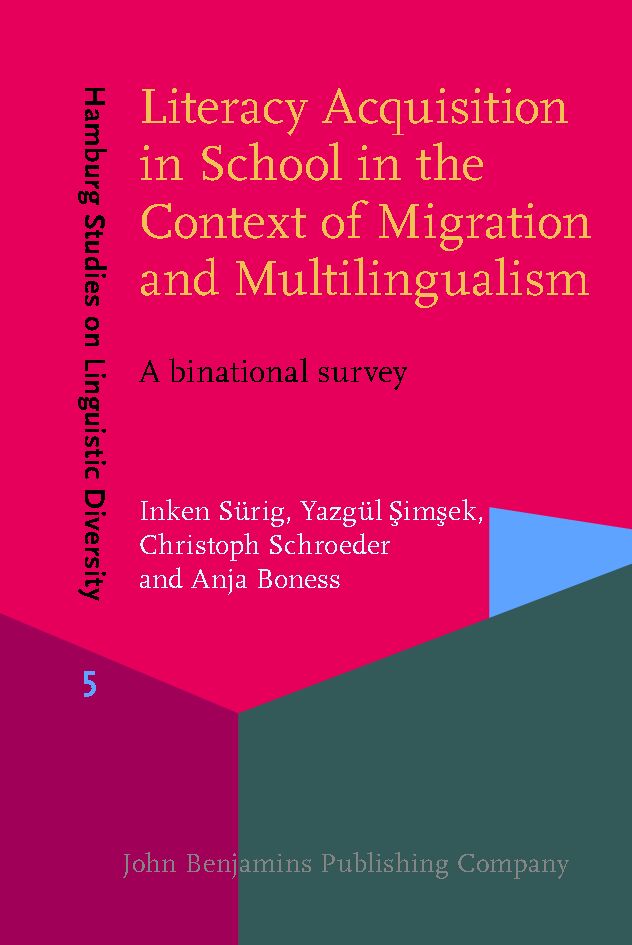
Literacy acquisition in school in the context of migration and multilingualism : a binational survey
This book presents the outcomes of a multi-methodical investigation of the processes of literacy acquisition. The focus is on mono- and bilingual first- and seventh-graders in schools in socially underprivileged areas of two major cities in Turkey and Germany. By means of extensive analyses of lesson videos, linguistic tests, interviews and ethnographic research, social, cultural, linguistic, pedagogic and didactic differences on the international, national, local and individual level are aligned with the momentary problem of exercising a school lesson and acquiring literacy on a daily basis. The results contradict to some degree that cultural and linguistic differences actually make a huge difference in the organisation and process of literacy acquisition. With the interdisciplinary background of the book, it addresses academics concerned with migration sociology, migration linguistics, classroom research, and bilingual education. In a broader perspective, the book contributes to the pedagogically and politically significant question how social and cultural characteristics of specific groups are stereotyped and partly unjustly combined in order to reach symbolic solutions for actual problems.
eBook

Cultural Migrants and Optimal Language Acquisition
This volume studies language acquisition among cultural migrants. The chapters investigate different aspects of their linguistic knowledge and production and make an important contribution to our understanding of the possibilities and limits of L2 ultimate attainment.
eBook

Pseudo-English
This series offers a wide forum for work on contact linguistics, using an integrated approach to both diachronic and synchronic manifestations of contact, ranging from social and individual aspects to structural-typological issues. Topics covered by the series include child and adult bilingualism and multilingualism, contact languages, borrowing and contact-induced typological change, code switching in conversation, societal multilingualism, bilingual language processing, and various other topics related to language contact. The series does not have a fixed theoretical orientation, and includes contributions from a variety of approaches.
eBook

Content and language integrated learning
This book contributes to the study of Content and Language Integrated Learning (CLIL), an approach to second/foreign language learning that teaches content using the target language. It brings together critical analyses on theoretical and implementation issues of CLIL, and studies on the effectiveness of CLIL on learners' language competence.
eBook

English as a foreign language for deaf and hard-of-hearing persons : challenges and strategies
Deaf and hard-of-hearing students form a specific group of foreign language learners. They need to use foreign languages just like their hearing peers if they want to enjoy the same benefits of globalization and technical advancements of today, yet they cannot take part in the same foreign language education. As sign language users, lip-readers or persons relying on hearing aids or cochlear implants in their everyday communication, they need special support in learning a foreign language. This book has been written by teachers and researchers involved in teaching English as a foreign language (EFL) to deaf and hard-of-hearing students in various different European countries, including the Czech Republic, France, Hungary, Norway, Poland, and Serbia. The chapters mirror both the authors' personal journeys through this field and give insight into various aspects of empirical research into the foreign language acquisition of hearing-impaired learners. They discuss mainly the issue of specific methodology for teaching EFL vocabulary, grammar, reading, writing and speaking to deaf and hard-of-hearing persons and the challenge of effective communication during the classes via sign language, cued speech or the oral approach. Special chapters are also devoted to EFL teachers' experience in special schools for the deaf. Educators interested in practical advice, responses to challenges and worked-out solutions to problems will particularly welcome this book as a useful source of ideas. It will also help novice teachers embarking on their careers in English language education for deaf and hard-of-hearing children and adults.
eBook

Disciplinary differences in the use of English in higher education
In post-Bologna Europe, there has been a noticeable increase in English-medium instruction. In this article we take the case of Sweden as an illustrative example of the wider disciplinary issues involved in changing the teaching language in this way. By 2008 the use of English in Swedish higher education had risen to such an extent that it had to be regulated at the governmental level and through university language policies. Such policies have attempted to provide generalised pragmatic guidelines for language use across educational programmes. In this paper we argue that such general policies fail to take into consideration fundamental disciplinary differences and their potential impact on language use. We present a theoretical argument about the knowledge structures of disciplines, relating these to the disciplinary literacy goals of educational programmes. We then illustrate our argument using data from an extensive survey carried out at a major Swedish university. We conclude that the disciplinary variation in the use of English can be seen as a product of different knowledge-making practices and educational goals. This conclusion problematises \"one-size-fits-all\" language policies which only deal with general features of language use and do not allow for discipline-specific adjustments.(HRK / Abstract übernommen).
Journal Article

How Many Languages Do We Need?
In the global economy, linguistic diversity influences economic and political development as well as public policies in positive and negative ways. It leads to financial costs, communication barriers, divisions in national unity, and, in some extreme cases, conflicts and war--but it also produces benefits related to group and individual identity. What are the specific advantages and disadvantages of linguistic diversity and how does it influence social and economic progress? This book examines linguistic diversity as a global social phenomenon and considers what degree of linguistic variety might result in the greatest economic good. Victor Ginsburgh and Shlomo Weber look at linguistic proximity between groups and between languages. They describe and use simple economic, linguistic, and statistical tools to measure diversity's impact on growth, development, trade, the quality of institutions, translation issues, voting patterns in multinational competitions, and the likelihood and intensity of civil conflicts. They address the choosing of core languages in a multilingual community, such as the European Union, and argue that although too many official languages might harm cohesiveness, efficiency, and communication, reducing their number brings about alienation and disenfranchisement of groups. Demonstrating that the value and drawbacks of linguistic diversity are universal, How Many Languages Do We Need? suggests ways for designing appropriate linguistic policies for today's multilingual world.
eBook

Content-and-Language Integrated Learning: From Practice to Principles?
This article surveys recent work on content-and-language integrated learning (CLIL). Related to both content-based instruction and immersion education by virtue of its dual focus on language and content, CLIL is here understood as an educational model for contexts where the classroom provides the only site for learners’ interaction in the target language. That is, CLIL is about either foreign languages or lingua francas. The discussion foregrounds a prototypical CLIL context (Europe) but also refers to work done elsewhere. The first part of the discussion focuses on policy issues, describing how CLIL practice operates in a tension between grassroots decisions and higher order policymaking, an area where European multi- and plurilingual policies and the strong impact of English as a lingua franca play a particularly interesting role. The latter is, of course, of definite relevance also in other parts of the world. The second part of the article synthesizes research on learning outcomes in CLIL. Here, the absence of standardized content testing means that the main focus is on language-learning outcomes. The third section deals with classroom-based CLIL research and participants’ use of their language resources for learning and teaching, including such diverse perspectives as discourse pragmatics, speech acts, academic language functions, and genre. The final part of the article discusses theoretical underpinnings of CLIL, delineating their current state of elaboration as applied linguistic research in the area is gaining momentum.
Journal Article