
Catalogue Search | MBRL


Are you sure you want to remove the book from the shelf?

{{itemTitle}}
1,637
result(s) for
"Language and culture Europe"
Sort by:
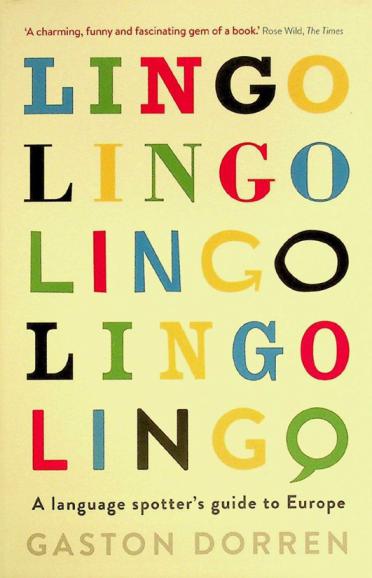
Lingo : a language spotter's guide to Europe
\"Welcome to Europe as you've never known it before, seen through the peculiarities of its languages and dialects. Combining linguistics and cultural history, Gaston Dorren takes us on an intriguing tour of the continent, from Proto-Indo-European (the common ancestor of most European languages) to the rise and rise of English, via the complexities of Welsh plurals and Czech pronunciation. Along the way we learn why Esperanto will never catch on, how the language of William the Conqueror lives on in the Channel Islands and why Finnish is the easiest European language. Surprising, witty and full of extraordinary facts, this book will change the way you think about the languages around you. Polyglot Gaston Dorren might even persuade you that English is like Chinese.\"--Wheelers.co.nz.
Book

Minority Languages and Cultural Diversity in Europe
To what extent is linguistic continuity a prerequisite for
ethno-cultural survival? Focusing on the Gaelic community in
Scotland and the Sorbs of Lusatia, this study illuminates core
assumptions and rationales in relation to minority language
revitalisation ideologies in Scotland and Germany and shows how
they have been affected by assimilation processes arising from
modernisation and globalisation. A thorough review of relevant
theoretical debates is followed by a presentation of historical
contexts and a detailed analysis of contemporary discourses
about bilingualism, cultural difference and ethno-cultural
belonging within the Gaelic and Sorbian communities. Drawing on
more than 100 interviews, a questionnaire survey and a wide
range of comments by Gaelic and Sorbian speakers in the media,
the author identifies current ideological faultlines in Gaelic
and Sorbian activist circles and argues that minority language
planners must critically engage with competing theoretical
paradigms if revitalisation efforts are to be successful.
eBook


Multilingualism in the Middle Ages and Early Modern Age
Bi- and multilingualism are of great interest for contemporary linguists since this phenomenon deeply reflects on language acquisition, language use, and sociolinguistic conditions in many different circumstances all over the world. Multilingualism was, however, certainly rather common already, if not especially, in the premodern world. For some time now, research has started to explore this issue through a number of specialized studies. The present volume continues with the investigation of multilingualism through a collection of case studies focusing on important examples in medieval and early modern societies, that is, in linguistic and cultural contact zones, such as England, Spain, the Holy Land, but also the New World. As all contributors confirm, the numerous cases of multilingualism discussed here indicate strongly that the premodern period knew considerably less barriers between people of different social classes, cultural background, and religious orientation. But we also have to acknowledge that already then human communication could fail because of linguistic hurdles which prevented mutual understanding in religious and cultural terms.
eBook


The Discursive Construction of National Identity
How do we construct national identities in discourse? Which topics, which discursive strategies and which linguistic devices are employed to construct national sameness and uniqueness on the one hand, and differences to other national collectives on the o
eBook


Cultural migrants and optimal language acquisition
This volume studies language acquisition among cultural migrants. The chapters investigate different aspects of their linguistic knowledge and production and make an important contribution to our understanding of the possibilities and limits of L2 ultimate attainment.
eBook


Literacy acquisition in school in the context of migration and multilingualism : a binational survey
This book presents the outcomes of a multi-methodical investigation of the processes of literacy acquisition. The focus is on mono- and bilingual first- and seventh-graders in schools in socially underprivileged areas of two major cities in Turkey and Germany. By means of extensive analyses of lesson videos, linguistic tests, interviews and ethnographic research, social, cultural, linguistic, pedagogic and didactic differences on the international, national, local and individual level are aligned with the momentary problem of exercising a school lesson and acquiring literacy on a daily basis. The results contradict to some degree that cultural and linguistic differences actually make a huge difference in the organisation and process of literacy acquisition. With the interdisciplinary background of the book, it addresses academics concerned with migration sociology, migration linguistics, classroom research, and bilingual education. In a broader perspective, the book contributes to the pedagogically and politically significant question how social and cultural characteristics of specific groups are stereotyped and partly unjustly combined in order to reach symbolic solutions for actual problems.
eBook