
Catalogue Search | MBRL


Are you sure you want to remove the book from the shelf?

{{itemTitle}}
16,901
result(s) for
"Language and emotions."
Sort by:


Computational paralinguistics : emotion, affect and personality in speech and language processing
This book presents the methods, tools and techniques that are currently being used to recognise (automatically) the affect, emotion, personality and everything else beyond linguistics ('paralinguistics') expressed by or embedded in human speech and language.
It is the first book to provide such a systematic survey of paralinguistics in speech and language processing. The technology described has evolved mainly from automatic speech and speaker recognition and processing, but also takes into account recent developments within speech signal processing, machine intelligence and data mining.
Moreover, the book offers a hands-on approach by integrating actual data sets, software, and open-source utilities which will make the book invaluable as a teaching tool and similarly useful for those professionals already in the field.
Key features:
* Provides an integrated presentation of basic research (in phonetics/linguistics and humanities) with state-of-the-art engineering approaches for speech signal processing and machine intelligence.
* Explains the history and state of the art of all of the sub-fields which contribute to the topic of computational paralinguistics.
* C overs the signal processing and machine learning aspects of the actual computational modelling of emotion and personality and explains the detection process from corpus collection to feature extraction and from model testing to system integration.
* Details aspects of real-world system integration including distribution, weakly supervised learning and confidence measures.
* Outlines machine learning approaches including static, dynamic and context?sensitive algorithms for classification and regression.
* Includes a tutorial on freely available toolkits, such as the open-source 'openEAR' toolkit for emotion and affect recognition co-developed by one of the authors, and a listing of standard databases and feature sets used in the field to allow for immediate experimentation enabling the reader to build an emotion detection model on an existing corpus.
eBook


Happiness and \Pain\ across Languages and Cultures
In the fast-growing fields of happiness studies and pain research, which have attracted scholars from diverse disciplines including psychology, philosophy, medicine, and economics, this volume provides a much-needed cross-linguistic perspective. It centres on the question of how much ways of talking and thinking about happiness and pain vary across cultures, and seeks to answer this question by empirically examining the core vocabulary pertaining to \"happiness\" and \"pain\" in many languages and in different religious and cultural traditions. The authors not only probe the precise meanings of the expressions in question, but also provide extensive cultural contextualization, showing how these meanings are truly cultural. Methodologically, while in full agreement with the view of many social scientists and economists that self-reports are the bedrock of happiness research, the volume presents a body of evidence highlighting the problem of translation and showing how local concepts of \"happiness\" and \"pain\" can be understood without an Anglo bias. The languages examined include (Mandarin) Chinese, Danish, English, French, German, Japanese, Koromu (a Papua New Guinean language), and Latin American Spanish. Originally published in International Journal of Language and Culture Vol. 1:2 (2014).
eBook


Consensus and dissent : negotiating emotion in the public space
This book is the result of intensive and continued discussions about the social role of language and its conceptualisations in societies other than Northern (European-American) ones. Language as a means of expressing as well as evoking both interiority and community has been in the focus of these discussions, led among linguists, anthropologists, and Egyptologists, and leading to a collection of essays that provide studies that transcend previously considered approaches. Its contributions are in particular interested in understanding how the attitude of the individual towards societal processes and strategies of norming is negotiated emotionally, and how individual interests and attitudes can be articulated. Discourses on public spaces are in the focus, in order to analyse those strategies that are employed to articulate dissent (for example, in the sense of face-threatening acts). This raises a number of questions on the spatial and public situatedness of emotions and language: How is the public space dealt with and reflected in language as property, heritage, and as a part of ascribed identities? Which role do emotions play in this space? How is emotion employed there as part of place making in relation to identity constructions? What is the connection between emotion, performance and emblematic spaces and places? Which opportunities of the violation of norms and transgression do such public spaces offer to actors and speakers? These questions intend to address the communicative representation of core cultural processes and concepts.
eBook


Contrasting the semantic space of ‘shame’ and ‘guilt’ in English and Japanese
This article sheds light on the significant yet nuanced roles of shame and guilt in influencing moral behaviour, a phenomenon that became particularly prominent during the COVID-19 pandemic with the community’s heightened desire to be seen as moral. These emotions are central to human interactions, and the question of how they are conveyed linguistically is a vast and important one. Our study contributes to this area by analysing the discourses around shame and guilt in English and Japanese online forums, focusing on the terms shame, guilt, haji (‘shame’) and zaiakukan (‘guilt’). We utilise a mix of corpus-based methods and natural language processing tools, including word embeddings, to examine the contexts of these emotion terms and identify semantically similar expressions. Our findings indicate both overlaps and distinct differences in the semantic landscapes of shame and guilt within and across the two languages, highlighting nuanced ways in which these emotions are expressed and distinguished. This investigation provides insights into the complex dynamics between emotion words and the internal states they denote, suggesting avenues for further research in this linguistically rich area.
Journal Article
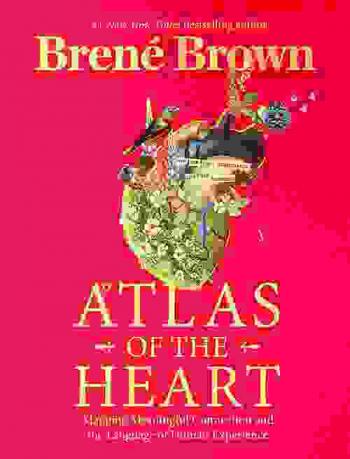
Atlas of the heart : mapping meaningful connection and the language of human experience
\"In Atlas of the Heart, Brown takes us on a journey through 85 of the emotions and experiences that define what it means to be human. As she maps the necessary skills and lays out an actionable framework for meaningful connection, she gives us the language and tools to access a universe of new choices and second chances - a universe where we can share and steward the stories of our bravest and most heartbreaking moments with one another in a way that builds connection. Over the past two decades, Brown's extensive research into the experiences that make us who we are has shaped the cultural conversation and helped define what it means to be courageous with our lives. Atlas of the Heart draws on this research, as well as Brown's singular skills as a researcher/storyteller, to lay out an invaluable, research-based framework that shows us that naming an experience doesn't give the experience more power, it gives us the power of understanding, meaning, and choice. Brown shares, \"I want this to be an atlas for all of us, because I believe that, with an adventurous heart and the right maps, we can travel anywhere and never fear losing ourselves. Even when we have no idea where we are.\"\"-- Provided by publisher.

Linguistic Markers and Emotional Intensity
The purpose of this experiment is to explore possible relationships between the intensity of emotions and the lexical modalities for expressing those emotions. In this experiment, 60 Hebrew-speaking subjects were asked to watch four short films that aroused emotion. Two of the films gave rise to different degrees of happiness, and two produced sadness. At the end of each film, subjects were asked to report on their emotions. This experiment was based on the supposition that there is a relationship between the various lexical modalities used by the subjects when writing about their emotions and the intensity of those emotions. The lexical modalities examined included intensifiers, the use of emotion words, repetitions, the use of first person singular, the use of metaphors, and the use of exclamations, among others. This experiment supported the research hypothesis, as it confirmed that significant differences existed between the lexical modalities found in texts written with lower emotional intensity (for both happiness and sadness) and those written with greater emotional intensity.
Journal Article