
Catalogue Search | MBRL


Are you sure you want to remove the book from the shelf?

{{itemTitle}}
69,137
result(s) for
"Language and languages Philosophy."
Sort by:

Philosophy of language : the classics explained
Many beginning students in philosophy of language find themselves grappling with dense and difficult texts not easily understood by someone new to the field. This book offers an introduction to philosophy of language by explaining ten classic, often anthologised, texts.
Book

Key Ideas in Linguistics and the Philosophy of Language
A single-volume reference work which offers an overview of some of the principal ideas about language that have been developed in linguistics and in the philosophy of language.
eBook

Tractatus logico-philosophicus
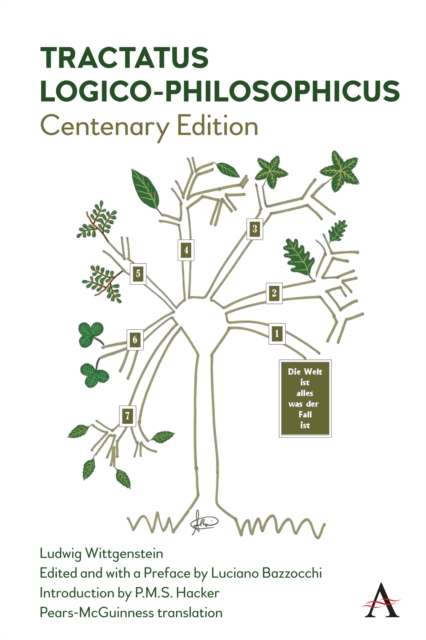
This new edition of Wittgenstein's book, strictly following the author's recommendations, allows a more immediate comprehension of the text and dissolves several false problems that had deceived readers and scholars for a century. The faithful interpretation of decimal numbers (which alone, according to Wittgenstein, \"give perspicuity and clarity to the book\") shows that the Tractatus stems from a home-page containing seven cardinal propositions and develops level by level, by perfectly coherent reading units. Indeed, \"the Tractatus must be read in accordance with the numbering system, and that demands that the reader follow the text after the manner of a logical tree, which is the way in which the book was composed and in which Wittgenstein arranged his philosophical remarks\" (Peter Hacker, The Philosophical Quarterly). Thence, the Tractatus is no longer an obstacle course, where critics and students were strenuously committed to decipher anacolutes, semantic jumps and bizarre combinations. On the contrary, it reveals to be, at long last, a book that every reader, from her own point of view, can enjoy. The actual form of Wittgenstein's work discloses the harmony and the aesthetic value of a philosophical text that is contemporary and is one of the most amazing masterpieces of world literature.
eBook


A Sceptical Guide to Meaning and Rules
No other recent book in Anglophone philosophy has attracted as much criticism and has found so few friends as Saul Kripke's \"Wittgenstein on Rules and Private Language\". Amongst its critics, one finds the very top of the philosophical profession. Yet, it is rightly counted amongst the books that students of philosophy, at least in the Anglo-American world, have to read at some point in their education. Enormously influential, it has given rise to debates that strike at the very heart of contemporary philosophy of mind and language. In this major new interpretation, Martin Kusch defends Kripke's account against the numerous weighty objections that have been put forward over the past twenty years and argues that none of them is decisive. He shows that many critiques are based on misunderstandings of Kripke's reasoning; that many attacks can be blocked by refining and developing Kripke's position; and that many alternative proposals turn out either to be unworkable or to be disguised variants of the view they are meant to replace. Kusch argues that the apparent simplicity of Kripke's text is deceptive and that a fresh reading gives Kripke's overall argument a new strength.
eBook

Critical Pragmatics
Critical Pragmatics develops three ideas: language is a way of doing things with words; meanings of phrases and contents of utterances derive ultimately from human intentions; and language combines with other factors to allow humans to achieve communicative goals. In this book, Kepa Korta and John Perry explain why critical pragmatics provides a coherent picture of how parts of language study fit together within the broader picture of human thought and action. They focus on issues about singular reference, that is, talk about particular things, places or people, which have played a central role in the philosophy of language for more than a century. They argue that attention to the 'reflexive' or 'utterance-bound' contents of utterances sheds new light on these old problems. Their important study proposes a new approach to pragmatics and should be of wide interest to philosophers of language and linguists.
eBook


Semiotics Unbounded
Semiotics Unboundedoffers a new and original survey of the science of signs, evaluating it in relation to the problems of our time, not only of a scientific order, but also the problems concerning everyday social life.
eBook