
Catalogue Search | MBRL


Are you sure you want to remove the book from the shelf?

{{itemTitle}}
16,163
result(s) for
"Language and languages Style"
Sort by:

Translation and style
\"Style plays a major role in the translation of literary, as well as non-literary texts, and Translation and Style offers an updated survey of this highly interdisciplinary area of translation studies. Jean Boase-Beier examines a variety of disciplines and theoretical approaches including stylistics, literary criticism, and narratology to investigate how we translate style. This revised and expanded edition of the 2006 book Stylistic Approaches to Translation offers new and accessible explanations on recent developments in the field, notably in the areas of relevance theory and cognitive stylistics. With many authentic examples to show how style affects translation, this book is an invaluable resource for both students and scholars working in translation studies and comparative literature\"-- Provided by publisher.
Book

Style
Style refers to ways of speaking - how speakers use the resource of language variation to make meaning in social encounters. This 2007 book develops a coherent theoretical approach to style in sociolinguistics, illustrated with copious examples. It explains how speakers project different social identities and create different social relationships through their style choices, and how speech-style and social context inter-relate. Style therefore refers to the wide range of strategic actions and performances that speakers engage in, to construct themselves and their social lives. Coupland draws on and integrates a wide variety of contemporary sociolinguistic research as well as his own extensive research in this field. The emphasis is on how social meanings are made locally, in specific relationships, genres, groups and cultures, and on studying language variation as part of the analysis of spoken discourse.
eBook

Corpus Stylistics
This book combines stylistic analysis with corpus linguistics to present an innovative account of the phenomenon of speech, writing and thought presentation - commonly referred to as 'speech reporting' or 'discourse presentation'. This new account is based on an extensive analysis of a quarter-of-a-million word electronic collection of written narrative texts, including both fiction and non-fiction. The book includes detailed discussions of:
The construction of this corpus of late twentieth-century written British narratives taken from fiction, newspaper news reports and (auto)biographies
The development of a manual annotation system for speech, writing and thought presentation and its application to the corpus.
The findings of a quantitive and qualitative analysis of the forms and functions of speech, writing and thought presentation in the three genres represented in the corpus.
The findings of the analysis of a range of specific phenomena, including hypothetical speech, writing and thought presentation, embedded speech, writing and thought presentation and ambiguities in speech, writing and thought presentation.
Two case studies concentrating on specific texts from the corpus.
Corpus Stylistics shows how stylistics, and text/discourse analysis more generally, can benefit from the use of a corpus methodology and the authors' innovative approach results in a more reliable and comprehensive categorisation of the forms of speech, writing and thought presentation than have been suggested so far. This book is essential reading for linguists interested in the areas of stylistics and corpus linguistics.
Elena Semino is Senior Lecturer in the Department of Linguistics and Modern English Language at Lancaster University. She is the author of Language and World Creation in Poems and Other Texts (1997), and co-editor (with Jonathan Culpetter) of Cognitive Stylistics: Language and Cognition in Text Analysis (2002). Mick Short is Professor of English Language and Literature at Lancaster University. He has written Exploring the Language of Poems, Plays and Prose (1997) and (with Geoffrey Leech) Style in Fiction (1997). He founded the Poetics and Linguistics Association and was the founding editor of its international journal, Language and Literature.
1. A Corpus-Based Approach to the Study of Discourse Presentation in Written Narratives 2. Methodology: The Construction and Annotation of the Corpus 3. A Revised Model of Speech, Writing and Thought Presentation 4. Speech Presentation in the Corpus: A Quantitative and Qualitative Analysis 5. Writing Presentation in the Corpus: A Quantitative and Qualitative Analysis 6. Thought Presentation in the Corpus: A Quantitative and Qualitative Analysis 7. Specific Phenomena in Speech, Writing Presentation 8. Case Studies of Specific Texts from the Corpus 9. Conclusion
eBook


Mind Style and Cognitive Grammar
Mind Style and Cognitive Grammar advances our understanding of mind style: the experience of other minds, or worldviews, through language in literature. This book is the first to set out a detailed, unified framework for the analysis of mind style using the account of language and cognition set out in cognitive grammar. Drawing on insights from cognitive linguistics, Louise Nuttall aims to explain how character and narrator minds are created linguistically, with a focus on the strange minds encountered in the genre of speculative fiction. Previous analyses of mind style are reconsidered using cognitive grammar, alongside original analyses of four novels by Margaret Atwood, Kazuo Ishiguro, Richard Matheson and J.G. Ballard. Responses to the texts in online forums and literary critical studies ground the analyses in the experiences of readers, and support an investigation of this effect as an embodied experience cued by the language of a text. Mind Style and Cognitive Grammar advances both stylistics and cognitive linguistics, whilst offering new insights for research in speculative fiction.
eBook
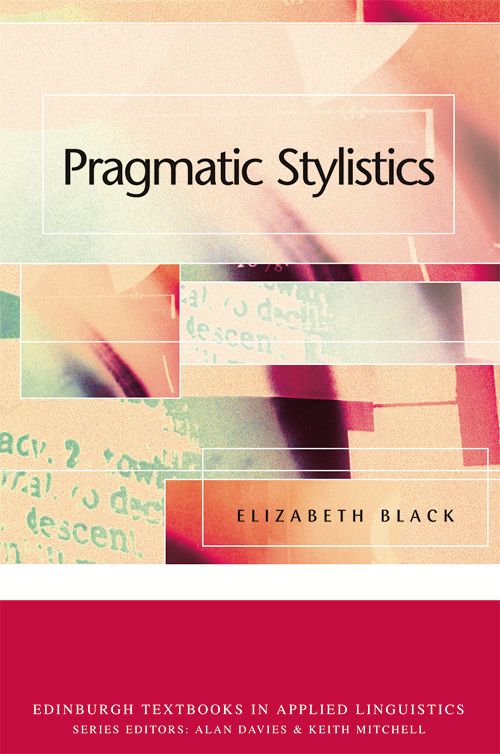
Pragmatic stylistics
This textbook series provides advanced introductions to the main areas of study in contemporary Applied Linguistics, with a principal focus on the theory and practice of language teaching and language learning and on the processes and problems of language in use.
eBook


Style and reader response : minds, media, methods
Style and Reader Response: Minds, media, methods profiles the diversity of theoretical and methodological approaches in reception-oriented research in stylistics. Collectively, the chapters investigate how real readers, players, audiences, and viewers respond to, experience, and interpret texts. Contributions to the book investigate discourse types such as contemporary literature, poetry, political speeches, digital fiction, art exhibitions, and online news discourse. The volume also exemplifies the variety of empirical approaches in reception research, with contributors drawing on a range of methods including discussion groups, interviews, questionnaires, and think-aloud protocols with data analysed from both online and offline sources. Style and Reader Response makes an important contribution to an emerging paradigm within stylistics in which verifiable insights from readers are used to generate new models and new understandings of texts across media, with each essay demonstrating the centrality of empirical research for theoretical, methodological, and/or analytical advancements within and beyond stylistics.
eBook