
Catalogue Search | MBRL


Are you sure you want to remove the book from the shelf?

{{itemTitle}}
30,076
result(s) for
"Language and logic"
Sort by:

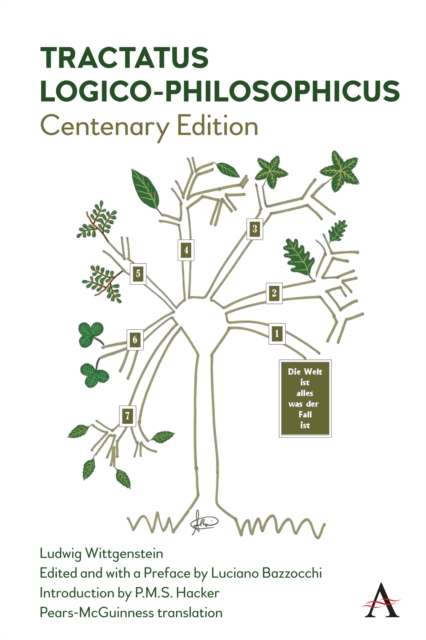
Tractatus logico-philosophicus
This new edition of Wittgenstein's book, strictly following the author's recommendations, allows a more immediate comprehension of the text and dissolves several false problems that had deceived readers and scholars for a century. The faithful interpretation of decimal numbers (which alone, according to Wittgenstein, \"give perspicuity and clarity to the book\") shows that the Tractatus stems from a home-page containing seven cardinal propositions and develops level by level, by perfectly coherent reading units. Indeed, \"the Tractatus must be read in accordance with the numbering system, and that demands that the reader follow the text after the manner of a logical tree, which is the way in which the book was composed and in which Wittgenstein arranged his philosophical remarks\" (Peter Hacker, The Philosophical Quarterly). Thence, the Tractatus is no longer an obstacle course, where critics and students were strenuously committed to decipher anacolutes, semantic jumps and bizarre combinations. On the contrary, it reveals to be, at long last, a book that every reader, from her own point of view, can enjoy. The actual form of Wittgenstein's work discloses the harmony and the aesthetic value of a philosophical text that is contemporary and is one of the most amazing masterpieces of world literature.
eBook

Thinking and being
Opposing a long-standing orthodoxy of the Western philosophical tradition running from ancient Greek thought until the late nineteenth century, Frege argued that psychological laws of thought--those that explicate how we in fact think--must be distinguished from logical laws of thought--those that formulate and impose rational requirements on thinking. Logic does not describe how we actually think, but only how we should. Yet by thus sundering the logical from the psychological, Frege was unable to explain certain fundamental logical truths, most notably the psychological version of the law of non-contradiction--that one cannot think a thought and its negation simultaneously. Irad Kimhi's Thinking and Being marks a radical break with Frege's legacy in analytic philosophy, exposing the flaws of his approach and outlining a novel conception of judgment as a two-way capacity. In closing the gap that Frege opened, Kimhi shows that the two principles of non-contradiction--the ontological principle and the psychological principle--are in fact aspects of the very same capacity, differently manifested in thinking and being. As his argument progresses, Kimhi draws on the insights of historical figures such as Aristotle, Kant, and Wittgenstein to develop highly original accounts of topics that are of central importance to logic and philosophy more generally. Self-consciousness, language, and logic are revealed to be but different sides of the same reality. Ultimately, Kimhi's work elucidates the essential sameness of thinking and being that has exercised Western philosophy since its inception.-- Provided by publisher
Book
Historical pragmatics of controversies : case studies from 1600 to 1800
This work gives an introduction to the new research field of historical pragmatics of controversies and provides seven case studies (from 1609 to 1796) on controversies in the fields of astronomy/astrology, medicine, chemistry, philosophy, and theology.
eBook

Tractatus logico-philosophicus
Wittgenstein's 'Tractatus Logico-Philosophicus' is one of the most influential philosophical texts of the 20th century. Michael Beaney's new translation and detailed notes take into account the developments in scholarly understanding of the text.
BOOK

Quantifiers in Language and Logic
Quantification is a topic which brings together linguistics, logic, and philosophy. Quantifiers are the essential tools with which, in language or logic, we refer to quantity of things or amount of stuff. In English they include such expressions as no, some, all, both, or many. This book presents the definitive interdisciplinary exploration of how they work — their syntax, semantics, and inferential role.
eBook

Thetics and Categoricals
Contributions in this volume not only guide the reader through the history of philosophical logic and distributions of impersonals in contrast to Kantian categorical sentences, but also the correspondences in Japanese and Chinese which, in contrast to German and English, sport specific morphological markers for thetics as opposed to categoricals.
eBook


Logica modernorum in Prague about 1400 : the sophistria disputation 'Quoniam quatuor' (MS Cracow, Jagiellonian Library 686, FF. 1RA-79RB), with a partial reconstruction of Thomas of Cleve's Logica
The Prague Sophistriatract is a two-part tract intended to help students avoid problems concerning fallacies in arguments and ambiguities of words. It was dictated by a master or aspirant master of arts to young students about 1396 or shortly after, in Prague. The manuscript was brought to Cracow in the early 15th century. After a substantial intro
eBook