
Catalogue Search | MBRL


Are you sure you want to remove the book from the shelf?

{{itemTitle}}
22
result(s) for
"Language arts Audio-visual aids."
Sort by:


Using Video to Support Teacher Reflection and Development in ELT
Currently, there are many research articles across a wide array of teacher education journals that present promising practices in video as a tool in teacher learning, but no practitioner-friendly text that organizes a variety of approaches for application in the field. This book fills that gap by helping educators to greatly expand their repertoire and confidence in introducing, designing, implementing, and assessing video- based professional development. The authors focus on the variety of ways in which video can support and encourage reflection, increase awareness, foster collaboration, share practice, provide a tool for analysis, aid in materials production, and establish online communities of practice.
Video allows more possibilities for context-sensitive noticing, editing, sharing, repackaging, and tagging, especially in combination with screen-capture software, and there is an increasing array of tools that can be harnessed to support teacher learning and reflection. These can help to make aspects of classrooms, methodology and learning more concrete and visible. Across the chapters, the book draws on a growing community of educators using video in a wide range of approaches and features some of their experiences and views through data and vignettes. In doing so, this text acts as a conduit for innovative and effective video and visual media use in language teacher education.
eBook

Introduction to audiovisual archives
Today, audiovisual archives and libraries have become very popular especially in the field of collecting, preserving and transmitting cultural heritage. However, the data from these archives or libraries – videos, images, sound tracks, etc. – constitute as such only potential cognitive resources for a given public (or “target community”). They have to undergo more or less significant qualitative transformations in order to become user- or community-relevant intellectual goods.
These qualitative transformations are performed through a series of concrete operations such as: audiovisual text segmentation, content description and indexing, pragmatic profiling, translation, etc. These and other operations constitute what we call the semiotic turn in dealing with digital (audiovisual) texts, corpora of texts or even entire (audiovisual) archives and libraries. They demonstrate practically and theoretically the well-known “from data to meta-data” or “from (simple) information to (relevant) knowledge” problem – a problem that obviously directly influences the effective use, the social impact and relevancy and therefore also the future of digital knowledge archives.
It constitutes, indeed, the heart of a diversity of important R&D programs and projects all over the world.
eBook

Media in Foreign Language Teaching and Learning
While educators and educational psychologists debate the influence of media on learning, there can be little doubt that media is now an integral constituent of any educational context. In particular, computer and internet media, with their immense processing power and multimedia capabilities, can have significant bearing on learning processes and outcomes in today's learning environment. Such media, which are increasingly designed to be highly interactive and adaptable, can enable reflective, productive and communicative activities and have much potential for foreign language learning. The book contains 16 papers which look at different forms of media and explore how these affect or can be used effectively in foreign language education. The first of three parts focuses on important theoretical and pedagogical issues in selecting and using media. In the second part, insightful empirical research findings are presented on the contributions of different forms of media in language teaching and learning, including their effect on learners' learning motivation. The third and concluding part of the book provides in-depth accounts of how media can be harnessed to drive innovative curricular practice as well as students' evaluations of these curricular projects.
eBook
English in the digital age : information and communications technology (ICT) and the teaching of English
New communications technology has been a boon to teaching and learning subjects of English, from reading and writing to literature such as Shakespeare. This book explores the ways that information and communications technology, or ICT, can be employed in teaching English and enriching the abilities of students. What are the advantages of ICT, and what are some of the concerns? Contributors from Europe, Australia, and North America address the use of media in teaching, from video, film, and audiotape to computer games and online resources. English in the Digital Age surveys the ways ICT is presently being employed in teaching and learning, and it introduces new methods for education.
eBook
Back of the Napkin
This original book provides a whole new way of looking at business problems and ideas. Dan Roam demonstrates how thinking with pictures can help you discover and develop new ideas, solve problems in unexpected ways, and dramatically improve your ability to share your insights with others. Used properly, a simple drawing on a humble napkin is more powerful than Excel or PowerPoint. It can help us crystallise ideas, think outside of the box, and communicate in a way that other people simply \"get\". Drawing on 20 years of visual problem solving combined with recent discoveries in vision science, Roam shows us how to clarify a problem or sell an idea by visually breaking it down using a simple set of visualisation tools. His strategies take advantage of everyones innate ability to look, see, imagine and show.
eBook
The acquisition of Italian : morphosyntax and its interfaces in different modes of acquisition
A major contribution to the study of language acquisition and language development inspired by theoretical linguistics has been made by research on the acquisition of Italian syntax. This book offers an updated overview of results from theory-driven experimental and corpus-based research on the acquisition of Italian in different modes (monolingual, early and late L2, SLI, etc.), as well as exploring possible developments for future research. The book focuses on experimental studies which address research questions generated by linguistic theory, providing a detailed illustration of the fruitful interaction between linguistic theorizing and developmental studies. The authors are leading figures in theoretical linguistics and language acquisition; their own work is featured in the research presented here. Students and advanced researchers will benefit from the systematic review offered by this book and the critical assessment of the field that it provides.
eBook

Audiovisual translation and media accessibility at the crossroads : Media for All 3
This third volume in the Media for All series offers a diverse selection of articles which bear testimony to the vigour and versatility of research and developments in audiovisual translation and media accessibility. The collection reflects the critical impact of new technologies on AVT, media accessibility and consumer behaviour and shows the significant increase in collaborative and interdisciplinary research targeting changing consumer perceptions as well as quality issues. Complementing newcomers such as crowdsourcing and potentially universal emoticons, classical themes of AVT studies such as linguistic analyses and corpus-based research are featured. Prevalent throughout the volume is the impact of technology on both methodologies and content. The book will be of interest to researchers from a wide range of disciplines as well as audiovisual translators, lecturers, trainers and students, producers and developers working in the field of language and media accessibility.
eBook
Researching audio description : new approaches
Audio description is one of the many services available to guarantee accessibility to audiovisual media. It describes and narrates images and sounds and resulting audio is then mixed with the original soundtrack. Audio description is a complex process that touches production, distribution and reception. Researching Audio Description: New Approachesgathers academic information and data from the many existing research projects, practices, and training across the world. The book has a telescopic approach, from two introductory chapters where accessibility in general is contextualised as a human right, and the basic concepts of disability and impairment are explored. Research on specific features for audio description script drafting are focused in the second part of the book, with a view to revising existing funded projects and their outcomes. The book offers a wealth of information on both the practical and philosophical, from different approaches in perception and cognition,and different research methodologies. Project information contained in the contributions identifies trends in current research-funded studies which will be valuable as a pointer towards future proposals. The book shows the dynamic state of audio description practice, training and research, while contributing towards the growing critical mass needed in building the field of accessibility studies.
eBook
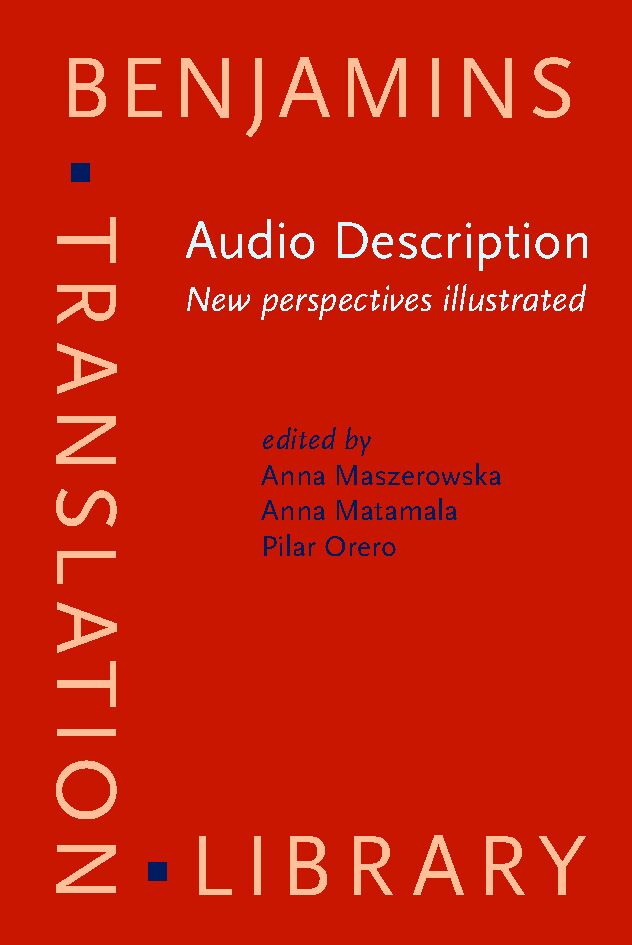
Audio description : new perspectives illustrated
Audio description (AD) is a narrative technique which provides complementary information regarding the where, who, what and how of any audiovisual content. It translates the visuals into words. The principal function of this ad hoc narrative is to make audiovisual content available to all: be it a guided city tour of Barcelona, a 3D film, or a Picasso painting. Audio description is one of the younger siblings of Audiovisual Translation, and it is epigonic to the audiovisual translation modality chosen. This book is the first volume on the topic written in English and it brings together an international team of leading audio description teachers, scholars, and practitioners to address the basic issues regarding audio description strategies. Using one stimulus, Quentin Tarantino's film Inglourious Basterds (2009), the authors analysed what, when, where and how to audio describe. The book is written in a collaborative effort, following a bottom up approach. The many issues that surfaced in the process of the analysis were grouped in broader categories represented in the ten chapters this book contains. A good example of a successful international collaboration, the volume sets a robust practical and theoretical framework for the many studies on audio description to come in the future. Considering the structure of the individual contributions, the book is not only oriented towards the identification of the challenges that await the describer, but it also offers an insight into their possible solutions.
eBook