
Catalogue Search | MBRL


Are you sure you want to remove the book from the shelf?

{{itemTitle}}
2,491
result(s) for
"Language policy -- Developing countries"
Sort by:
Bilingual Education and Language Policy in the Global South
This volume considers a range of ways in which bilingual programs can make a contribution to aspects of human and economic development in the global South. The authors examine the consequences of different policies, programs, and pedagogies for learners and local communities through recent ethnographic research on these topics. The revitalization of minority languages and local cultural practices, management of linguistic and cultural diversity, and promotion of equal opportunities (both social and economic) are all explored in this light.
eBook
Global Issues in Language, Education and Development
The question of why the issue of language features increasingly at the centre of debates about education for social and economic development at the beginning of the 21st Century is compelling. Within a rapidly changing world, language, literacy and communication are seen as constituting key elements in the process of lifelong learning. Contemporary technological development and cultural shifts intersect in complex ways with the legacy of colonialism and underdevelopment within developing countries with a colonial history. This book addresses some of these issues related to language and development. Part I explores the relationship between colonial and postcolonial social policies on the unresolved language problems that prevail in many developing countries. Part II comprises case studies of Mali, Pakistan and South Africa. Part III draws on key motifs identified in the previous two sections, and discusses linguistic diversity as an important variable of cultural capital within the interactive global cultural economy. The book's focus on language, education and development makes it essential reading in Development Studies, International and Comparative Education, Sociology and Educational Policy Studies. Its focus on language issues within the global cultural economy would make it an important text in Applied Linguistic Studies.
eBook
English language teaching in Bangladesh today: Issues, outcomes and implications
Given the significance of English in the global world, English language teaching in Bangladesh has become subject to a supreme concern in maintaining economic growth and developing a skilled workforce. In this article, several barriers have been discussed based on a critical analysis of published materials. This review article covers several key issues such as the status of English in the country; English in education policies; factors affecting the implementation of communicative language teaching curriculum, method, and materials in Bangladesh; validity of the current assessment and its washback effect on English language teaching in Bangladesh; and current situation of teachers’ professional development. The article concluded with language policy and planning implications for policymakers, curriculum and material developers, public exams’ test-setters, and future English teacher training programmes, keeping the overall development of ELT in Bangladesh in mind.
Journal Article

Pride, prejudice and pragmatism: family language policies in the UK
In this study, we examine how mobility and on-going changes in sociocultural contexts impact family language policy (FLP) in the UK. Using a questionnaire and involving 470 transnational families across the UK, our study provides a descriptive analysis of different family language practices in England and establishes how attitudes influence the different types of FLP in these families. Complementing the descriptive analysis, we use interview data to understand the driving forces behind the different types of language practices and language management activities, and explore how ideological constructs of ‘pride’, ‘prejudice’ and ‘pragmatism’ are directly related to negative or positive attitudes towards the development of children’s heritage language. The findings indicate that migration trajectories, social values, raciolinguistic policing in schools, and linguistic loyalty have shaped family decisions about what languages to keep and what languages to let go. Our paper responds to the linguistic and demographic changes in British society, and makes an important contribution to our knowledge about multilingual development of children in transnational families. Critically, this study shows that FLPs alone cannot save the minority languages; institutionally sanctioned language practices and ideologies have to make a move from limiting the use of these languages in educational contexts to legitimising them as what they are: linguistic resources and languages of pride.
Journal Article
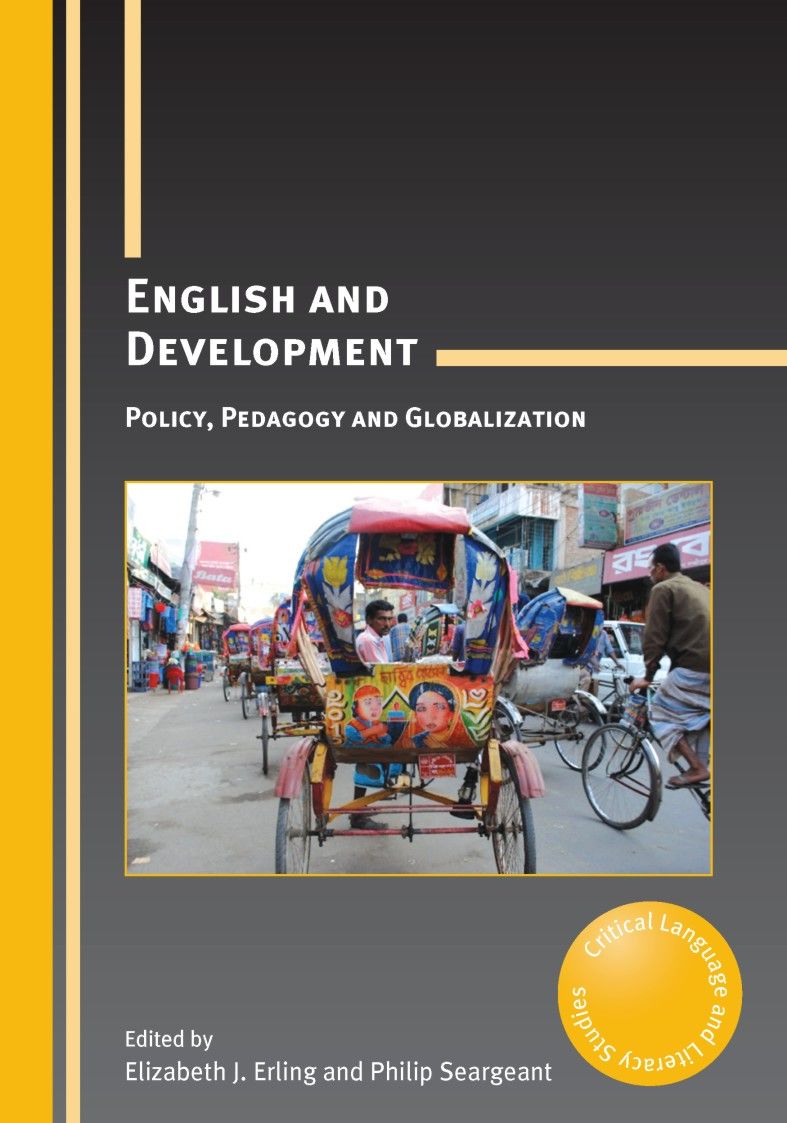
English and Development
This book investigates the relationship between English and personal and national development in the era of globalization. It addresses the effects that the increased use of English and the promotion of English-language education are having in developmental contexts, and their impact on broader educational issues.
eBook

Necessity or opportunity? Government size, tax policy, corruption, and implications for entrepreneurship
Government size, corruption, and tax policy can influence allocation towards necessity or opportunity-driven entrepreneurship. Using a comparative multi-source sample across 52 countries during 2005–2015, we apply a mixed-process estimation of the simultaneously unrelated system of equations and unpack these heterogeneous and complex effects. Interestingly, our results show that the influence of tax policy and corruption on necessity and opportunity entrepreneurship depends on government size. Our results hold for numerous robustness analyses.
Institutions matter for the choice of opportunity and necessity-driven entrepreneurship. Government size, the level of corruption, and tax policy directly affect entrepreneurs’ motivation and incentives. We study 52 countries during 2005–2015 to find out to what extent tax rate, corruption, and a range of government expenditure change the allocation of necessity and opportunity entrepreneurship. Our main implications are for (1) Research: Formal and informal institutions need to be considered when studying entrepreneurship allocation, particularly in an emerging and developing country context. Results suggest that the impact of the same institutional settings and informal institutions such as corruption on necessity and opportunity entrepreneurship is not uniform in size and scope and have different magnitude. The effect of government expenditure on necessity and opportunity entrepreneurship is not ubiquitous. (2) Management: The broader institutional context affects allocation of entrepreneurship, and potential entrepreneurs can consider how corruption in particular can affect them. (3) Policy: Policymakerscan measure the extent to which opportunity and necessity entrepreneurship are likely to change, when they make changes to tax policy, resources for public spending, and take anti-corruption measures.
Journal Article

Developing the global potential of citizen science
Citizen science is gaining increasing prominence as a tool for science and engagement. However, despite being a potentially valuable tool for sustainable development, citizen science has little visibility in many developing countries. We undertook a collaborative prioritisation process with experts in conservation and the environment to assess the potential of environmental citizen science in East Africa, including its opportunities, benefits and barriers. This provided principles that are applicable across developing countries, particularly for large‐scale citizen science. We found that there was great potential for citizen science to add to our scientific knowledge of natural resources and biodiversity trends. Many of the important benefits of citizen science were for people, as well as the environment directly. Major barriers to citizen science were mostly social and institutional, although projects should also consider access to suitable technology and language barriers. Policy implications. Citizen science can provide data to support decision‐making and reporting against international targets. Participation can also provide societal benefits, informing and empowering people, thus supporting the United Nations’ Sustainable Development Goals. In developing countries, innovation is needed to further develop culturally relevant citizen science that benefits participants and end users. This should be supported through regional networks of stakeholders for sharing best practice. Foreign Language Swahili Sayansi ya wananchi inaendelea kuongezeka kwa umaarufu kama chombo cha sayansi na ushiriki. Hata hivyo, licha ya kuwa chombo cha thamani cha maendeleo endelevu, sayansi ya wananchi haionekani sana katika nchi nyingi zinazoendelea. Tulifanya mchakato wa ushirikiano wa kutoa vipaumbele pamoja na wataalamu wa uhifadhi na mazingira ili kuchunguza uwezekano wa sayansi ya wananchi ya mazingira katika Afrika ya Mashariki, ikijumuisha fursa, faida na vikwazo. Hii ilitoa kanuni zinazoweza kutumika katika nchi zinazoendelea, hasa kwa sayansi ya wananchi kwa kiwango kikubwa. Tuligundua kuwa kuna uwezo mkubwa wa sayansi ya wananchi ili kuongeza ujuzi wetu wa kisayansi kuhusu nyenzo za asili na mielekeo ya bioanuwai. Faida muhimu nyingi za sayansi ya wananchi zilikuwa kwa watu, lakini moja kwa moja kwa mazingira pia. Vikwazo vikuu kwa sayansi ya wananchi vilikuwa kijamii na kitaasisi hasa, ingawa miradi inapaswa pia kufikiria upatikanaji wa teknolojia zinazofaa na vikwazo vya lugha. Athari za sera ni kama ifuatavyo. Sayansi ya wananchi inaweza kutoa data kusaidia kuunda maamuzi na kuandika ripoti ili kufikia malengo ya kimataifa. Ushiriki unaweza pia kutoa faida za jamii, kuwajulisha na kuwawezesha watu na kwa hiyo kuunga mkono Malengo ya Maendeleo ya Umoja wa Mataifa. Katika nchi zinazoendelea kunahitaji kuwa na ubunifu ili kuendeleza sayansi ya wananchi inayofaa utamaduni inayopata washiriki na watumiaji wa mwisho. Hii inapaswa kuungwa mkono kupitia mitandao ya kikanda ya washikadau kwa kugawana taratibu bora.
Journal Article

The effect of Chinese EFL students’ learning motivation on learning outcomes within a blended learning environment
The purpose of this study was to explore the relationship between Chinese English as a foreign language (EFL) students’ learning motivation and learning outcomes in a blended learning environment. A questionnaire was administered to 960 EFL students, and 10 of them participated in an interview. Following a series of analyses on the data collected through the questionnaire, consisting of exploratory factor analysis, reliability analysis, descriptive analysis, and correlation analysis, a structural relationship model that integrated learning motivation and learning outcomes was developed and tested. The results reveal that both intrinsic motivation and extrinsic motivation have a positive relationship with learning outcomes within a blended learning environment, both of which are conducive to improving students’ English linguistic competence and facilitating their psychological development of English learning. Moreover, intrinsic motivation is more important than extrinsic motivation. In intrinsic motivation, intrinsic interest in English and the intrinsic goal of understanding English culture are the two most important motives. Based on these results, implications and recommendations for future research are provided. Implications for practice or policy: Foreign language educators should consider the stimulation of students' learning motivation as the main task in blended courses. Foreign language educators should pay more attention to the development of students’ intrinsic motivation than extrinsic motivation to produce more favourable learning outcomes in blended courses. Foreign language educators should focus on developing students’ intrinsic interest in foreign language and culture in terms of the cultivation of students’ intrinsic motivation in blended courses.
Journal Article

Investing in young children : an early childhood development guide for policy dialogue and project preparation
Investing in young children is the responsible thing to do. All children deserve a chance to grow into healthy, educated, and competent people, no matter where and when they were born. While parents bear most of the responsibility for raising their children, especially in the early years of life, governments also have an important role during this critical time of human capital accumulation. For example, governments can ensure that all expectant mothers and young children have access to quality health services and nutrition. They can support parents and other caregivers in providing a positive and stimulating environment for children from birth on by promoting parenting information programs, investing in direct services such as home-based visits, funding daycare centers and preschools, or providing financial incentives to access good quality programs for infants and children. This Early Childhood Development (ECD) guide presents lessons and experiences that have been useful in informing the policy debate about ECD interventions and the design of such programs across the world. Whether the user of this guide is at the initial stage of deciding whether to expand an ECD portfolio or already in the program design stage, the content offers a range of evidence- based options to inform policy and investment choices.
eBook

High school teachers’ perception of AR and VR in English language teaching and learning activities: A developing country perspective
AR and VR are new introductions in many developing countries, including Malaysia. The present study conducted a qualitative case study with 23 high school teachers and investigated their perceptions of AR and VR in English language teaching and learning activities. A semi-structured interview was employed to collect the data. The data was analysed based on the thematic analysis suggested by Braun and Clarke (
Qualitative Research in Psychology, 3
(2), 77–101,
2006
). The findings revealed positive and negative perceptions of integrating AR and VR in English language teaching and learning activities. The positive themes were related to effective English language learning, engaging students, bringing your own device (BYOD) and active learning. The negative perceptions were related to time-consuming and health-related matters. The study further suggested approaches that might be effective in adopting AR and VR in English language teaching and learning activities. It is hoped that the outcome of the present study can provide insights for teachers, curriculum planners, and policymakers to consider the strengths and limitations of AR and VR before it is integrated into English language teaching and learning activities.
Journal Article