
Catalogue Search | MBRL


Are you sure you want to remove the book from the shelf?

{{itemTitle}}
143
result(s) for
"Language policy -- European Union countries"
Sort by:

English-Only Europe?
English-Only Europe? explores the role of languages in the process of European integration. Languages are central to the development of an integrated Europe. The way in which the European Union deals with multilingualism has serious implications for both individual member countries and international relations. In this book, Robert Phillipson considers whether the contemporary expansion of English represents a serious threat to other European languages. After exploring the implications of current policies, Phillipson argues the case for more active language policies to safeguard a multilingual Europe. Drawing on examples of countries with explicit language policies such as Canada and South Africa, the book sets out Phillipson's vision of an inclusive language policy for Europe, and describes how it can be attained.
eBook

Discourse and struggle in minority language policy formation : Corsican language policy in the EU context of governance
The author presents a new approach to the study of language policy, by focusing on language policy formation and implementation as a dynamic, conflict-laden process involving the interaction of various actors with different motivations and uneven bargaining powers, rather than as a product, examinable post hoc from existing language legislation.
eBook
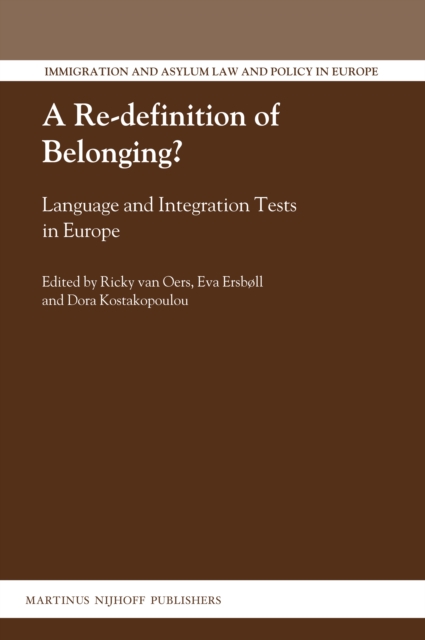
A Re-definition of Belonging?
The introduction of language and integration tests as a condition for naturalisation and other types of legal residence permits reflects an important recent change in citizenship policies in European countries. In this book, experts from nine countries reflect on the redefinition of political belonging by examining the policies concerning immigrant integration.
eBook

English-Only Europe?: Language Policy Challenges
English-Only Europe? explores the role of languages in the process of European integration.Languages are central to the development of an integrated Europe. The way in which the European Union deals with multilingualism has serious implications for both individual member countries and international relations.In this book, Robert Phillipson considers whether the contemporary expansion of English represents a serious threat to other European languages. After exploring the implications of current policies, Phillipson argues the case for more active language policies to safeguard a multilingual Europe. Drawing on examples of countries with explicit language policies such as Canada and South Africa, the book sets out Phillipson's vision of an inclusive language policy for Europe, and describes how it can be attained.
eBook

Quality and Equity in Education
This book presents a vision of plurilingual, intercultural education, demonstrates how it can be realised in practice, and does so in a way which is easily and quickly accessible to teachers of all subjects and in all educational institutions, as well as to other educationists, including policymakers.
eBook

The European Repository Landscape 2008
It is widely acknowledged that a common knowledge base for European research is necessary. Research repositories are an important innovation to the scientific information infrastructure. In 2006, digital repositories in the 27 countries of the European were surveyed, covering 114 repositories from 17 European countries. In follow-up, this book presents the results of the 2008 survey. It shows an increasing number of respondents, but also a further diversification in the character of a repository.,Repositories may be institutional or thematically based, and as such non-institutional as well. 178 Institutional research repositories and 14 thematic and other noninstitutional repositories from 22 European countries took part actively. European practices should be harmonized and the development of state-of-the-art technology facilitated. Authors, institutes and information users are stakeholders in this process. In presenting a state-of the art of developments, this book is a valuable guide for them in developing their policy on research repositories without losing contact with others. The ongoing process of widespread and diversification of digital repositories puts urgency on coherent approach, as a basic feature of repositories is the retrievability of information that may be dispersed over many of them. Continued monitoring of developments will be necessary.
eBook
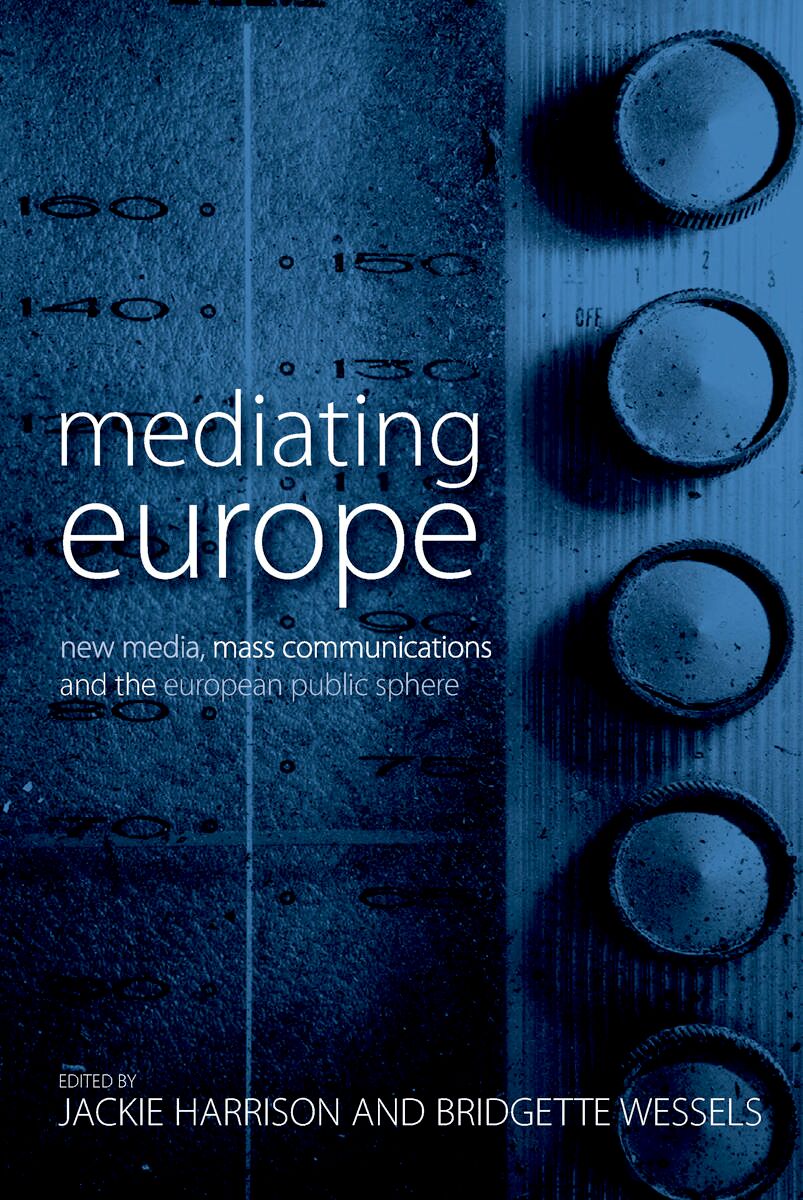
Mediating Europe
The on-going constitutionalization of Europe has led to various changes in media and communications, opening up areas of debate regarding the role of traditional and new media in developing a specific European public sphere as part of the wider European Project. This timely volume addresses the little understood relationship between old and new media, communications policy at the European level, issues of regulation and competition within the EU, the role of the European Parliament in media policymaking, and the questions emerging about the sustainability of traditional public service broadcasting. To understand the concrete significance of these debates two contributions address specific practical areas, i.e. the potential of online environments and specific developments in European media contexts, such as channel strategies, web-related services, iDTV and community networks. Consequently, Mediating Europe provides an original and important contribution to understanding the role of the media in shaping a European public sphere.
eBook

How Many Languages Do We Need?
In the global economy, linguistic diversity influences economic and political development as well as public policies in positive and negative ways. It leads to financial costs, communication barriers, divisions in national unity, and, in some extreme cases, conflicts and war--but it also produces benefits related to group and individual identity. What are the specific advantages and disadvantages of linguistic diversity and how does it influence social and economic progress? This book examines linguistic diversity as a global social phenomenon and considers what degree of linguistic variety might result in the greatest economic good.
Victor Ginsburgh and Shlomo Weber look at linguistic proximity between groups and between languages. They describe and use simple economic, linguistic, and statistical tools to measure diversity's impact on growth, development, trade, the quality of institutions, translation issues, voting patterns in multinational competitions, and the likelihood and intensity of civil conflicts. They address the choosing of core languages in a multilingual community, such as the European Union, and argue that although too many official languages might harm cohesiveness, efficiency, and communication, reducing their number brings about alienation and disenfranchisement of groups.
Demonstrating that the value and drawbacks of linguistic diversity are universal,How Many Languages Do We Need?suggests ways for designing appropriate linguistic policies for today's multilingual world.
eBook

The Unexamined Relationship Between Neoliberalism and Plurilingualism: A Cautionary Tale
In recent years, TESOL scholars have offered both explicit and implicit critiques of language ideologies developed within nationalist frameworks that positioned monolingualism in a standardized national language as the desired outcome for all citizens. These scholars have used insights from both the social and the natural sciences to call into question static conceptualizations of language and have reconceptualized language pedagogy in ways that place the fluid and dynamic language practices of bilingual students at the center of instruction. This dynamic turn in TESOL has informed the emergence of plurilingualism as a policy ideal among language education scholars in the European Union. This article argues that this shift in the field of TESOL parallels the characteristics of the ideal neoliberal subject that fits the political and economic context of the current sociohistorical period—in particular, the desire for flexible workers and lifelong learners to perform service-oriented and technological jobs as part of a post-Fordist political economy. These parallels indicate a need for a more critical treatment of the concept of plurilingualism to avoid complicity with the promotion of a covert neoliberal agenda. The article ends with a framework for TESOL that works against the grain of neoliberal governance.
Journal Article

Managing plurilingual and intercultural practices in the workplace : the case of multilingual Switzerland
The contributions in this volume stem from different lines of research and represent both a continuation and an advancement of the European DYLAN project. The book addresses the meanings and implications of multilingualism and plurilingual repertoires as well as the ways in which cultural diversity is managed in companies and institutions in Switzerland. Characterised by official quadrilingualism, but also by new dimensions of multilingualism resulting from massive immigration, important workforce mobility and increasing globalisation, Switzerland offers an ideal laboratory for studying phenomena linked to multilingualism and cultural diversity. On the one hand, a special focus is put on the best practices of diversity management and language regimes with particular attention paid to the interplay between official languages and English, and to ways of leveraging diversity awareness, fostering cultural inclusiveness and enhancing intercultural learning in vocational education and training.On the other hand, the chapters examine at close range the way actors' plurilingual repertoires are developed and how their use is adapted to particular objectives and specific conditions. Being observed in several types of multilingual professional settings, the plurilingual strategies, including English as lingua franca, are particularly examined in terms of power relations and processes of inclusion or exclusion.
eBook