
Catalogue Search | MBRL


Are you sure you want to remove the book from the shelf?

{{itemTitle}}
10
result(s) for
"Language revival Case studies"
Sort by:
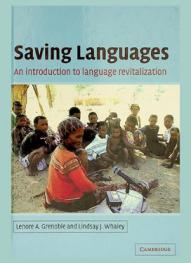

Saving Languages
Language endangerment has been the focus of much attention and as a result, a wide range of people are working to revitalize and maintain local languages. This book serves as a general reference guide to language revitalization, written not only for linguists and anthropologists, but also for language activists and community members who believe they should ensure the future use of their languages, despite their predicted loss. Drawing extensively on case studies, it sets out the necessary background and highlights central issues such as literacy, policy decisions, and allocation of resources. Its primary goal is to provide the essential tools for a successful language revitalization program, such as setting and achieving realistic goals, and anticipating and resolving common obstacles. Clearly written and informative, Saving Languages will be an invaluable resource for all those interested in the fate of small language communities around the globe.
eBook

Revivals, nationalism, and linguistic discrimination : threatening languages
\"Is linguistic revival beneficiary to the plight of newly emerging, peripheral or even threatened cultures? Or is it a smokescreen that hides the vestiges of ethnocentric ideologies, which ultimately create a hegemonic relationship? This book takes a critical look at revival exercises of exemplary historical and geopolitical value, and argues that a critical, and cautious approach to revival movements is necessary. The cases of Sinhala, Kazakh, Mongolian, Catalan, and even Hong Kong Cantonese, show that it is not through linguistic revival, but rather through political representation and economic development, that the peoples in question achieve competitiveness and equality amongst their neighbours. On the other hand, linguistic revival in these and other contexts can, and has been, used at the detriment of other, marginal groups, recreating the same dynamics that generated to need for revival in the first place. This book argues that respect for linguistic and other diversity, multilingualism and multiculturalism, are not compatible with linguistic revival that mirrors nation-building and sovereign identity construction\"-- Provided by publisher.
Book

Rejecting the Marginalized Status of Minority Languages
This book explores Indigenous, tribal and minority (ITM)
language education in oral and/or written communication and in the
use of new technologies and online resources for pedagogical
purposes in diverse geopolitical contexts. It demonstrates that ITM
language education transpires in both formal and informal spaces
for children or adults and that sometimes these spaces are online,
where they become de-territorialized discourses of teaching and
learning.' The volume brings together examples of ITM language
education that are challenging the forces that flatten
'languacultures' into artefacts of history. It also examines the
economic and material realities of the people who live in and
through their 'languacultures', or who aspire to do as much. The
book will be useful for educators and all those interested in
Indigenous and minority language issues, as well as for a wide
range of undergraduate, graduate and research contexts where topics
of language education and minority rights are the focus.
eBook

“A Voice that Would Sound All the Notes”: Sound and Regeneration in Vladimir Jabotinsky’s Hebrew Revivalism
The vernacularization of Hebrew speech was an integral component of the Zionist conception of national revival. In this article I explore some of the ways in which the discourse of regeneration and the figure of the “muscle Jew” shaped ideas about the sonic component of Hebrew speech, through the case of study of Vladimir Ze’ev Jabotinsky. I show that Jabotinsky took speech, and Hebrew speech in particular, to be a potent site of regeneration, viewed as the cultivation of corporeal sensitivity to form. I trace his invention of a sonic counterpart to the muscle Jew, and demonstrate how, employing a conception of speech sounds as manifesting qualities of speakers, he constructed an ideological program for regenerative Hebrew speech that challenged the grammatical prescriptions of mainstream revivalists and included observations of and prescriptions about patterns of Hebrew speech down to the level of phonemes and phonological processes.
Journal Article

Language policy issues involved in the reclamation of Narungga in South Australia
This article deals with some of the complex issues involved in language policy for Indigenous languages in South Australia. For many languages which are endangered at present, past language policies are responsible for deliberately putting them aside. However, today’s language policy documents, both universal and specifically Australian, are highly appreciative of the linguistic, cultural, social and political benefits of Indigenous language maintenance and revival. Nevertheless, the reality concerning Indigenous languages in Australia is not satisfactory, as the case study of the Narungga language of Yorke Peninsula, South Australia, shows. In particular, this article focuses on the development of the Narungga language project, which was initiated by the Narungga Aboriginal Progress Association Inc. (NAPA) in 2001. Narungga is one of the South Australian languages which suffered extremely from English language imperialism in Australia. Up until the NAPA project, Narungga was considered extinct, and little interest was shown to reclaim the language. NAPA proved that much more language material had been documented than was initially thought, which now raises hopes of a total revival of the Narungga language and culture. This article presents the NAPA language project with its difficulties and laudable successes from a language policy point of view.
Journal Article

Monastic Politics and the Local State in China: Authority and Autonomy in an Ethnically Tibetan Prefecture
In asking how Tibetan monks can beat up a group of Chinese Communist Party officials and get away with it, this case study has addresses a number of issues regarding political change in contemporary China. Here, Hillman investigates the origins of the conflict and the changing nature of relations between the monastery and the local government since the revival of religious institutions in the 1980s. The analysis touches upon a number of themes in contemporary Chinese politics and society, including the state's relations with non-state institutions and the increasing significance of religion and ethnic identities in local society, in an effort to illuminate the complexity of forces driving political change in China today.
Journal Article

'Why Did We Have the Partition?' The Making of a Research Interest
This \"case study\" examines the shaping of a research interest. It turns on the Partition of the South Asian subcontinent in 1947, leading to the Independence and establishment of the sovereign states of Pakistan and India. The Partition was a climax within a pattern of recurrent violence in the name of Hindus and Muslims for several generations before 1947, a pattern that recurs at lower intensity continually. This study explores the emerging of an interest in the social origins of the Partition out of several decades of the author's personal experience. It tracks the origins of a sense of difference between the religiously defined social categories to the medieval period--though the Mughal period saw wide-ranging cooperative activity too. The colonial period saw a major change of phase, with heightened insecurities amidst large changes in polity, economy, and society, and the rise of influential institutions for religious revival on both sides. Amidst comprehensive enlargements in the scales of organisations, communications, and activities, the sense of opposition between groups, defined in religious terms, grew; and so too the frequency and intensity of aggression across the divide. The violence in 1947 was exceptionally brutal and large in scale; but the underlying attitudes had long been in the making. To take full measure of that long inception, one needs to summon the resources not only of history but also of a wide array of other social sciences.
Journal Article

Linguistic Revival: Politics and Culture in Catalonia
The role of language in the processes of state formation and challenges to state authority is insufficiently understood. What interests do rulers have in unifying their realms linguistically? Under what conditions do subjects from upper and lower strata in linguistically distinct regions of a state change their language repertoires in accordance with the dictates of rulers? To what extent is language change a response to political, as opposed to economic or demographic, factors? Under what conditions do languages that face extinction become the object of revival movements?
Journal Article

The Norwegian Folk Revival and the Gammeldans Controversy
Goertzen focuses on a turning point in the revival of Norwegian folk music and dance and presents a multilayered case study in the politics of culture. \"Gammeldans\" music focuses on Norway's adaptations of the music of 19th century pan-European social dances.
Journal Article