
Catalogue Search | MBRL


Are you sure you want to remove the book from the shelf?

{{itemTitle}}
11
result(s) for
"Lateinunterricht"
Sort by:


The school of Rome
This fascinating cultural and intellectual history focuses on education as practiced by the imperial age Romans, looking at what they considered the value of education and its effect on children. W. Martin Bloomer details the processes, exercises, claims, and contexts of liberal education from the late first century BCE to the third century CE—the epoch of rhetorical education. He examines the adaptation of Greek institutions, methods, and texts by the Romans, and traces the Romans’ own history of education. Bloomer argues that while Rome’s enduring educational legacy includes the seven liberal arts and a canon of school texts, its practice of competitive displays of reading, writing, and reciting were intended to instill in the young social as well as intellectual ideas.
eBook

Being special
Purpose - The first state high schools in New South Wales (NSW) were restricted to children with high academic ability. The purpose of this paper is to explore the lived experience of over 70 former students from three such schools, one coeducational, the other two single-sex, with special attention to academic and social curricula.Design methodology approach - The study investigates memories of a particular moment in the history of secondary schooling in NSW before the establishment of mass secondary education. The authors utilise theoretical concepts from recent oral history studies regarding memory communities and intersectionality.Findings - In bringing ex-students' memories of both single-sex and coeducational academically-selective high schooling together, the study reports on the homogeneity of the memories of this type of schooling despite the different sexual structures of the schools. The respondents, it is argued, constitute a \"memory community\" in that they recalled their selection for high school as marking them out as intellectually superior, \"special\". Their main differentiating feature arose from their sex and gender socialisation. Females were made more consistently conscious of their responsibilities within their schools' gender regime.Originality value - The approach in this paper adjusts the focus of traditional oral history research in the history of education to \"history from within\" (rather than \"from below\"); to experiences of both academic and socialcurriculum (not \"formal informal\"); to a gendered approach incorporating both sexes; and to a comparative approach across academically-selective coeducational and single-sex high schools.
Journal Article
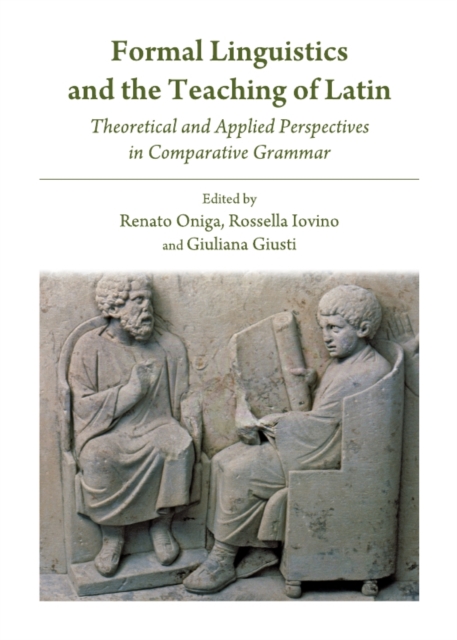
Formal linguistics and the teaching of Latin : theoretical and applied perspectives in comparative grammar
This volume offers a coherent collection of 26 papers presented at an international conference held in November 2010, exploring the latest achievements of formal and comparative linguistics applied to the teaching of Latin. The three sections (syntax and morphology, semantics and pragmatics, history and theory of teaching) compare Latin with different ancient and modern languages, aiming to represent grammar rules as the product of mental processes. The book is addressed to linguists, teacher.
eBook

Actiotope model and self-regulated learning
Research on self-regulated learning takes two central perspectives on the learning process, that of the learning individual and that of the accompanying environmental factors. We suggest combining both of these perspectives in a systemic model, the actiotope model. 399 pupils in fifth and sixth grade were examined at three points in time: prior to the introduction of a new subject (Latin, French, or physics), three to five weeks after the introduction, and, finally, about twelve weeks after the new subject had been introduced. Hierarchical linear modeling shows that the adaptivity of the actiotope explains the frequency of self-regulated learning obtained via self-report measures (goal setting, planning, monitoring, regulating); but the actiotope's adaptivity does not explain individual differences in the development of self-regulated learning processes. (Orig.).
Journal Article


Les dictionnaires de Pierre Danet pour la collection Ad usum Delphini
Cet article décrit les cinq dictionnaires donnés par Pierre Danet, entre 1673 et 1698, pour la collection Ad usum Delphini. Danet rédige un premier dictionnaire latin-français en 1673, et en fournit une édition refondue en 1680 ; en 1677, il publie les Radices, court lexique français-latin, où les mots latins sont classés par famille de mots autour de leur étymon ; en 1683, il rédige un dictionnaire français-latin, puis un nouveau dictionnaire latin-français en 1691, suivi enfin d'un Dictionnaire des Antiquités en 1698. Ces ouvrages sont le reflet des deux orientations de la collection, car ils sont à la fois, pour les premiers, liés aux besoins précis de l'éducation du Dauphin, et plus ouverts, ensuite, vers un public « honnête homme » à la recherche d'instruments qui lui permettent de perfectionner sa culture. Enfin, ils suivent aussi les évolutions de la pédagogie du latin au cours du siècle, trahissant la part de plus en plus importante que prend l'exercice de version latine à tous les niveaux d'enseignement. This paper describes the five dictionaries produced by Pierre Danet from 1673 to 1698, to the Ad usum Delphini collection. Danet wrote his first Latin-French dictionary in 1673, and revised it for a second edition in 1680. In 1677 he published the Radices, an abridged Latin-French dictionary where words are grouped in etymological families ; Danet then wrote a French-Latin dictionary in 1683, a new Latin-French dictionary in 1691, and lastly, a « dictionary of Antiquities » in 1698. These books reflected the two objectives of the collection : the first dictionaries were specifically developed for the dauphin's education, while the latter ones aimed at a wider public of well-educated gentlemen, who were seeking the means to improve their culture. These dictionaries also reflect the general evolution of pedagogy during the seventeenth century, and show the increasingly large place of French translation at all levels of Latin language training. Der Beitrag beschreibt die fünf zwischen den Jahren 1673 und 1698 von Pierre Danet für die Reihe Ad usum Delphini redigierten Wörterbücher. Danet legt 1673 ein erstes lateinisch-französisches Wörterbuch vor, das er 1680 für eine Neuauflage überarbeitet. 1677 veröffentlicht er die Radices, ein kleines zweiprachiges Wörterbuch, in dem die lateinischen Wörter nach Wortfamilien sortiert um ihr Etymon gruppiert werden. 1683 folgt ein französisch-lateinisches Wörterbuch, 1691 ein weiteres lateinisch-französisches Wörterbuch und 1698 schlieβlich ein Dictionnaire des Antiquités. Diese Werke spiegeln die doppelte Zielsetzung der Buchreihe wieder, dienen doch vor allem die ersteren zum einen dem konkreten Zweck der Erziehung des Kronprizen, zum anderen der Befriedigung des Bildungshungers eines breiteren Publikums von honnêtes hommes. Schlieβlich spiegeln sie auch die zeittypischen Entwicklungen innerhalb des Lateinunterrichts selbst, wo auf allen Unterrichtsebenen der Übersetzung aus dem Lateinischen immer mehr an Bedeutung gewann.
Journal Article