
Catalogue Search | MBRL


Are you sure you want to remove the book from the shelf?

{{itemTitle}}
15
result(s) for
"Latin America Social life and customs 19th century."
Sort by:


Transatlantic travels in nineteenth-century Latin America
Transatlantic Travels in Nineteenth-Century Latin America: European Women Pilgrims retraces the steps of five intrepid “lady travelers” who ventured into the geography of the New World—Mexico, the Southern Cone, Brazil, and the Caribbean—at a crucial historical juncture, the period of political anarchy following the break from Spain and the rise of modernity at the turn of the twentieth century. Traveling as historians, social critics, ethnographers, and artists, Frances Erskine Inglis (1806–82), Maria Graham (1785–1842), Flora Tristan (1803–44), Fredrika Bremer (1801–65), and Adela Breton (1849–1923) reshaped the map of nineteenth-century Latin America. Organized by themes rather than by individual authors, this book examines European women’s travels as a spectrum of narrative discourses, ranging from natural history, history, and ethnography. Women’s social condition becomes a focal point of their travels. By combining diverse genres and perspectives, women’s travel writing ushers a new vision of post-independence societies. The trope of pilgrimage conditions the female travel experience, which suggests both the meta-end of the journey as well as the broader cultural frame shaping their individual itineraries.
eBook

Nineteenth-century Spanish America : a cultural history
\"Nineteenth-Century Spanish America : A Cultural History provides a panoramic and accessible introduction to the era in which Latin America took its first steps into the Modern Age. Including colorful characters like circus clowns, prostitutes, bullfighters, street puppeteers, and bestselling authors, this book maps vivid and often surprising combinations of the new and the old, the high and the low, and the political and the cultural. Christopher Conway shows that beneath the diversity of the New World there was a deeper structure of shared patterns of cultural creation and meaning. Whether it be the ways that people of refinement from different countries used the same rules of etiquette, or how commoners shared their stories through the same types of songs, Conway creates a multidisciplinary framework for understanding the culture of an entire hemisphere. The book opens with key themes that will help students and scholars understand the century, such as the civilization and barbarism binary, urbanism, the divide between conservatives and liberals, and transculturation. In the chapters that follow, Conway weaves transnational trends together with brief case studies and compelling snapshots that help us understand the period. How much did books and photographs cost in the nineteenth century? What was the dominant style in painting? What kinds of ballroom dancing were popular? Richly illustrated with striking photographs and lithographs, this is a book that invites the reader to rediscover a past age that is not quite past, still resonating into the present\"-- Provided by publisher.
Book

Nineteenth-Century Spanish America
Nineteenth-Century Spanish America: A Cultural History
provides a panoramic and accessible introduction to the era in
which Latin America took its first steps into the Modern Age.
Including colorful characters like circus clowns, prostitutes,
bullfighters, street puppeteers, and bestselling authors, this book
maps vivid and often surprising combinations of the new and the
old, the high and the low, and the political and the cultural.
Christopher Conway shows that beneath the diversity of the New
World there was a deeper structure of shared patterns of cultural
creation and meaning. Whether it be the ways that people of
refinement from different countries used the same rules of
etiquette, or how commoners shared their stories through the same
types of songs, Conway creates a multidisciplinary framework for
understanding the culture of an entire hemisphere.
The book opens with key themes that will help students and
scholars understand the century, such as the civilization and
barbarism binary, urbanism, the divide between conservatives and
liberals, and transculturation. In the chapters that follow, Conway
weaves transnational trends together with brief case studies and
compelling snapshots that help us understand the period. How much
did books and photographs cost in the nineteenth century? What was
the dominant style in painting? What kinds of ballroom dancing were
popular? Richly illustrated with striking photographs and
lithographs, this is a book that invites the reader to rediscover a
past age that is not quite past, still resonating into the
present.
eBook
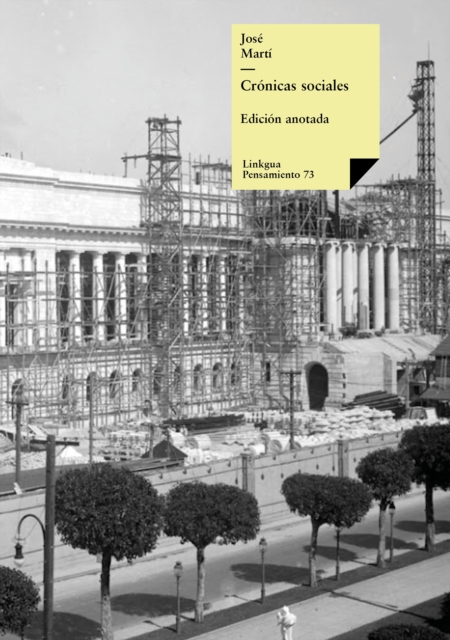
Crónicas sociales
Las Crónicas sociales recogen artículos de José Martí sobre la vida social y política de diferentes países de Latinoamérica. Son un texto de referencia en la literatura cubana del siglo XIX. Las crónicas martianas son una muestra del mejor periodismo escrito por el escritor cubano. Sus rasgos son: * el conocimiento y dominio del tema, * la documentación rigurosa, * la atención al detalle, * y a todo ello se suma su inconfundible estilo, su lenguaje, su ética y el vigor de su palabra que se proyecta a través de los siglos. Las ideas y reflexiones de José Martí, manifiesta a través de sus crónicas, conservan una asombrosa vigencia y la claridad imprescindible para entender, tanto la historia como la realidad social, política y económica actual de las naciones que conforman el continente americano.
eBook


A companion to Latin American literature and culture
Cutting-edge and insightful discussions of Latin American literature and culture In the newly revised second edition of A Companion to Latin American Literature and Culture, Sara Castro-Klaren delivers an eclectic and revealing set of discussions on Latin American culture and literature by scholars at the cutting edge of their respective fields.
eBook

Gender and the Negotiation of Daily Life in Mexico, 1750-1856
History is not just about great personalities, wars, and revolutions; it is also about the subtle aspects of more ordinary matters. On a day-to-day basis the aspects of life that most preoccupied people in late eighteenth- through mid nineteenth-century Mexico were not the political machinations of generals or politicians but whether they themselves could make a living, whether others accorded them the respect they deserved, whether they were safe from an abusive husband, whether their wives and children would obey them-in short, the minutiae of daily life.
Sonya Lipsett-Rivera'sGender and the Negotiation of Daily Life in Mexico, 1750-1856explores the relationships between Mexicans, their environment, and one another, as well as their negotiation of the cultural values of everyday life. By examining the value systems that governed Mexican thinking of the period, Lipsett-Rivera examines the ephemeral daily experiences and interactions of the people and illuminates how gender and honor systems governed these quotidian negotiations. Bodies and the built environment were inscribed with cultural values, and the relationship of Mexicans to and between space and bodies determined the way ordinary people acted out their culture.
eBook

Death and Dying in Colonial Spanish America
When the Spanish colonized the Americas, they brought many cultural beliefs and practices with them, not the least of which involved death and dying. The essays in this volume explore the resulting intersections of cultures through recent scholarship related to death and dying in colonial Spanish America between the sixteenth and eighteenth centuries. The authors address such important questions as: What were the relationships between the worlds of the living and the dead? How were these relationships sustained not just through religious dogma and rituals but also through everyday practices? How was unnatural death defined within different population strata? How did demo-graphic and cultural changes affect mourning?The variety of sources uncovered in the authors' original archival research suggests the wide diversity of topics and approaches they employ: Nahua annals, Spanish chronicles, Inquisition case records, documents on land disputes, sermons, images, and death registers. Geographically, the range of research focuses on the viceroyalties of New Spain, Peru, and New Granada.The resulting records-both documentary and archaeological-offer us a variety of vantage points from which to view each of these cultural groups as they came into contact with others. Much less tied to modern national boundaries or old imperial ones, the many facets of the new historical research exploring the topic of death demonstrate that no attitudes or practices can be considered either \"Western\" or universal.
eBook

The Moral Electricity of Print
Best Nineteenth-Century Book Award Winner, 2018, Latin
American Studies Association Nineteenth-Century Section
Moral electricity-a term coined by American transcendentalists in
the 1850s to describe the force of nature that was literacy and
education in shaping a greater society. This concept wasn't
strictly an American idea, of course, and Ronald Briggs introduces
us to one of the greatest examples of this power: the literary
scene in Lima, Peru, in the nineteenth century. As Briggs notes in
the introduction to The Moral Electricity of Print , \"the
ideological glue that holds the American hemisphere together is a
hope for the New World as a grand educational project combined with
an anxiety about the baleful influence of a politically and morally
decadent Old World that dominated literary output through its
powerful publishing interests.\" The very nature of living as a
writer and participating in the literary salons of Lima was, by
definition, a revolutionary act that gave voice to the formerly
colonized and now liberated people. In the actions of this literary
community, as men and women worked toward the same educational
goals, we see the birth of a truly independent Latin American
literature.
eBook