
Catalogue Search | MBRL


Are you sure you want to remove the book from the shelf?

{{itemTitle}}
43
result(s) for
"Latin American literature African influences."
Sort by:


Critical Perspectives on Afro-Latin American Literature
After generations of being rendered virtually invisible by the US academy in critical anthologies and literary histories, writing by Latin Americans of African ancestry has become represented by a booming corpus of intellectual and critical investigation. This volume aims to provide an introduction to the literary worlds and perceptions of national culture and identity of authors from Spanish-America, Brazil, and uniquely, Equatorial Guinea, thus contextually connecting Africa to the history of Spanish colonization. The importance of Latin America literature to the discipline of African Diaspora studies is immeasurable, and this edited collection provides a ripe cultural context for critical comparative analysis among the vast geographies that encompass African and African Diaspora studies. Scholars in the area of African Diaspora Studies, Black Studies, Latin American Studies, and American literature will be able to utilize the eleven essays in this edition to enhance classroom instruction and further academic research.
Introduction Antonio D. Tillis Part One: Engaging the Transnational, Cosmopolitan and Postcolonial in Afro-Hispanic Texts Introduction to Part One Antonio D. Tillis 1. Roots and Routes: Transnational Blackness in Afro-Costa Rican Literature Dorothy E. Mosby 2. Los nietos de Felicidad Dolores (The Grandchildren of Felicidad Dolores) and the Contemporary Afro-Hispanic Historical Novel: A Postcolonial Reading Sonja Stephenson Watson 3. Cultural Transnationality and Cosmopolitanism in the Poetic Journeys of Nancy Morejón Antonio D. Tillis Part Two: Africa and African Cosmology and Literary Tradition in Hispanic (Con) Texts Introduction to Part Two Antonio D. Tillis 4. Yoruba Cosmology as Technique in Malambo by Lucía Charún-Illescas Aida L. Heredia 5. Myth, Legend & Reality: Redesigning the Narrative Style in Manuel Zapata Olivella’s Hemingway, the Death Stalker Cristina Cabral 6. Nicomedes Santa Cruz: A Clarion for Black Cultural Traditions in Peru Martha Ojeda 7. Bridging Literary Traditions in the Hispanic World: Equatorial Guinean Drama and the Dictatorial Cultural-Political Order Elisa Rizo Part Three: Defining and Redefining Identities in Latin American Literature Introduction to Part Three Antonio D. Tillis 8. Black, Woman, Poor: The Many Identities of Conceição Evaristo Ana Beatriz Rodrigues Gonçalves 9. The Triumph Within: Carolina Maria de Jesus and Strategies for Black Female Empowerment in Brazil Dawn Duke 10. Talking Back with Ana Lydia Vega: Identity, Gender and the Subversive Portrayal of Mestizaje Emmanuel Harris, III 11. Dialogically Redefining the Nation: Hip-hop and the Collective Identity Lesley Feracho
Antonio D. Tillis is an Associate Professor at Dartmouth College. A Fulbright Scholar at the Federal University of Minas Gerais, Brazil (2009-2010), he is the editor of PALARA (Publication of the Afro-Latin American Research Association) and author of Manuel Zapata Olivella and the \"Darkening\" of Latin American Literature (2005) and Caribbean-African…Upon Awakening: Poetry by Blas Jiménez (2010).
eBook


Mayaya Rising
Who are the Black heroines of Latin America and the Caribbean? Where do we turn for models of transcendence among women of African ancestry in the region? In answer to the historical dearth of such exemplars, Mayaya Rising explores and celebrates the work of writers who intentionally center powerful female cultural archetypes. In this inventive analysis, Duke proposes three case studies and a corresponding womanist methodology through which to study and rediscover these figures. The musical Cuban-Dominican sisters and former slaves Teodora and Micaela Ginés inspired Aida Cartagena Portalatin's epic poem Yania tierra; the Nicaraguan matriarch of the May Pole, \"Miss Lizzie,\" figures prominently in four anthologies from the country's Bluefields region; and the iconic palenqueras of Cartagena, Colombia are magnified in the work of poets María Teresa Ramírez Neiva and Mirian Díaz Pérez. In elevating these figures and foregrounding these works, Duke restores and repairs the scholarly record.
eBook
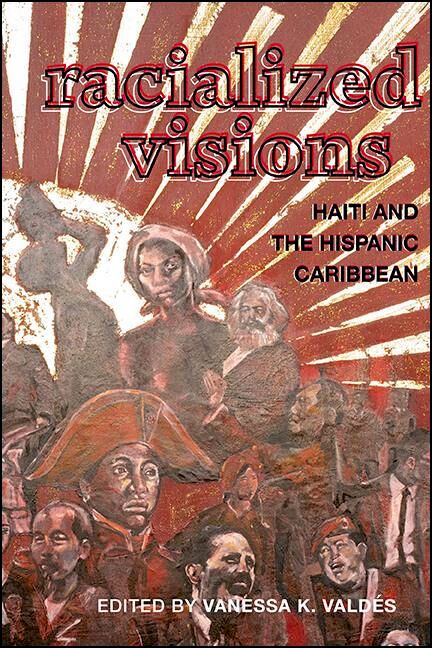
Racialized Visions
As a Francophone nation, Haiti is seldom studied in conjunction
with its Spanish-speaking Caribbean neighbors. Racialized
Visions challenges the notion that linguistic difference has
kept the populations of these countries apart, instead highlighting
ongoing exchanges between their writers, artists, and thinkers.
Centering Haiti in this conversation also makes explicit the role
that race-and, more specifically, anti-blackness-has played both in
the region and in academic studies of it. Following the Revolution
and Independence in 1804, Haiti was conflated with blackness.
Spanish colonial powers used racist representations of Haiti to
threaten their holdings in the Atlantic Ocean. In the years since,
white elites in Cuba, the Dominican Republic, and Puerto Rico
upheld Haiti as a symbol of barbarism and savagery. Racialized
Visions powerfully refutes this symbolism. Across twelve
essays, contributors demonstrate how cultural producers in these
countries have resignified Haiti to mean liberation. An
introduction and conclusion by the editor, Vanessa K. Valdés, as
well as foreword by Myriam J. A. Chancy, provide valuable
historical context and an overview of Afro-Latinx studies and its
futures.
eBook

The fear of French negroes
The Fear of French Negroes is an interdisciplinary study that explores how people of African descent responded to the collapse and reconsolidation of colonial life in the aftermath of the Haitian Revolution (1791-1845). Using visual culture, popular music and dance, periodical literature, historical memoirs, and state papers, Sara E. Johnson examines the migration of people, ideas, and practices across imperial boundaries. Building on previous scholarship on black internationalism, she traces expressions of both aesthetic and experiential transcolonial black politics across the Caribbean world, including Hispaniola, Louisiana and the Gulf South, Jamaica, and Cuba. Johnson examines the lives and work of figures as diverse as armed black soldiers and privateers, female performers, and newspaper editors to argue for the existence of \"competing inter-Americanisms\" as she uncovers the struggle for unity amidst the realities of class, territorial, and linguistic diversity. These stories move beyond a consideration of the well-documented anxiety insurgent blacks occasioned in slaveholding systems to refocus attention on the wide variety of strategic alliances they generated in their quests for freedom, equality and profit.
eBook

Receptions of the classics in the African diaspora of the hispanophone and lusophone worlds
Atlantis Otherwise expands the study of the African diaspora by focusing on postcolonial literary expressions from Latin America and Africa.The book studies the presence of classical references in texts written by writers (black and non-black) who are committed to the articulation of the fragmented history of the African experience.
eBook

Bridging the Gaps: Towards a New Paradigmatic Interface of Translation Studies and Comparative Literature
The paper explores the possibilities of new theories in comparative literature through the tenets of translation studies. In doing so, it looks into the turbulence in the relational space between translation studies and comparative literature. There have been prior attempts to incorporate the praxis of translation into comparative literature. The present study seeks to approach Comparative Literature through theoretical ideations from translation studies. In the given academic scenario, both the disciplines need to explore newer avenues of knowledge as a means of sustenance. The paper argues that the inversion of the traditional academic relationship, that subverts hegemonic knowledge-formation shall expand the boundaries of both fields of studies through theoretical interrelations as well as text-based examples.
Journal Article

Can Family Socioeconomic Resources Account for Racial and Ethnic Test Score Gaps?
This article considers whether the disparate socioeconomic circumstances of families in which white, black, and Hispanic children grow up account for the racial and ethnic gaps in school readiness among American preschoolers. It first reviews why family socioeconomic resources might matter for children's school readiness. The authors concentrate on four key components of parent socioeconomic status that are particularly relevant for children's well-being--income, education, family structure, and neighborhood conditions. They survey a range of relevant policies and programs that might help to close socioeconomic gaps, for example, by increasing family incomes or maternal educational attainment, strengthening families, and improving poor neighborhoods. Their survey of links between socioeconomic resources and test score gaps indicates that resource differences account for about half of the standard deviation--about 8 points on a test with a standard deviation of 15--of the differences. Yet, the policy implications of this are far from clear. They note that although policies are designed to improve aspects of \"socioeconomic status\" (for example, income, education, family structure), no policy improves \"socioeconomic status\" directly. Second, they caution that good policy is based on an understanding of causal relationships between family background and children outcomes, as well as cost-effectiveness. They conclude that boosting the family incomes of preschool children may be a promising intervention to reduce racial and ethnic school readiness gaps. However, given the lack of successful large-scale interventions, the authors suggest giving only a modest role to programs that address parents' socioeconomic resources. They suggest that policies that directly target children may be the most efficient way to narrow school readiness gaps.
Journal Article
