
Catalogue Search | MBRL


Are you sure you want to remove the book from the shelf?

{{itemTitle}}
10
result(s) for
"Latin language -- Grammar -- Congresses"
Sort by:

Pragmatic Approaches to Latin and Ancient Greek
Pragmatics forms nowadays an integral part of the description not only of modern languages but also of ancient languages such as Latin and Ancient Greek. This book explores various pragmatic phenomena in these two languages, which are accessible through corpora consisting of a broad range of text types. It comprises empirical synchronic studies that deal with three main topics: (i) speech acts and pragmatic markers, (ii) word order, and (iii) discourse markers and particles. The specificity of this book consists in the discussion and application of various methodological approaches. It provides new insights into the pragmatic phenomena encountered, compares, where possible, the results of the investigation of the two languages, and draws conclusions of a more general nature. The volume will be of interest to linguists working on pragmatics in general and to scholars of Latin and Ancient Greek in particular.
eBook

Latinitatis Rationes
This volume assembles 50 contributions presented at the XVII International Colloquium on Latin Linguistics.They embrace essential topics of Latin linguistics with different theoretical and methodological approaches: phonetics, syntax, etymology and semantics, pragmatics and textual analysis.
eBook

Latin linguistics and linguistic theory : proceedings of the 1st International Colloquium on Latin Linguistics, Amsterdam, April 1981
The articles of this collection on Latin linguistics are representative of the kind of research that is currently carried out in the field of linguistics. Most deal with syntax or sentence structure, but they vary with respect to their emphasis on theory or description. They also vary with respect to the grammatical framework with which they are formulated, with some preponderance of transformational generative approaches. All papers are well-informed about the major developments in contemporary linguistics and make extensive use of recent methods and types of argumentation. In the introduction the volume editor briefly reviews the present state of Latin linguistics, starting with a section on the question whether it is possible to conduct up-to-date linguistic research for Latin at all. To be followed by a brief sketch of the impact of recent linguistic theories on Latin linguistics in general, and in a final third section an outline is presented of the possible interest the contributions to this volume may have for linguists working on languages other than Latin.
eBook

Linguistic studies on Latin : selected papers from the 6th International Colloquium on Latin Linguistics (Budapest, 23-27 March 1991)
The volume contains 26 articles (17 in English, 9 in French), selected from the papers presented at the 6th International Colloquim on Latin Linguistics, organized in Budapest. The authors share a common interest in applying to the study of Latin the conceptual framework of contemporary linguistics, mainly, but not exclusively, the theoretical tools of functional grammar and of the newest trends in pragmatics. Most studies envisage Latin in its synchronic functioning, but some papers embrace diachronic processes, from the archaic period to late and even pre-Romance stages. The volume is divided in several sections: \"Phonology and Morpho-syntax\" includes one paper on phonology (Fr. Biville) and three on morphology (G.C.L.M. Bakkum, G. Haverling, P. Manuel Suárez). Problems of the syntax of the simple sentence, often in relation to word order phenomena, are discussed in seven articles in Section 2 (Ch. Elerick, H. Fugier, Jan R. de Jong, Marius Lavency, E. Rizzi and P. Molinelli, Hannah Rosén, M.H. Somers). The grammatical problems of the complex sentence were examined by a great many participants of the colloquium, and the third section, \"Subordination\", presents eight of those papers (Gu. Calboli, P. De Carvalho, P. Cuzzolin, J. Dangel, S. Mellet, J.A.H. Mensink, P. Ramat, E. Vester). The section on text cohesion and particles - an almost traditional field of research in new Latin linguistics - includes papers by A.M. Bolkestein, C. Kroon, R. Risselada, and M.E. Torrego. The final section, \"Problems of the Lexicon\", devoted to the historical-comparative or semantic descriptive analysis of lexical elements, contains four articles (R. Coleman, B. García Hernández, L. Nadjo, Chr. Touratier). An Index of Names closes the volume.
eBook
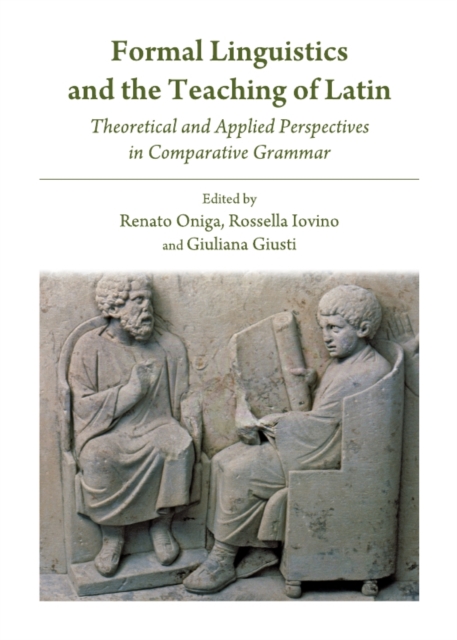
Formal linguistics and the teaching of Latin : theoretical and applied perspectives in comparative grammar
This volume offers a coherent collection of 26 papers presented at an international conference held in November 2010, exploring the latest achievements of formal and comparative linguistics applied to the teaching of Latin. The three sections (syntax and morphology, semantics and pragmatics, history and theory of teaching) compare Latin with different ancient and modern languages, aiming to represent grammar rules as the product of mental processes. The book is addressed to linguists, teacher.
eBook

Grammatical analyses in Basque and Romance linguistics : papers in honor of Mario Saltarelli
This volume contains fifteen articles on current theoretical issues in Basque and Romance linguistics. Even though Basque and Romance languages are typologically different and have different genetic origins, one thousand years of coexistence have shown certain parallelisms in their respective grammars. It is Mario Saltarelli that first offered a formal linguistic account of phonological and syntactic phenomena that occur in these two language groups. Thus, this compilation of articles in both Basque and Romance linguistics not only pays tribute to Saltarelli's work by acknowledging his formalization of this relational insight, but also comprises state of the art research on languages with strong geographical and historical kinship.Fifteen reviewed articles written by sixteen top scholars in the field provide fresh analyses of long standing challenging phenomena in Romance and Basque linguistics such as geminates, the evolution of Basque plosives, clitic doubling, clitic clustering, directionality of clitization, the role of agreement, focus, the interaction of voice and aspect, unaccusativity, semantic interpretation and syntactic structure of Determiner Phrases, obviation, control, and anaphoric and pronominal binding. This variety of topics however is unified by limiting the contributions to the four major formal areas of linguistics, and to one single framework, Generative Grammar, although in some of its many incarnations such as Minimalism, Optimality Theory, and Relational Grammar. All this, along with the number of languages covered by the authors (Aragonese, Basque, Catalan, French, Galician, Gascon, Italian and many of its dialects (Ligurian, Piedmontese, Tuscan...), Classical and Late Latin, Occitan, Brazilian and European Portuguese, Romanian, Old and Modern Spanish among others), makes the book of great value to any linguist working
in Romance or Basque linguistics.
eBook

Inflection and Word Formation in Romance Languages
Formation principles of Italian brand names in the food market have been described on the basis of a corpus comprising 950 brand names collected in a field research (Zilg 2006). The analysis of the morphological structure of brand names focuses on the question whether these names can be captured using traditional word-formation concepts and criteria and, if this is the case, which word-formation types are productive. The term \"adspeak affixoids\" is introduced to describe a creation method at the interface of derivation and compounding. Furthermore, the high combinability of (modifying) suffixes and stems is analysed. Finally, the author tries to answer the question whether morphology acts autonomously with regard to brand names.
eBook

Grammatical theory and Romance languages : selected papers from the 25th Linguistic Symposium on Romance Languages (LSRL XXV), Seattle, 2-4 March 1995
This volume presents recent theoretical research on Romance languages, selected from papers presented at the 25th Linguistic Symposium on Romance Languages. It includes studies of individual Romance languages as well as comparative studies - both within the Romance family and with non-Romance languages (Basque, Bulgarian, Germanic and Quechua). Papers in phonetics and phonology treat stress, syllable structure, s-weakening, and the declination effect. Morphological topics include class-marker suppression and gender agreement and suppletion. Topics in syntactic theory include clitics, participial and adjectival agreement, the syntax of tense, mood, negation, adjectival predication, Tough-constructions, quantification and null objects.
eBook

Diachronic studies in romance linguistics : papers presented at the Conference on Diachronic Romance Linguistics, University of Illinois, April 1972
No detailed description available for \"Diachronic Studies in Romance Linguistics\".
eBook
