
Catalogue Search | MBRL


Are you sure you want to remove the book from the shelf?

{{itemTitle}}
20
result(s) for
"Latin language Demonstratives."
Sort by:

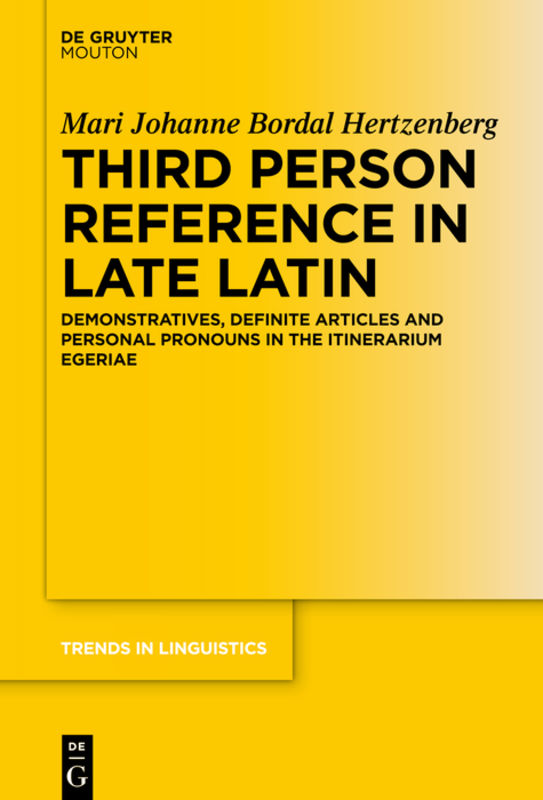
Third Person Reference in Late Latin
The series publishes state-of-the-art work on core areas of linguistics across theoretical frameworks as well as studies that provide new insights by building bridges to neighbouring fields such as neuroscience and cognitive science. The series considers itself a forum for cutting-edge research based on solid empirical data on language in its various manifestations, including sign languages. It regards linguistic variation in its synchronic and diachronic dimensions as well as in its social contexts as important sources of insight for a better understanding of the design of linguistic systems and the ecology and evolution of language.
eBook

Ecce in Archaic Latin: interjection or demonstrative?
Longstanding debate persists regarding the classification of Latin
as word class. While some scholars regard it as a particle or demonstrative, others characterize it as an interjection. This study examines the implications of these approaches and analyzes the behavior of
in Archaic Latin according to different grammatical and semantic criteria. The analysis confirms that
functions primarily as a predicative demonstrative. Furthermore, it contends that
can be specifically categorized as a presentative predicative demonstrative. These results suggest that the interjectional use of this demonstrative must have arisen only secondarily.
Journal Article

Latin follis and vellō as evidence for a sound change -lǵ h - > lɣ > ll with an excursus on Greek λάχνη, ἀμφιλαχαίνω and cognates
Handbook treatments of Latin historical phonology do not discuss the fate of the consonant clusters ·lh and ·rh (or, rather, Proto-Italic ·l?, ·r?) that would reflect Indo-European ·-lghand ·-rgh-. Indeed, no secure examples of such reflexes have been identified thus far. In this paper I argue that ·-lgh- > ·-l?- was assimilated to Latin -ll-, adducing two plausible examples (follis 'skin bag' < PIE ·bholg h-i-, vellō 'to tear out, pluck' < PIE ·u?elg h-e/o-) and a possible example (fel fellis 'gall bladder'). In addition, I suggest that the demonstrative pronoun ille may reflect ·olplus the pronominal stem ·hothat underlies hic. In an excursus, Greek λάχνη 'down, fluff' and (ἀµφι)λαχαίνω 'to weed' are also derived from the PIE root ·u?elg hunderlying vellō.·
Journal Article
Latin follis and vellō as evidence
Handbook treatments of Latin historical phonology do not discuss the fate of the consonant clusters *lh and *rh (or, rather, Proto-Italic *lɣ, *rɣ) that would reflect Indo-European *-lgh- and *-rgh-. Indeed, no secure examples of such reflexes have been identified thus far. In this paper I argue that *-lgh- > *-lɣ- was assimilated to Latin -ll-, adducing two plausible examples (follis 'skin bag' < PIE *bholǵh-i-, vellō 'to tear out, pluck' < PIE *u̯elǵh-e/o-) and a possible example (felfellis 'gall bladder'). In addition, I suggest that the demonstrative pronoun ille may reflect *ol- plus the pronominal stem *ho- that underlies hic. In an excur- sus, Greek λάχνη 'down, fluff' and (ἀμφι)λαχαίνω 'to weed' are also derived from the PIE root *u̯elǵh- underlying vellō.*
Journal Article

Deixis and person in Ibero- and Gallo-Romance demonstratives
Demonstratives in Romance languages display greater morphological complexity than the definite articles that developed from them, illuminating the internal structure of both sets of forms. Building on the work of Leu (2015), Bernstein et al. (1999), and others, we claim that Ibero- and Gallo-Romance demonstratives can be decomposed into a deictic or locative component and a definite determiner, and that an agreement relation involving person connects these two heads (cf. Guardiano & Stavrou 2020). Compared with their Latin precursors, which displayed a three-way system (1st/proximal, 2nd/medial, 3rd/distal), the modern Romance forms are relatively unstable: a loss of forms through grammaticalization is followed by a gain through realignment or addition of forms. Our analysis also builds on the ideas that the D head encodes person (Bernstein 2008a,b; Longobardi 2008) and that Romance demonstrative systems are person-oriented (Vincent 1999; Ledgeway 2015; Terenghi 2023). When a definite determiner is decoupled from its demonstrative source, as happened across Romance in its transition from Latin, it retains its person feature and loses its deictic force, which it subsequently regains.
Journal Article

Between demonstrative and definite: A grammar competition model of the evolution of French l-determiners
This article investigates the spread of the le/la/les-forms in the diachrony of French on the basis of large-scale corpora. It focuses on the issue of their “mixed” distribution viz. the observation that during a long period of time the le/la/les-forms in French do not pattern as either (anaphoric) demonstratives from which they originate (Late Latin ille), nor as (uniqueness-based) definites, which they end up becoming in Modern French. We model the phenomenon as a competition between two grammars which ascribe different Logical Forms to the l-forms and test model predictions in contexts which differ with respect to whether they satisfy the relevant conditions for either demonstrative or definite semantics. We also suggest that this change was part of a larger change involving the spread of presupposition triggers within noun phrases. We show that our model correctly predicts the relative rates of determiner spread in various contexts.
Journal Article
The emergence of the grammatical paradigm of nominal determiners in French and in Romance: Comparative and diachronic perspectives
This article is devoted to the emergence of a new paradigm in French and Romance: that of nominal determiners. Latin had no articles, and although possessives, demonstratives and indefinites could determine the noun, they could also be used as pronouns or adjectives, so that the morpho-syntactic category of nominal determiners did not exist as such. We first examine the diachronic evolution of French, where a far-reaching grammaticalization process took place. Syntagmatically, all determiners end up in the NP-initial position as the only available syntactic slot, contributing to the highly configurational NP pattern characteristic of Modern French. From a paradigmatic viewpoint, determiners no longer correspond to a syntactic function, but to a separate morpho-syntactic category. We also evaluate to what extent this evolution took place in two other Romance languages, Italian and Spanish. Through the analysis of this particular evolution, based on parallel corpora consisting of a Latin text and its translations in Old, Middle, and Modern French on the one hand, and in Spanish and Italian on the other, our study also provides evidence for more general mechanisms, analogy in particular, at work in the creation of new paradigms. Cet article est consacré à l’émergence d'un nouveau paradigme grammatical en français et dans les langues romanes, celui de la détermination nominale. Le latin n'avait pas d'articles, alors que les possessifs, les démonstratifs et les indéfinis, tout en pouvant servir de déterminant nominal, étaient par ailleurs utilisés comme pronom ou adjectif. La détermination nominale en tant que catégorie morpho-syntaxique autonome était donc inexistante. Nous examinons d'abord comment a eu lieu, au cours de l’évolution diachronique du français, un processus important de grammaticalisation. Syntagmatiquement, tous les déterminants se retrouvent dans la position initiale du NP comme seule position syntaxique disponible, ce qui contribue au caractère hautement configurationnel du constituant nominal du français moderne. D'un point de vue paradigmatique, les déterminants ne correspondent plus à une fonction syntaxique, mais à une catégorie morphosyntaxique distincte. Nous évaluons ensuite dans quelle mesure cette évolution a eu lieu dans deux autres langues romanes, l'italien et l'espagnol. Notre analyse est basée sur des corpus parallèles comprenant un texte latin et ses traductions en français médiéval et moderne, d'une part, et ses traductions en espagnol et en italien, d'autre part. Elle met en évidence des mécanismes et des motivations plus généraux, notamment l'analogie, qui sont à l’œuvre dans la création de nouveaux paradigmes.
Journal Article
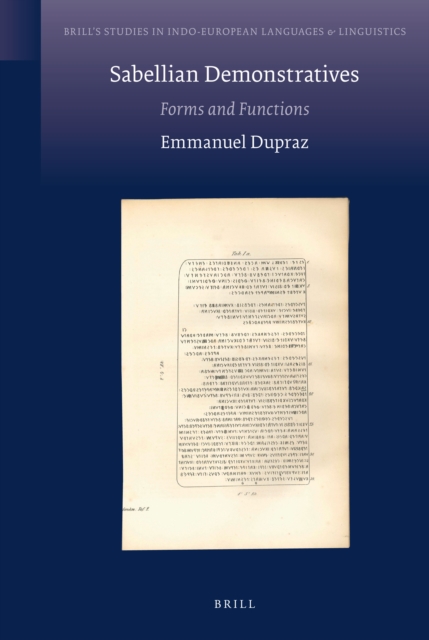
Sabellian demonstratives : forms and functions
This book describes the semantic, syntactic, and pragmatic features of Sabellian demonstratives. It contains new hypotheses on the epigraphic genres in Republican Italy and a reconstruction of these grammatical items' Italic origins based on typological principles.
eBook

A Translation of the Linguae Annamiticae seu Tunchinensis brevis declaratio
The oldest known surviving grammar of quốc ngữ, called the Linguae Annamiticae seu Tunchinensis brevis declaratio, was published in 1651 in Rome and written in Latin by French Jesuit missionary Alexandre de Rhodes. Presented here is the first complete English translation of de Rhodes’ text. It comprises eight chapters: quốc ngữ letters; accents; nouns; personal, reflexive, and demonstrative pronouns; relative and interrogative pronouns; verbs; additional parts of speech; and syntax. This English version makes this Latin text, which is a fundamental work highlighting the origins of quốc ngữ, accessible to non-Latin-reading scholars of the Vietnamese language for the first time. Included with this translation is an introduction that situates de Rhodes’ work in the context of other contemporary Jesuit linguists also working on quốc ngữ and points out that the Brevis declaratio follows the model of the grammar book of Manuel Alvares. Appended at the end of the translation is a glossary that clarifies some linguistic vocabulary de Rhodes used.
Journal Article