
Catalogue Search | MBRL


Are you sure you want to remove the book from the shelf?

{{itemTitle}}
737
result(s) for
"Latin language Syntax."
Sort by:

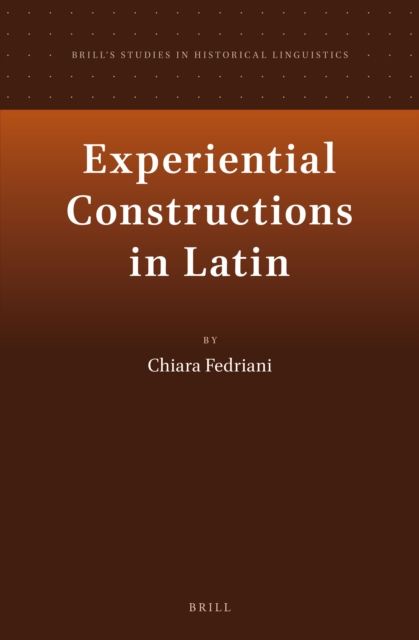
Experiential Constructions in Latin
This book offers a corpus-based synchronic and diachronic investigation of Experiential constructions in Latin, focusing on patterns of variation and change in argument realization and non-canonical case-marking and providing insights in the domain of diachronic verbal syntax and semantics.
eBook

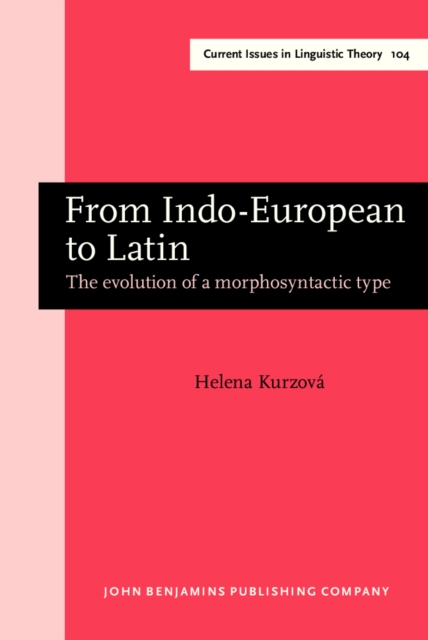
From Indo-European to Latin : the evolution of a morphosyntactic type
This study aims to describe the typological characteristics of the original Indo-European structure, called the derivative-flectional stage (or (sub)type), and to trace its developments to the paradigmatically organized structure of the individual Indo-European languages, called the paradigmatic-flectional stage (or (sub)type). This development is demonstrated in Latin, a language characterized by highy developed inflection, which attests, especially by its verbal system, an alternative way of paradigmatizing the original structure, differing from Old Indian and Greek on which traditional reconstruction was based.The notion of derivative-flectional type is used to try to penetrate to the original form and historical sources of the IE flectional type without presupposing radical typological change between Proto-IE and IE. The author's view differs from the traditional theory of prehistoric change in IE structure (from isolation to flection via agglutination) in that she assumes the origins of flection lie in lexico-derivative categorization.The book is divided into three parts: 1. The Origins and Evolution of the Indo-European Flectional Type 2. The Basic Principles and Origins of the Nominal System and Inflections 3. The Indo-European Origins of the Latin Verbal System.
eBook

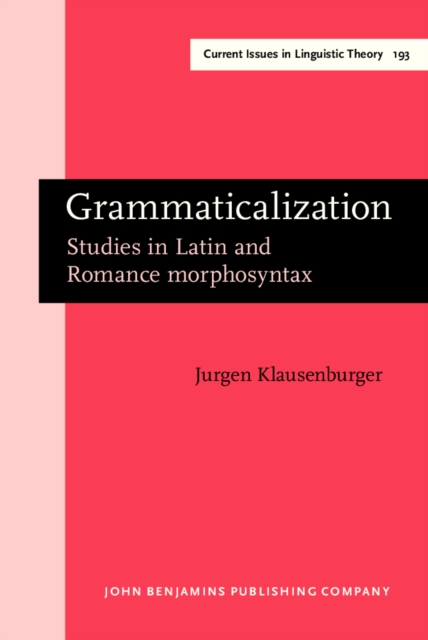
Grammaticalization : studies in Latin and Romance morphosyntax
In this monograph, various aspects of the morphosyntactic evolution of the Romance languages are shown to interact in a theory of grammaticalization. The study argues for the incorporation and subordination of inflectional morphology within a grammaticalization continuum, constituting but a portion of the latter. Parameters of natural morphology are seen as principles of grammaticalization, but the reverse is also true, rendering grammaticalization and natural morphology indistinguishable. In the context of this theoretical framework, Chapter 2 deals with Latin, French, and Italian verbal inflection, focusing on universal and system-dependent parameters of natural morphology. In Chapter 3, a theory of grammaticalization is built on divergent elements, including not only grammaticalization studies proper, but also the perception/production line of inquiry, and typology and branching issues, permitting the phasing out of the traditional synthesis/analyis cycle. Chapter 4 touches on nominal inflection, in particular that of Old French and Rumanian, the most revealing histories in the Romance domain. Chapter 5, finally, thoroughly discusses extant theoretical questions in grammaticalization, prominently featuring the relevance of 'invisible hand' explanations and the crucial role played by unidirectionality. This study will be of interest to specialists in Romance and historical linguistics, as well as morphological theory.
eBook
Syntax of the sentence
This is the first of a multi-volume set dealing with the long-term evolution of Latin syntax, roughly from the 4th century BCE up to the 6th century CE. There are six pivotal chapters in this volume, each dealing with a subject which is critical to the understanding of the syntactic system. Topics covered include contact phenomena (from Greek and Semitic), the development of word order, particles, coordination, and the syntax of questions and answers. The volume is introduced by the editors in an explanatory \"Prolegomena\", and the textual parameters are set in a chapter on literary genres and sociolinguistics. Crafted in a functional-typological framework, chapters are user-sensitive, with a minimum of technical jargon and formalism, making them accessible to the widest range of readers.
eBook
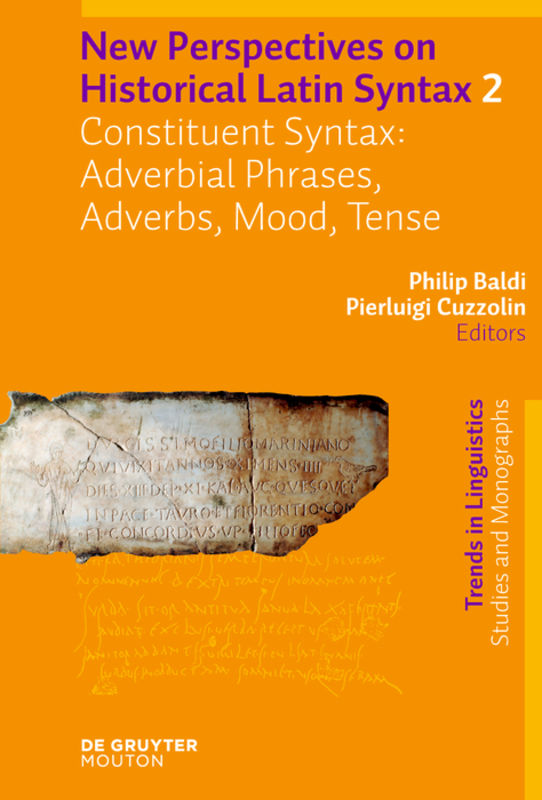
Constituent syntax : adverbial phrases, adverbs, mood, tense
New Perspectives on Historical Latin Syntax: Constituent Syntax (Adverbial Phrases, Adverbs, Mood, Tense) is the second of four volumes dealing with the long-term evolution of Latin syntax, roughly from the 4th century BCE up to the 6th century CE. This volume, along with Volume 3, comprises chapters dealing with structure and evolution of syntactic phenomena below the level of the sentence. Topics treated in this volume include adverbs, adverbial phrases, mood/modality and tense/aspect. Chapters are distinguished by their depth of treatment, clear style and ample illustration with original citations. Their readability is enhanced by the non-technical presentation which characterizes all volumes in the set.
Key features
* first publication to investigates the long-term syntactic history of Latin
* generally accessible to linguists and non-linguists
* theoretically coherent, formulated in functional-typological terms
* does not require reading fluency in Latin, since all examples are translated into English
eBook