
Catalogue Search | MBRL


Are you sure you want to remove the book from the shelf?

{{itemTitle}}
76
result(s) for
"Law -- Great Britain -- History -- 16th century"
Sort by:

Communal justice in Shakespeare's England : drama, law, and emotion
The sixteenth century was a turning point for both law and drama. Relentless professionalization of the common law set off a cascade of lawyerly self-fashioning – resulting in blunt attacks on lay judgment. English playwrights, including Shakespeare, resisted the forces of legal professionalization by casting legal expertise as a detriment to moral feeling. They celebrated the ability of individuals, guided by conscience and working alongside members of their community, to restore justice. Playwrights used the participatory nature of drama to deepen public understanding of and respect for communal justice. In plays such as King Lear and Macbeth , lay people accomplish the work of magistracy: conscience structures legal judgment, neighbourly care shapes the coroner’s inquest, and communal emotions give meaning to confession and repentance.
An original and deeply sourced study of early modern literature and law, Communal Justice in Shakespeare’s England contributes to a growing body of scholarship devoted to the study of how drama creates and sustains community. Penelope Geng brings together a wealth of imaginative and documentary archives – including plays, sermons, conscience literature, Protestant hagiographies, legal manuals, and medieval and early modern chronicles – proving that literature never simply reacts to legal events but always actively invents legal questions, establishes legal expectations, and shapes legal norms.
eBook

Writing the history of parliament in Tudor and early Stuart England
This volume of essays explores the rise of parliament in the historical imagination of early modern England. The enduring controversy about the nature of parliament informs nearly all debates about the momentous religious, political and governmental changes of the period – most significantly, the character of the Reformation and the causes of the Revolution. Meanwhile, scholars of ideas have emphasised the historicist turn that shaped political culture. Religious and intellectual imperatives from the sixteenth century onwards evoked a new interest in the evolution of parliament, framing the ways that contemporaries interpreted, legitimised and contested Church, state and political hierarchies. Parliamentary ‘history’ is explored through the analysis of chronicles, more overtly ‘literary’ texts, antiquarian scholarship, religious polemic, political pamphlets, and of the intricate processes that forge memory and tradition.
eBook

Political Communication and Political Culture in England, 1558-1688
This book surveys the channels through which political ideas and knowledge were conveyed to the English people from the beginning of the reign of Elizabeth I to the Revolution of 1688. Shapiro argues that an assessment of English political culture requires an examination of all means by which this culture was expressed and communicated. While the discussion focuses primarily on genres such as the sermon, newsbook, poetry, and drama, it also considers the role of events and institutions. Shapiro is the first to explore and elucidate the entire web of communication in early modern English political life.
eBook

This England
Patrick Collinson was one of Britain’s foremost early modern historians. This volume collects together a number of his most interesting and least easily accessible essays with a thoughtful introduction written specifically for this book. This England is a celebration of ‘Englishness’ in the sixteenth century. It explores the growing conviction of ‘Englishness’ through the rapidly developing English language; the reinforcement of cultural nationalism as a result of the Protestant Reformation; the national and international situation of England at a time of acute national catastrophe; and of Queen Elizabeth I, the last of her line, remaining unmarried, refusing to even discuss the succession to her throne. Introducing students of the period to an aspect of history largely neglected in the current vogue for histories of the Tudors, Collinson investigates the rising role of English, of England’s God-centredness, before focusing on the role of Elizabethans as citizens rather than mere subjects. It responds to a demand for a history which is no less social than political, and investigates what it meant to be a citizen of early modern England, living through the 1570s and 1580s.
eBook

Treason by Words
Under the Tudor monarchy, English law expanded to include the category of \"treason by words.\" Rebecca Lemon investigates this remarkable phrase both as a legal charge and as a cultural event. English citizens, she shows, expressed competing notions of treason in opposition to the growing absolutism of the monarchy. Lemon explores the complex participation of texts by John Donne, Ben Jonson, and William Shakespeare in the legal and political controversies marking the Earl of Essex's 1601 rebellion and the 1605 Gunpowder Plot.
Lemon suggests that the articulation of diverse ideas about treason within literary and polemical texts produced increasingly fractured conceptions of the crime of treason itself. Further, literary texts, in representing issues familiar from political polemic, helped to foster more free, less ideologically rigid, responses to the crisis of treason. As a result, such works of imagination bolstered an emerging discourse on subjects' rights.Treason by Wordsoffers an original theory of the role of dissent and rebellion during a period of burgeoning sovereign power.
eBook

Crowds and Popular Politics in Early Modern England
Early modern England was marked by profound changes in economy, society, politics and religion. It is widely believed that the poverty and discontent which these changes often caused resulted in major rebellion and frequent ‘riots’. Whereas the politics of the people have often been described as a ‘many-headed monster’; spasmodic and violent, and the only means by which the people could gain expression in a highly hierarchical society and a state that denied them a political voice, the essays in this collection argue for the inherently political nature of popular protest through a series of studies of acts of collective protest, up to and including the English Revolution. The work of John Walter has played a central role in defining current understanding of the field and has been widely read and cited by those working on the politics of subaltern groups. This collection of essays offers a radical re-evaluation of the nature of crowds and protests during the period, and it will make fascinating reading for historians of the period.
eBook

Pirate Nests and the Rise of the British Empire, 1570-1740
Analyzing the rise and subsequent fall of international piracy from the perspective of colonial hinterlands, Mark G. Hanna explores the often overt support of sea marauders in maritime communities from the inception of England's burgeoning empire in the 1570s to its administrative consolidation by the 1740s. Although traditionally depicted as swashbuckling adventurers on the high seas, pirates played a crucial role on land. Far from a hindrance to trade, their enterprises contributed to commercial development and to the economic infrastructure of port towns. English piracy and unregulated privateering flourished in the Pacific, the Caribbean, and the Indian Ocean because of merchant elites' active support in the North American colonies. Sea marauders represented a real as well as a symbolic challenge to legal and commercial policies formulated by distant and ineffectual administrative bodies that undermined the financial prosperity and defense of the colonies. Departing from previous understandings of deep-sea marauding, this study reveals the full scope of pirates' activities in relation to the landed communities that they serviced and their impact on patterns of development that formed early America and the British Empire.
eBook

Elizabeth I and the Old Testament
Throughout her reign, Elizabeth I and her supporters used biblical analogies to perpetuate the Queen's claim to be England's providential Protestant monarch. While Elizabeth's parallels with various biblical figures - including Deborah, Esther, Judith, David, Solomon, and Daniel - have all received varying levels of attention in the scholarship, this is the first analysis of how biblical analogy functioned as a religio-political tool for Elizabeth across her reign. Taking both a chronological and thematic approach, this book addresses this gap by analyzing Elizabeth and her supporters' use of the Old Testament to provide justification for decisions (or the lack thereof), to offer counsel to the Queen, and to vindicate both female kingship and the royal supremacy. It argues that biblical analogies were a vital component of Elizabethan royal iconography, and that their widespread use demonstrates their potency as a tool for legitimizing and sustaining her power.
eBook

The sorcerer's tale : faith and fraud in Tudor England
An earl’s son, plotting murder by witchcraft; conjuring spirits to find buried treasure; a stolen coat embroidered with pure silver; crooked gaming-houses and brothels; a terrifying new disease, and the self-trained surgeon who claims he can treat it. This is the world of Gregory Wisdom, a physician, magician, and consummate con-man at work in sixteenth-century London. In this book, Alec Ryrie uses previously unknown documents to reconstruct this extraordinary man’s career. The journey takes us through the cut-throat business of early modern medicine, down to Tudor London’s gangland of fraud and organized crime; from the world of Renaissance magi and Kabbalistic conjurers to street-corner wizards; and into the chaotic, exhilarating religious upheavals of the Reformation. On the way, we learn how Tudor England’s dignified public face and its rapacious underworld were intimately connected to each other. Gregory Wisdom’s career is an object lesson in how to conjure up wealth and respectability from nothing in a turbulent age. And it provides a unique glimpse into a world intoxicated with new ideas, where it was impossible to know quite what to believe - or who to trust.
eBook
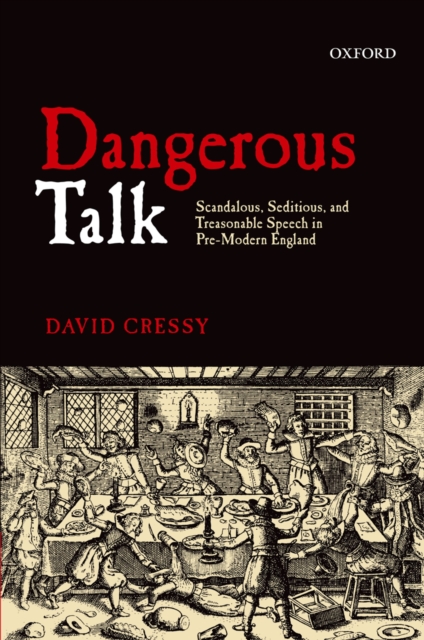
Dangerous talk : scandalous, seditious, and treasonable speech in pre-modern England
This book, filled with insults through the ages, is the full history of scurrilous political speech. Giving a voice to those gossips, rumourmongers and traitors, usually left out of history, this book examines the speech of ordinary people, who spoke scornfully of monarchs. The book reveals the lost conversations and expressions that got people into trouble, as well as unveiling moments when private words had public consequence. Although the proverb reads, ‘words were but wind’, tongues caused social damage, words challenged political authority, and treasonous speech imperilled the crown. Royals monitored talk they deemed dangerous in various ways: policing and surveillance, judicial intervention, political propaganda, and the crafting of new law. In early Tudor times, to speak ill of the monarch could risk execution, whereas by the end of the Stuart era, similar words could be dismissed with a shrug. This book traces the development of free speech across five centuries of popular political culture, and demonstrates how formerly treasonable talk, finally gained protection as ‘the birthright of an Englishman’.
eBook