
Catalogue Search | MBRL


Are you sure you want to remove the book from the shelf?

{{itemTitle}}
27,486
result(s) for
"Law Developing countries."
Sort by:


Law against the State
This collection of rich, empirically grounded case studies investigates the conditions and consequences of 'juridification' - the use of law by ordinary individuals as a form of protest against 'the state'. Starting from the actual practices of claimants, these case studies address the translation and interpretation of legal norms into local concepts, actions and practices in a way that highlights the social and cultural dynamism and multivocality of communities in their interaction with the law and legal norms. The contributors to this volume challenge the image of homogeneous and primordially norm-bound cultures that has been (unintentionally) perpetuated by some of the more prevalent treatments of law and culture. This volume highlights the heterogeneous geography of law and the ways boundaries between different legal bodies are transcended in struggles for rights. Contributions include case studies from South Africa, Malawi, Sierra Leone, Turkey, India, Papua New Guinea, Suriname, the Marshall Islands and Russia.
eBook


Lawlessness and Economics
How can property rights be protected and contracts be enforced in countries where the rule of law is ineffective or absent? How can firms from advanced market economies do business in such circumstances? InLawlessness and Economics, Avinash Dixit examines the theory of private institutions that transcend or supplement weak economic governance from the state.
In much of the world and through much of history, private mechanisms--such as long-term relationships, arbitration, social networks to disseminate information and norms to impose sanctions, and for-profit enforcement services--have grown up in place of formal, state-governed institutions. Even in countries with strong legal systems, many of these mechanisms continue under the shadow of the law. Numerous case studies and empirical investigations have demonstrated the variety, importance, and merits, and drawbacks of such institutions.
This book builds on these studies and constructs a toolkit of theoretical models to analyze them. The models shed new conceptual light on the different modes of governance, and deepen our understanding of the interaction of the alternative institutions with each other and with the government's law. For example, one model explains the limit on the size of social networks and illuminates problems in the transition to more formal legal systems as economies grow beyond this limit. Other models explain why for-profit enforcement is inefficient. The models also help us understand why state law dovetails with some non-state institutions and collides with others. This can help less-developed countries and transition economies devise better processes for the introduction or reform of their formal legal systems.
eBook


Criminal Legalities in the Global South
This edited volume presents the work of academics from the Global South and explores, from local and regional settings, how the legal order and people's perceptions of it translates into an understanding of what constitutes \"criminal\" behaviors or activities. This book aims to address the gap between criminal law in theory and practice in the Global South by assembling 11 chapters from established and emerging scholars from various underrepresented regions of the world.
Drawing on research from Singapore, the Philippines, Peru, Indonesia, India, the Dominican Republic, Burma, Brazil, Bangladesh, and Argentina, this book explores a range of issues that straddle the line between social deviance and legal crimes in such societies, including extramarital affairs, gender-based violence, gambling, LGBT issues, and corruption. Issues of inclusivity versus exclusivity, modernity versus tradition, globalization of capital versus cultural revivalism are explored. The contributions critically analyze the role politics and institutions play in shaping these issues. There is an urgent need for empirical studies and new theoretical approaches that can capture the complexity of crime phenomena that occur in the Global South. This book will provide essential material to facilitate the development of new approaches more suitable to understanding the social phenomena related to crime in these societies.
This book will make an important contribution in the development of Southern criminology. It will be of interest to students and researchers of criminology and sociology engaged in studies of sentencing and punishment, theories of crime, law and practice, and postcolonialism.
eBook

The locust effect : why the end of poverty requires the end of violence
While the world has made encouraging strides in the fight against global poverty, the hidden plague of everyday violence silently undermines our best efforts to help the poor. Common violence like rape, forced labor, illegal detention, land theft, and police abuse has become routine and relentless. And like a horde of locusts devouring everything in its path, the unchecked plague of violence ruins lives, blocks the road out of poverty, and undercuts development. Gary A. Haugen and Victor Boutros offer an account of how we got here and what it will take to end the plague.
Book

Corporate Social Responsibility, Human Rights and the Law
The control of multinational corporations is an area of law that has attracted immense attention both at national and international level. In recognition of the importance of the subject matter, the United Nations Secretary General has appointed a special representative to work in this area.
The book discusses the current trend by MNCs to self regulate by employing voluntary corporate social responsibility (CSR) strategy. Olufemi Amao argues that the CSR concept is insufficient to deal with externalities emanating from MNCs' operations, including human rights violations. Amao maintains that for CSR to be effective, the law must engage with the concept. In particular, he examines how the law can be employed to achieve this goal. While noting that the control of MNCs involves regulation at the international level, it is argued that more emphasis needs to be placed on possibilities at home, in States and host States where there are stronger bases for the control of corporations.
This book will be useful to academic scholars, students, policy makers in developing countries, UN, UN Agencies, the African Union and its agencies, the European Union and its agencies and other international policy makers.
eBook

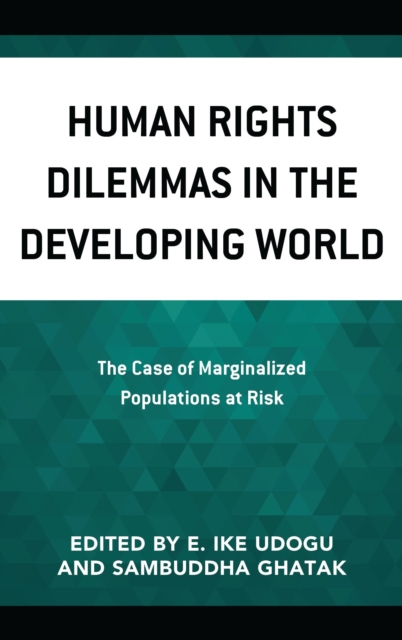
Human rights dilemmas in the developing world
This book brings the quandaries that many minority groups confront in Latin America, Asia and Africa into the limelight. The chapters in this volume-written by experts on this subject-matter-examine and provide invaluable solutions to the human rights infractions in Argentina, Brazil, Colombia, Guatemala, Mexico, India, Indonesia, Malaysia, Burundi, Central African Republic, Congo Brazzaville, Angola, Cameroon, Gabon, Nigeria and South Africa.
eBook