
Catalogue Search | MBRL


Are you sure you want to remove the book from the shelf?

{{itemTitle}}
7,206
result(s) for
"Law Europe History."
Sort by:


Homosexuality and the European Court of Human Rights
Homosexuality and the European Court of Human Rights is the first book-length study of the Court's jurisprudence in respect of sexual orientation. It offers a socio-legal analysis of the substantial number of decisions and judgments of the Strasbourg organs on the wide range of complaints brought by gay men and lesbians under the European Convention on Human Rights. Providing a systematic analysis of Strasbourg case law since 1955 and examining decades of decisions that have hitherto remained obscure, the book considers the evolution of the Court's interpretation of the Convention and how this has fashioned lesbian and gay rights in Europe. Going beyond doctrinal analysis by employing a nuanced sociological consideration of Strasbourg jurisprudence, Paul Johnson shows how the Court is a site at which homosexuality is both socially constructed and regulated. He argues that although the Convention is conceived as a 'living instrument' to be interpreted 'in the light of present-day conditions' the Court's judgments have frequently forged and advanced new social conditions in respect of homosexuality. Johnson argues that the Court's jurisprudence has an extra-legal importance because it provides an authoritative and powerful discursive resource that can be mobilized by lesbians and gay men to challenge homophobic and heteronormative social relations in contemporary societies. As such, the book considers how the Court's interpretation of the Convention might be evolved in the future to better protect lesbian and gay rights and lives.
eBook

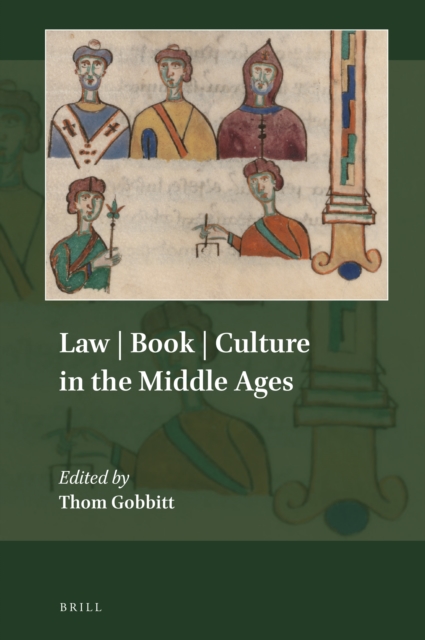
Law | Book | Culture in the Middle Ages
In Law | Book | Culture in the Middle Ages fifteen contributions are brought together, each taking a detailed view on the role of manuscripts and the written word in legal cultures and literate representations thereof. Four broad thematic approaches exploring the manuscript contexts and reception, of law and legal thought are considered: Law-Books, Law Society, Legal Practice, and Text Edition. The studies span the medieval period and reach across western and central Europe, closely considering facets of manuscript culture and legal literacies and practices from what are now Bulgaria, England, France and Germany, Iceland, Ireland, Italy, the Netherlands, Norway and Wales. Contributors are Rolf H. Bremmer, Jr., Hannah Burrows, Sonia Colafrancesco, Jan van Doren, Stefan Drechsler, Daniela Fruscione Pistoresi, Thom Gobbitt, Katherine J. Har, Lucy Hennings, Petar Parvanov, Fangzhe Dimurjan Qiu, Ben Reinhard, Sara Elin Roberts, Francesco Sangriso, and Chiara Simbolotti.
eBook
International law in the long nineteenth century (1776-1914) : from the public law of Europe to global international law?
\"International Law in the Long Nineteenth Century gathers ten studies that reflect the ever-growing variety of themes and approaches that scholars from different disciplines bring to the historiography of international law in the period. Three themes are explored: 'international law and revolutions' which reappraises the revolutionary period as crucial to understanding the dynamics of international order and law in the nineteenth century. In 'law and empire', the traditional subject of nineteenth-century imperialism is tackled from the perspective of both theory and practice. Finally, 'the rise of modern international law', covers less familiar aspects of the formation of modern international law as a self-standing discipline. Contributors are: Camilla Boisen, Raphaël Cahen, James Crawford, Ana Delic, Frederik Dhondt, Andrew Fitzmaurice, Vincent Genin, Viktorija Jakjimovska, Stefan Kroll, Randall Lesaffer, and Inge Van Hulle\"-- Provided by publisher.
Book
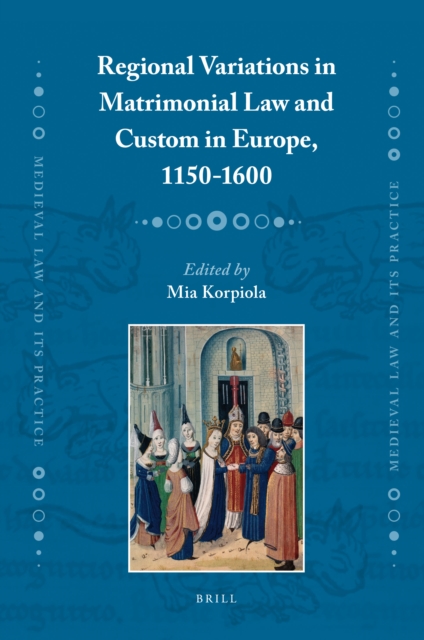
Regional Variations in Matrimonial Law and Custom in Europe, 1150-1600
The book approaches medieval marriage law and custom from a comparative perspective. Although concentrating on source material from one region, some articles discuss the regionality and universality of matrimonial practices and norms. Others compare several regions.
eBook

Law as Profession and Practice in Medieval Europe
This volume brings together papers by a group of scholars, distinguished in their own right, in honour of James Brundage. The essays are organised into four sections, each corresponding to an important focus of Brundage's scholarly work. The first section explores the connection between the development of medieval legal and constitutional thought. Thomas Izbicki, Kenneth Pennington, and Charles Reid, Jr. explore various aspects of the jurisprudence of the Ius commune, while James Powell, Michael Gervers and Nicole Hamonic, Olivia Robinson, and Elizabeth Makowski examine how that jurisprudence was applied to various medieval institutions. Brian Tierney and James Muldoon conclude this section by demonstrating two important points: modern ideas of consent in the political sphere and fundamental principles of international law attributed to sixteenth century jurists like Hugo Grotius have deep roots in medieval jurisprudential thought. Patrick Zutshi, R. H. Helmholz, Peter Landau, Marjorie Chibnall, and Edward Peters have written essays that augment Brundage's work on the growth of the legal profession and how traces of a legal education began to emerge in many diverse arenas. The influence of legal thinking on marriage and sexuality was another aspect of Brundage's broad interests. In the third section Richard Kay, Charles Donahue, Jr., and Glenn Olsen explore the intersection of law and marriage and the interplay of legal thought on a central institution of Christian society. The contributions of Jonathan Riley-Smith and Robert Somerville in the fourth section round-out the volume and are devoted to Brundage's path-breaking work on medieval law and the crusading movement. The volume also includes a comprehensive bibliography of Brundage's work.
Kenneth Pennington is Kelly-Quinn Professor of Ecclesiastical and Legal History at The Catholic University of America, USA; Melodie Harris Eichbauer is Assistant Professor of Medieval History, History Department, Florida Gulf Coast University, Fort Myers, USA
eBook


Law and Language in the Middle Ages
Law and Language in the Middle Ages investigates the relationship between law and legal practice from the linguistic perspective, exploring not only how legal language expresses and advances power relations but also how the language of law legitimates power.; Readership: With its disciplinary approach, and chronological and geographical range, this volume will be of interest to scholars and students of law, history, medieval languages, translation studies and digital humanities.
eBook