
Catalogue Search | MBRL


Are you sure you want to remove the book from the shelf?

{{itemTitle}}
267
result(s) for
"Law Translating."
Sort by:


Corpus-based Translation of Private Legal Documents
Legal translation is hallmarked by peculiarities revolving around language intricacies, particular formulae, and system-specificity issues. At present, there is a spectrum of legal corpora dedicated to court-related topics and legislation, but there is no corpus composed of private legal documents such as contracts and agreements. This book wishes to bridge this gap by providing English-Italian comparable corpora related to the domain of (general) terms and conditions of service, together with a model for their use in the translation classroom. It offers a novel contribution to the scientific community as it makes corpora of private legal documents available for consultation. In addition, it shows that legal corpora built by following rigorous methods can become reliable tools in translator training and, most likely, in translation practice. This book is for students in Translation Studies, professional translators, researchers and scholars in legal language and legal translation, as well as legal practitioners and lawyers.
eBook


Research Methods in Legal Translation and Interpreting
The field of Legal translation and interpreting has strongly expanded over recent years. As it has developed into an independent branch of Translation Studies, this book advocates for a substantiated discussion of methods and methodology, as well as knowledge about the variety of approaches actually applied in the field. It is argued that, complex and multifaceted as it is, legal translation calls for research that might cross boundaries across research approaches and disciplines in order to shed light on the many facets of this social practice. The volume addresses the challenge of methodological consolidation, triangulation and refinement. The work presents examples of the variety of theoretical approaches which have been developed in the discipline and of the methodological sophistication which is currently being called for. In this regard, by combining different perspectives, they expand our understanding of the roles played by legal translators and interpreters, who emerge as linguistic and intercultural mediators dealing with a rich variety of legal texts; as knowledge communicators and as builders of specialised knowledge; as social agents performing a socially-situated activity; as decision-makers and agents subject to and redefining power relations, and as political actors shaping legal cultures and negotiating cultural identities, as well as their own professional identity.
Chapter 2 of this book is freely available as a downloadable Open Access PDF under a Creative Commons Attribution-Non Commercial-No Derivatives 4.0 license. https://tandfbis.s3-us-west-2.amazonaws.com/rt-files/docs/Open+Access+Chapters/9781138492103_oachapter2.pdf
eBook

Interpreter-mediated police interviews
\"This book shows how the participation of interpreters as mediators changes the dynamics of police interviews, particularly with regard to power struggles and competing versions of events. Employing a range of approaches including conversation analysis, interactional sociolinguistics and legal narrative theory, Interpreter-mediated Police Interviews provides a detailed study of the impact of interpreter mediation on this area of the justice system. It reveals how turn-by-turn decisions of communication by all three participants, including the interpreter, affect the trajectory of the institutional discourse. By providing a better understanding of police interview discourse and exploring the practical implications of interpreter participation, this book contributes to the improvement of interpreter-mediated investigative interviews and will be of great interest to legal professionals as well as interpreters and their trainers\"-- Provided by publisher.
BOOK
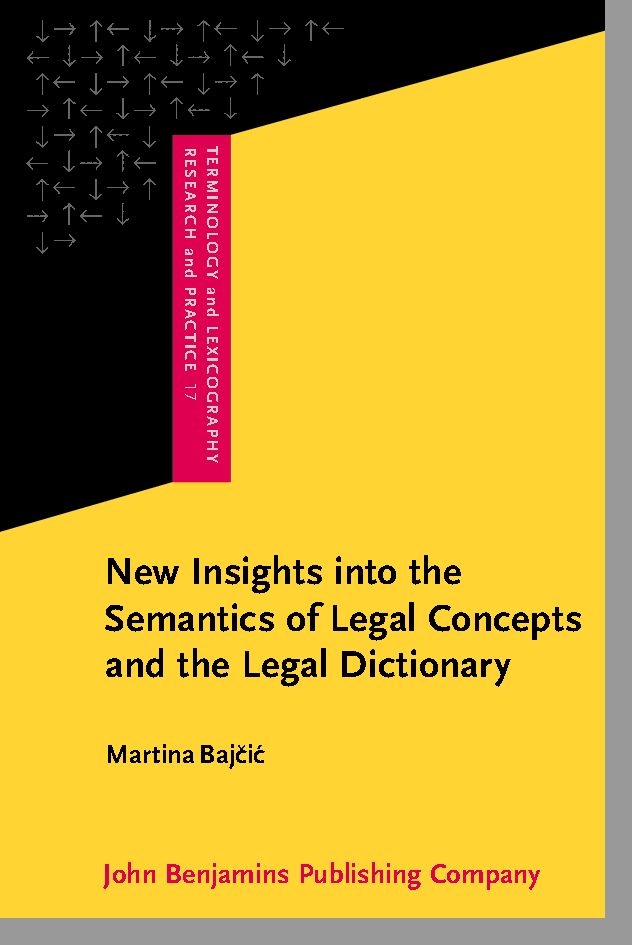
New Insights into the Semantics of Legal Concepts and the Legal Dictionary
This book focuses on legal concepts from the dual perspective of law and terminology. While legal concepts frame legal knowledge and take center stage in law, the discipline of terminology has traditionally been about concept description. Exploring topics common to both disciplines such as meaning, conceptualization and specialized knowledge transfer, the book gives a state-of-the-art account of legal interpretation, legal translation and legal lexicography with special emphasis on EU law. The special give-and-take of law and terminology is illuminated by real-life legal cases which demystify the ways courts do things with concepts. This original approach to the semantics of legal concepts is then incorporated into the making of a legal dictionary, thus filling a gap in the theory and practice of legal lexicography. With its rich repertoire of examples of legal terms in different languages, the book provides a blend of theory and practice, making it a valuable resource not only for scholars of law, language and lexicography but also for legal translators and students.
eBook

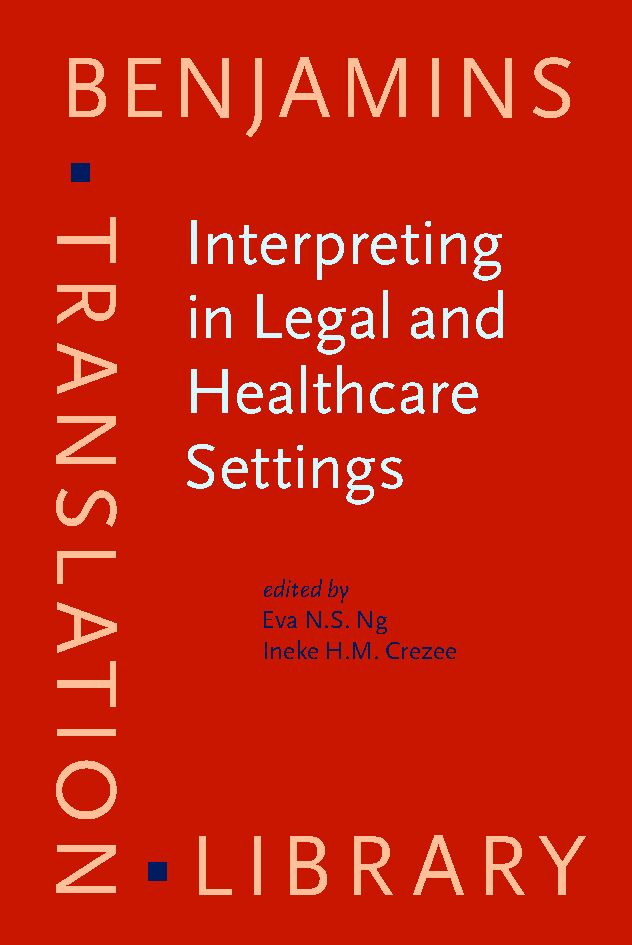
Interpreting in legal and healthcare settings : perspectives on research and training
The importance of quality interpreting in legal and healthcare settings can never be stressed enough, when any mistake - no matter how small - can compromise the delivery of justice or put someone's health at risk. This book addresses issues arising from interpreting in legal and healthcare settings by presenting cutting-edge research findings in interpreting and interpreter education in a number of countries around the world - including those which are relatively new to the field. It contains selected papers from a conference dedicated to such themes - the First International Conference on Legal and Healthcare Interpreting - as well as other invited papers related to the fields of legal and healthcare interpreting. This book is useful not only to scholars and educators, interpreters and translators working in legal or healthcare settings, but also to legal and healthcare professionals who work with interpreters in their day-to-day work, including judges, lawyers, police officers, doctors, midwives and nurses.
eBook

Towards the Professionalization of Legal Translators and Court Interpreters in the EU
The profession of legal translators and interpreters has been unjustly neglected despite its relevant role in international and multilingual legal settings. In order to bridge this gap, this volume brings together contributions from some of the leading experts in the field, including not only scholars, but also internationally acclaimed professional legal translators and interpreters. Coming from different EU Member States, the contributors address the status quo of the profession of legal translators and interpreters within their respective states, while proposing ways to raise the standards of the profession. In particular, effort is made to make the profession more uniform Union-wide in terms of training and accreditation of legal translators and interpreters and quality of their services. Topics covered include ISO standards for interpreting services in judicial settings, EULITA, Directive 2010/64/EU on the right to translation and interpretation in criminal proceedings, legal translation, translation of multilingual EU legislation, document translation, whispered interpreting, and the need to introduce uniform programmes for the education and training of legal translators and interpreters. Offering a mix of theory and practice, the book will appeal to scholars, practitioners and students with a special interest in legal translation and interpretation in the EU.
eBook