
Catalogue Search | MBRL


Are you sure you want to remove the book from the shelf?

{{itemTitle}}
141
result(s) for
"Law and literature -- History -- 17th century"
Sort by:


Shakespeare’s Imaginary Constitution
Through an examination of six plays by Shakespeare, the author presents an innovative analysis of political developments in the last decade of Elizabethan rule and their representation in poetic drama of the period. The playhouses of London in the 1590s provided a distinctive forum for discourse and dissemination of nascent political ideas. Shakespeare exploited the unique capacity of theatre to humanise contemporary debate concerning the powers of the crown and the extent to which these were limited by law. The autonomous subject of law is represented in the plays considered here as a sentient political being whose natural rights and liberties found an analogue in the narratives of common law, as recorded in juristic texts and law reports of the early modern era. Each chapter reflects a particular aspect of constitutional development in the late-Elizabethan state. These include abuse of the royal prerogative by the crown and its agents; the emergence of a politicised middle class citizenry, empowered by the ascendancy of contract law; the limitations imposed by the courts on the lawful extent of divinely ordained kingship; the natural and rational authority of unwritten lex terrae; the poetic imagination of the judiciary and its role in shaping the constitution; and the fusion of temporal and spiritual jurisdiction in the person of the monarch. The book advances original insights into the complex and agonistic relationship between theatre, politics, and law. The plays discussed offer persuasive images both of the crown’s absolutist tendencies and of alternative polities predicated upon classical and humanist principles of justice, equity, and community. ‘It is now canon in progressive U.S. legal scholarship that to focus solely on the text of our Constitution is myopic. We look as well for “constitutional moments”, moments when the zeitgeist is so transformed that our fundamental legal charter changes with it. In this breathtakingly erudite book, Paul Raffield argues that the late-Elizabethan period was such a “constitutional moment” in England, a moment literally “played out” for the polity by the greatest dramatist of all time. A lawyer and a thespian, Raffield handles both legal and literary sources with exquisite care. As with the works of the Old Masters, one dwells pleasurably on each detail until their cumulative force presses one backward to see the canvas in its sudden, glorious entirety. A major achievement.’ Kenji Yoshino Chief Justice Earl Warren Professor of Constitutional Law, NYU School of Law
eBook

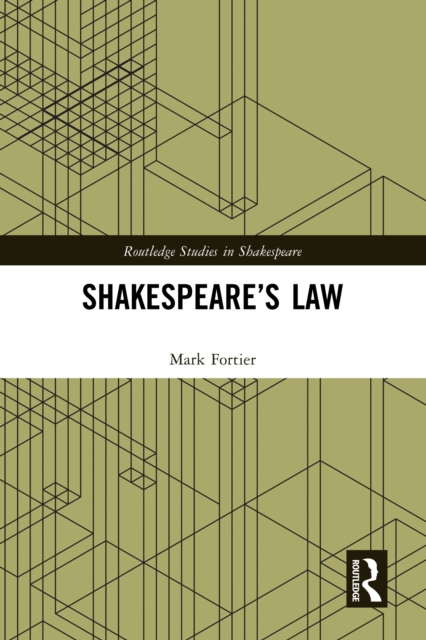
Shakespeare's Law
Shakespeare's Law is a critical overview of law and legal issues within the life, career, and works of William Shakespeare as well as those that arise from the endless array of activities that happen today in the name of Shakespeare. Mark Fortier argues that Shakespeare's attitudes to law are complex and not always sanguine, that there exists a deep and perhaps ultimate move beyond law very different from what a lawyer or legal scholar might recognize.
Fortier looks in detail at the legal issues most prominent across Shakespeare's work: status, inheritance, fraud, property, contract, tort (especially slander), evidence, crime, political authority, trials, and the relative value of law and justice. He also includes two detailed case studies, of The Merchant of Venice and Measure for Measure, as well as a chapter looking at law in works by Shakespeare's contemporaries. The book concludes with a chapter on the law as it relates to Shakespeare today.
The book shows that the legal issues in Shakespeare are often relevant to issues we face now, and the exploration of law in Shakespeare is as germane today, though in sometimes new ways, as in the past.
eBook


Shakespeare and the law
In July 2007, the School of Law at the University of Warwick hosted an international conference on 'Shakespeare and the Law'. This was a truly interdisciplinary event, which included contributions from eminent speakers in the fields of English, history, theatre and law. The intention was to provide a congenial forum for the exploration, dissemination and discussion of Shakespeare's evident fascination with and knowledge of law, and its manifestation in his works.
eBook

Theaters of Pardoning
From Gerald Ford's preemptive pardon of Richard Nixon and Donald Trump's claims that as president he could pardon himself to the posthumous royal pardon of Alan Turing, the power of the pardon has a powerful hold on the political and cultural imagination. InTheaters of Pardoning, Bernadette Meyler traces the roots of contemporary understandings of pardoning to tragicomic \"theaters of pardoning\" in the drama and politics of seventeenth-century England. Shifts in how pardoning was represented on the stage and discussed in political tracts and in Parliament reflected the transition from a more monarchical and judgment-focused form of the concept to an increasingly parliamentary and legislative vision of sovereignty.
Meyler shows that on the English stage, individual pardons of revenge subtly transformed into more sweeping pardons of revolution, from Shakespeare's Measure for Measure, where a series of final pardons interrupts what might otherwise have been a cycle of revenge, to later works like John Ford'sThe Laws of Candy and Philip Massinger's The Bondman, in which the exercise of mercy prevents the overturn of the state itself. In the political arena, the pardon as a right of kingship evolved into a legal concept, culminating in the idea of a general amnesty, the \"Act of Oblivion,\" for actions taken during the English Civil War. Reconceiving pardoning as law-giving effectively displaced sovereignty from king to legislature, a shift that continues to attract suspicion about the exercise of pardoning. Only by breaking the connection between pardoning and sovereignty that was cemented in seventeenth-century England, Meyler concludes, can we reinvigorate the pardon as a democratic practice.
eBook

Lines of Equity
The late seventeenth century was a period of major crises in science, politics, and economics in England. Confronted by a public that seemed to be sunk in barbarism and violence, English writers including John Milton, John Dryden, and Aphra Behn imagined serious literature as an instrument for change. InLines of Equity, Elliott Visconsi reveals how these writers fictionalized the original utterance of laws, the foundation of states, and the many vivid contemporary transitions from archaic savagery to civil modernity.
In their writings, they considered the nature of government, the extent of the rule of law, and the duties of sovereign and subject. They asked their audience to think like kings and judges: through the literary education of the individual conscience, the barbarous tendencies of the English people might be effectively banished. Visconsi calls this fictionalizing program \"imaginative originalism,\" and demonstrates the often unintended consequences of this literary enterprise.
By inviting the English people to practice equity as a habit of thought, a work such as Milton'sParadise Losthelped bring into being a mode of individual conduct-the rights-bearing deliberative subject-at the heart of political liberalism. Visconsi offers an original view of this transitional moment that will appeal to anyone interested in the cultural history of law and citizenship, the idea of legal origins in the early modern period, and the literary history of later Stuart England.
eBook

Marriage and Land Law in Shakespeare and Middleton
Marriage and Land Law in Shakespeare and Middleton examines the dynamics of early modern marriage-making, a time-honored practice that was evolving, often surreptitiously, from patriarchal control based on money and inheritance, to a companionate union in which love and the couple’s own agency played a role. Among early modern playwrights, the marriage plays of Shakespeare and Middleton are particularly, though not uniquely, concerned with this evolution, observing the movement towards spousal choice determined by the couple themselves. Through the late Elizabethan and early Jacobean period, the role of the patriarch, though often compromised, remained intact: the father or guardian negotiated the financial terms. And, in a culture that was still tied to feudal practices, land law held a primary place in the bargain. This book, while following the arc of changing marriage practices, focuses on the ways in which the oldest determination of status, land, affects marital decisions. Land is not a constant topic of conversation in the twenty-one theatrical marriages scrutinized here, but it is a persistent and omnipresent truth of family and economic life. In paired discussions of marriage plays by Shakespeare and Middleton—The Taming of the Shrew/A Chaste Maid in Cheapside, All’s Well That Ends Well/A Trick To Catch the Old One, Measure for Measure/A Mad World, My Masters, The Merchant of Venice/The Roaring Girl, and Much Ado About Nothing/No Wit, No Help Like A Woman’s—this book explores the attempts, maneuvers, intrigues, ruses, and schemes that marriageable characters deploy in order to control spousal choice and secure land. Special attention is given to patriarchal figures whose poor judgment exploits inheritance law weaknesses and to the lack of legal protection and hence the vulnerability of women—and men—who engage the system in unconventional ways. Investigation into the milieu of early modern patriarchal influence in marriage-making and the laws governing inheritance practices enables a fresh reading of Shakespeare’s and Middleton’s marriage comedies.
eBook

Taking Exception to the Law
Taking Exception to the Law explores how a range of early modern English writings responded to injustices perpetrated by legal procedures, discourses, and institutions. From canonical poems and plays to crime pamphlets and educational treatises, the essays engage with the relevance and wide appeal of legal questions in order to understand how literature operated in the early modern period.
Justice in its many forms – legal, poetic, divine, natural, and customary – is examined through insightful and innovative analyses of a number of texts, including The Merchant of Venice , The Faerie Queene , and Paradise Lost . A major contribution to the growing field of law and literature, this collection offers cultural contexts, interpretive insights, and formal implications for the entire field of English Renaissance culture.
eBook