
Catalogue Search | MBRL


Are you sure you want to remove the book from the shelf?

{{itemTitle}}
5
result(s) for
"Law and literature-History-18th century"
Sort by:

Civic longing : the speculative origins of U.S. citizenship
Citizenship defines the U.S. political experiment, but the modern legal category that it now names is a relatively recent invention. There was no Constitutional definition of citizenship until the ratification of the Fourteenth Amendment in 1868, almost a century after the Declaration of Independence. Civic Longing looks at the fascinating prehistory of U.S. citizenship in the years between the Revolution and the Civil War, when the cultural and juridical meaning of citizenship--as much as its scope--was still up for grabs. Carrie Hyde recovers the numerous cultural forms through which the meaning of citizenship was provisionally made and remade in the early United States. Civic Longing offers the first historically grounded account of the formative political power of the imaginative traditions that shaped early debates about citizenship. In the absence of a centralized legal definition of citizenship, Hyde shows, politicians and writers regularly turned to a number of highly speculative traditions--political philosophy, Christian theology, natural law, fiction, and didactic literature--to authorize visions of what citizenship was or ought to be. These speculative traditions sustained an idealized image of citizenship by imagining it from its outer limits, from the point of view of its \"negative civic exemplars\"--expatriates, slaves, traitors, and alienated subjects. By recovering the strange, idiosyncratic meanings of citizenship in the early United States, Hyde provides a powerful critique of originalism, and challenges anachronistic assumptions that read the definition of citizenship backward from its consolidation in the mid-nineteenth century as jus soli or birthright citizenship.-- Provided by publisher
Book

Women, Property, and the Letters of the Law in Early Modern England
Women, Property, and the Letters of the Law in Early Modern Englandexamines the competing narratives of property told by and about women in the early modern period. Through letters, legal treatises, case law, wills, and works of literature, the contributors explore women's complex roles as subjects and agents in commercial and domestic economies, and as objects shaped by a network of social and legal relationships. By constructing conversations across the disciplinary boundaries of legal and social history, sociology and literary criticism, the collection explores a diverse range of women's property relationships.
Recent research has revealed fissures in our knowledge about women's property relationships within a regime characterized by competing jurisdictions, diverse systems of tenure, and multiple concepts of property.Women, Property, and the Letters of the Law in Early Modern Englandturns to these points of departure for the study of women's legal status and property relationships in the early modern period. This interdisciplinary analysis of women and property is written in an accessible manner and will become a valuable resource for scholars and students of Renaissance, Restoration and eighteenth-century literature, early modern social and legal history, and women's studies.
eBook
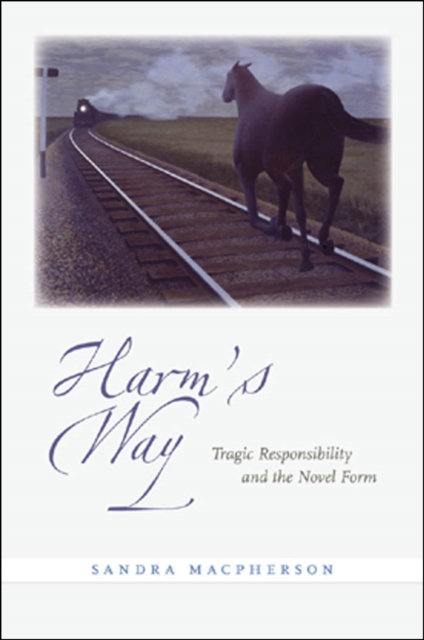
Harm's way : tragic responsibility and the novel form
A field-defining study of the novel as a tragic form. Sandra Macpherson's groundbreaking study of the rise of the novel connects its form to developments in liability law across the seventeenth to nineteenth centuries. In particular, Macpherson argues for a connection to legal principles of strict liability that hold persons accountable for harms inflicted upon others in the absence of intention, consent, direct action, or foreknowledge. In convincing polemical readings of Defoe, Richardson, and Fielding, she shows that these laws share with the novel the view that the state of a person's mind is irrelevant to the question of her responsibility for her actions. Macpherson urges readers to rethink the ancient consensus that the novel differs from tragedy in its elevation of character over plot. She concludes that the realist novel is ultimately a tragic form, committed to holding persons accountable for accidents of fate. Macpherson's original insights continue to have a broad and lasting impact on the study of the novel.
eBook

The Use of Censorship in the Enlightenment
Taking an interdisciplinary approach to the topic, this volume studies the role censorship played in the intellectual culture of the seventeenth and eighteenth centuries, how it was implemented, and how it affected the development philosophy and literary writing.
eBook

The Afterlife of Character, 1726-1825
The Afterlife of Character, 1726-1825 reconstructs how eighteenth-century British readers invented further adventures for beloved characters, including Gulliver, Falstaff, Pamela, and Tristram Shandy. Far from being close-ended and self-contained, the novels and plays in which these characters first appeared were treated by many as merely a starting point, a collective reference perpetually inviting augmentation through an astonishing wealth of unauthorized sequels. Characters became an inexhaustible form of common property, despite their patent authorship. Readers endowed them with value, knowing all the while that others were doing the same and so were collectively forging a new mode of virtual community.By tracing these practices, David A. Brewer shows how the literary canon emerged as much \"from below\" as out of any of the institutions that have been credited with their invention. Indeed, he reveals the astonishing degree to which authors had to cajole readers into granting them authority over their own creations, authority that seems self-evident to a modern audience.In its innovative methodology and its unprecedented attention to the productive interplay between the audience, the book as a material artifact, and the text as an immaterial entity, The Afterlife of Character, 1726-1825 offers a compelling new approach to eighteenth-century studies, the history of the book, and the very idea of character itself.
eBook