
Catalogue Search | MBRL


Are you sure you want to remove the book from the shelf?

{{itemTitle}}
1,811
result(s) for
"League of Nations."
Sort by:


The British people and the League of Nations
In the decades following Europe’s first total war, millions of British men and women looked to the League of Nations as the symbol and guardian of a new world order based on international co-operation. Founded in 1919 to preserve peace between its member-states, the League inspired a rich, participatory culture of political protest, popular education and civic ritual which found expression through the establishment of voluntary societies in dozens of countries across Europe and beyond. Embodied in the hugely popular League of Nations Union, this pro-League movement touched Britain in profound ways. Foremost amongst the League societies, the Union became one of Britain’s largest voluntary associations and a powerful advocate of democratic accountability and popular engagement in the making of foreign policy. Based on extensive archival research, The British people and the League of Nations offers a vivid account of this popular League consciousness and in so doing reveals the vibrant character of associational life between the wars.
eBook

British people and the League of Nations
In the decades following Europe’s first total war, millions of British men and women looked to the League of Nations as the symbol and guardian of a new world order based on international co-operation. Founded in 1919 to preserve peace between its member-states, the League inspired a rich, participatory culture of political protest, popular education and civic ritual which found expression through the establishment of voluntary societies in dozens of countries across Europe and beyond. Embodied in the hugely popular League of Nations Union, this pro-League movement touched Britain in profound ways. Foremost amongst the League societies, the Union became one of Britain’s largest voluntary associations and a powerful advocate of democratic accountability and popular engagement in the making of foreign policy. Based on extensive archival research, The British people and the League of Nations offers a vivid account of this popular League consciousness and in so doing reveals the vibrant character of associational life between the wars.
eBook


Who Elected the Bankers?
A former banker and staff member of the International Monetary Fund, Louis W. Pauly explains why people are deeply concerned about the emergence of a global economy and the increasingly integrated capital markets at its heart. In nations as diverse as France, Canada, Russia, and Mexico, the lives of citizens are disrupted when national policy falls out of line with the expectations of international financiers. Such dilemmas, ever more conspicuous around the world, arise from the disjuncture between a rapidly changing international economic system and a political order still constituted by sovereign states. The evolution of global capital markets inspires an understandable fear among people that the governing authorities accountable to them are losing the power to make substantive decisions affecting their own material prospects and those of their children. Pauly points out that today's capital markets resulted from decisions taken over many years by sovereign states, and particularly by the leading industrial democracies, who simultaneously crafted the instrument of multilateral economic surveillance. The effort to build adequate political foundations for global capital markets spans the twentieth century and links the histories of such institutions as the League of Nations, the International Monetary Fund, the European Union, and the Group of Seven.
eBook

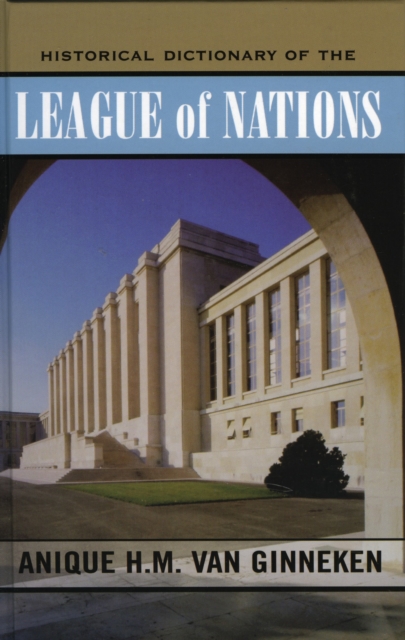
Historical dictionary of the League of Nations
Created in 1919, shortly after World War I, the League of Nations was principally designed to put an end to war. But it went into hibernation when World War II broke out, and was formally wound up in 1946. Not having achieved its primary objective, it was deemed a failure. However, the many accomplishments it did realize certainly allows for arguments against this idea. During its two-decade existence, the League of Nations resolved and defused many conflicts and crises, as well as established a rapport among its members. It was also active in many other political, social, and technical fields, including minorities, refugees, human rights, labor, health, telecommunications, and supervision of former colonial territories, which had become mandates. Above all, the League of Nations proved to be training ground for the United Nations and the countless other organizations, both governmental and non-governmental, which now surround us. Just what the League of Nations was able to do during its brief but hectic career is summed up in this book. The dictionary section contains several hundred cross-referenced entries on its founders and supporters, its rather small staff and secretariat, the various subordinate or related organizations, and their overwhelming tasks. The historical background is described in the introduction and plotted year by year in the chronology while the bibliography points to further reading.
eBook

Fascist Italy and the League of Nations, 1922-1935
\"This book analyses the relationship between Fascist Italy and the League of Nations in the interwar years. By uncovering the traces of those Italians working in the organization, this volume investigates Fascist Italy's membership of the League, and explores the dynamics between nationalism and internationalism in Geneva. The relationship between Fascist Italy and the League of Nations was contradictory, shifting from active collaboration to open disagreement. Previous literature has not reflected this oscillation in policy, focusing disproportionally on the problems Italy caused for the League, such as the Ethiopian crisis. Yet Fascist Italy remained in the League for more than fifteen years, and was the third largest power within the institution. How did a Fascist dictatorship fit into an organization espousing principles of liberal internationalism? By using archival sources from four countries, Elisabetta Tollardo shows that Fascist Italy was much more concerned with, and involved in, the League than currently believed\"--Bcak cover.
Book
The Versailles Treaty and its Legacy
This study, a realist interpretation of the long diplomatic record that produced the coming of World War II in 1939, is a critique of the Paris Peace Conference and reflects the judgment shared by many who left the Conference in 1919 in disgust amid predictions of future war. The critique is a rejection of the idea of collective security, which Woodrow Wilson and many others believed was a panacea, but which was also condemned as early as 1915. This book delivers a powerful lesson in treaty-making and rejects the supposition that treaties, once made, are unchangeable, whatever their faults.
eBook