
Catalogue Search | MBRL


Are you sure you want to remove the book from the shelf?

{{itemTitle}}
4,039
result(s) for
"Lean, David"
Sort by:

David Lean
'A rule of mine is this', said William Goldman in 1983, 'there are always three hot directors and one of them is always David Lean.' One of the best known and most admired of British film makers, David Lean had a directorial career that spanned five decades and encompassed everything from the intimate black-and-white romance of Brief Encounter (1945) to the spectacular Technicolor epic of Lawrence of Arabia (1962). This book offers comprehensive coverage of every feature film directed by Lean, yielding new insights on the established classics of his career as well as its lesser-known treasures. Its analysis prioritises questions of gender and emphasises the often-overlooked but highly significant recurrence of female-centred narratives throughout Lean's career. Drawing extensively on archival historical materials while also presenting nuanced close readings of individual films, David Lean offers a fascinating and original account of the work of a remarkable British film maker.
eBook

To Have and to Hold: The Possessive Spectator, the Spinster Narrative, and Katharine Hepburn in David Lean’s Summertime (1955)
Since the cinematic experience is so ephemeral, it has always been difficult to hold on to its precious moments, images and, most particularly, its idols . . . . the desire to possess and hold the elusive image led to repeated viewing, a return to the cinema to watch the same film over and over again . . [...]Starring Katharine Hepburn\" examines Katharine Hepburn's star persona in the mid-1950s, which complicates what at first seems to be a clichéd portrayal of an American spinster finding love abroad in the mid-1950s. On other fronts, the postwar market for American film exports was, in theory, high in some European countries now that wartime embargoes had been lifted, but those countries' currencies were often either nonexistent or so unstable that they had no real method to pay Hollywood film companies in ways that would show as profit in accounting ledgers, as Shandley points out (8). [...]because the United States controlled such a large percentage of the world's economy immediately after the war, some countries wanted to hang on to the few dollars they possessed in order to pay for essential commodities-hence \"the freezing of earnings generated by American companies so that such earnings had to be reinvested in the national economies rather than removed in the form of dollars\" (Shandley 8-9). [...]Shandley's title Runaway Romances has a double meaning, in the sense that it refers both to those Hollywood productions that migrated to Europe and to the runaway romance's narrative convention, which usually involves an American (male or female) traveler away from home becoming romantically involved with a European, almost always on a temporary basis.
Journal Article

From Kankakee to Venice: Postwar American Travel Consumerism in David Lean's Summertime (1955)
David Lean's Summertime (1955) marks a notable departure from his earlier study in conflicted romance, Brief Encounter (1945), for that black-and-white film, with its grimy wartime atmosphere and claustrophobic camera angles, contrasts with the evocative location work in Venice and vivid Technicolor cinematography.1 Summertime is also significant for the substitution of Lean's distinctly English characters with candidly American personalities who evince typical directness while navigating their Italian vacations. Two such Americans are Lloyd and Edith McIIhenny of Kankakee, Illinois, whom we first encounter on a vaporetto water taxi exchanging pleasantries with the film's protagonist, Jane Hudson. All three have travelled by ocean liner or aircraft to partake in the splendor of Venice. Their shared experiences, the similarities and marked differences, offer clues to postwar travel consumerism. As historian Jan Morris notes, Americans emerged from the Second World War with a new sense of optimism and purpose.2 Gone were the economic tribulations and self-doubt of the Great Depression as wartime investments had rejuvenated the nation and bolstered confidence. For many Americans, the defeat of the Axis powers had reinforced the preeminence of their way of life, a model premised on consumerism - the liberty to purchase both material goods and, to a larger extent, life experiences. For all the outward superiority of the American way of life, this film reveals the cultural and emotional shallowness that undermines assumptions of superpower status. On a personal level, the tourists must individually address the torment with loneliness for lives that, in many respects, remain unfulfilled. The question would be if this European adventure would help assuage a persistent and shared sense of regret.
Journal Article

Intermediary and Transmedial Thanatography in Jacobo Fernandez Serrano's Lois Pereiro: Breve encontro
In 2011, the poet Lois Pereiro (1958-1996) was honoured at the annual Dia das Letras Galegas (Galician Literature Day). The Galician publishing industry released a plethora of texts about Pereiro, including Jacobo Fernandez Serrano's comics biography Lois Pereiro: Breve encontro. This article examines the comic as an intermedial text that captures the influence of literature, films, music and comics in Pereiro's own writing. Furthermore, it is analysed as part of a transmedial network, together with other biographies published around the Dia das Letras. These texts address the role played by death in the poet's life and work (as he died at an early age of rapeseed oil poisoning and AIDS), and they can therefore be understood as 'thanatographies' as much as life writing. Keywords: banda desenada, comics biography, intermediality, Lois Pereiro, thanatography, transmediality
Journal Article
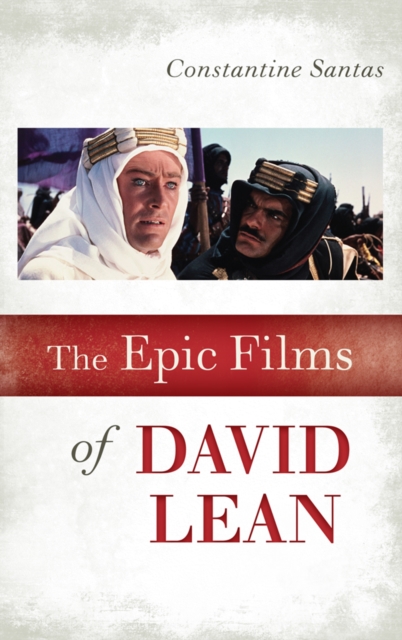
The epic films of David Lean
Widely regarded as one of cinema's most accomplished directors, David Lean helmed such classics as Brief Encounter, Great Expectations, and Oliver Twist. He twice received the Academy Award for best director, and two of his films, The Bridge on the River Kwai and Lawrence of Arabia won the Oscar for best picture. Both are featured on the American Film Institute's Top 100, with Lawrence of Arabia at number seven. Despite the awards and accolades for these motion pictures, many critics often look more favorably upon the smaller films that Lean produced earlier in his career, and in recent years his reputation as a director has diminished. In this study, Constantine Santas seeks to restore these now undervalued epics to the elevated esteem they once held. Without dismissing the earlier works or regarding them as irrelevant to Lean's evolution as an artist, this book shows that the epics, if analyzed from certain vantage points, are as worthy as any of Lean's previous films. In addition to Lean's Academy-Award-winning blockbusters, Santas also provides close analytical looks at Doctor Zhivago, Ryan's Daughter, and the director's final film, A Passage to India. Santas argues that the epics show a progression and refinement of Lean's work and that they are thematically broader and feature more complex characterization than his earlier films. In his analyses, Santas provides background material on the production of each epic; insights into structure, characters, techniques, and themes; and a look into the relationship between the films and their literary sources. Written in a clear and engaging manner, The Epic Films of David Lean will appeal not only to cinema students and scholars but also to the general fan of David Lean and his work.
eBook


David Lean
David Lean has been characterised as a director of highly romantic disposition whose films offer a vision of 'the romantic sensibility attempting to reach beyond the restraints and constrictions of everyday life'. This book proposes new perspectives on the work of David Lean and offers a fuller and more varied appreciation of his manifold achievements as a filmmaker. In so doing, the book makes interventions in wider academic debates around authorship, gender, genre and aesthetics in relation to the British cinema and transnational cinema of British cultural inheritance of which Lean was such a remarkable exponent. It first deals with Lean's early career, covering his entry into the film industry and flourishing formative years as an editor, honing skills, and his official entry into direction. It then examines Lean's four forays into the nineteenth century, encompassing his two Dickens adaptations as well as his two later Victorian dramas, both centred on rebellious females. Each film presents a vivid instance of the twentieth century in the process of 'inventing the Victorians'; put together, the quartet of films show how perceptions began to change during the pivotal postwar year. The book also focuses on the gender by focusing on a trio of films about women in love and three films centred on male visionaries.
eBook

Beyond the Epic
Two-time Academy Award winner Sir David Lean (1908--1991) was one of the most prominent directors of the twentieth century, responsible for the classics The Bridge on the River Kwai (1957), Lawrence of Arabia (1962), and Doctor Zhivago (1965). British-born Lean asserted himself in Hollywood as a major filmmaker with his epic storytelling and panoramic visions of history, but he started out as a talented film editor and director in Great Britain. As a result, he brought an art-house mentality to blockbuster films. Combining elements of biography and film criticism, Beyond the Epic: The Life and Films of David Lean uses screenplays and production histories to assess Lean's body of work. Author Gene D. Phillips interviews actors who worked with Lean and directors who knew him, and their comments reveal new details about the director's life and career. Phillips also explores Lean's lesser-studied films, such as The Passionate Friends (1949), Hobson's Choice (1954), and Summertime (1955). The result is an in-depth examination of the director in cultural, historical, and cinematic contexts. Lean's approach to filmmaking was far different than that of many of his contemporaries. He chose his films carefully and, as a result, directed only sixteen films in a period of more than forty years. Those films, however, have become some of the landmarks of motion-picture history. Lean is best known for his epics, but Phillips also focuses on Lean's successful adaptations of famous works of literature, including retellings of plays such as Brief Encounter (1945) and novels such as Great Expectations (1946), Oliver Twist (1948), and A Passage to India (1984). From expansive studies of war and strife to some of literature's greatest high comedies and domestic dramas, Lean imbued all of his films with his unique creative vision. Few directors can match Lean's ability to combine narrative sweep and psychological detail, and Phillips goes beyond Lean's epics to reveal this unifying characteristic in the director's body of work. Beyond the Epic is a vital assessment of a great director's artistic process and his place in the film industry.
eBook

David Lean's Lawrence: \Only flesh and blood\
Is it accurate ? I find it rather surprising that so few people have asked the question of David Lean's justly celebrated film Lawrence of Arabia. As historian Jeremy Wilson has observed, for every person who has read T. E. Lawrence s own Seven Pillars of Wisdom, there are hundreds, possibly thousands that have seen Lean's film and take it as a true picture of Lawrence and the Arab revolt. Anyone interested can read his point-by-point examination of the screenplay's flaws - the skewing of facts, character assassination, misplacing of events out of proper time frame, and outright falsification - which mount with the examination, building a case so damning of Bolt's (and Lean's) myopic vision and ulterior motives that those who ever regarded the film as history must revise their opinions.
Journal Article

Unfinished business: Michael Wilson's \“Seven Pillars of Wisdom\” screenplay
Michael Wilson, a blacklisted expatriate American screenwriter, had received no credit for his work on the screenplay of David Lean and Sam Spiegel's worldwide success, The Bridge on the River Kwai. This paper describes Wilson's subsequent work for Spiegel and Lean on an adaptation of T.E. Lawrence's Seven Pillars of Wisdom. Differences with Lean over story direction on what would become Lawrence of Arabia eventually led to Wilson's departure and replacement by Robert Bolt. Although his contributions to the script were officially hidden, Wilson successfully appealed to the British Writers' Guild in a screen credit arbitration. But not until three decades later after the film's release was his credit formally acknowledged in the United States.
Journal Article