
Catalogue Search | MBRL


Are you sure you want to remove the book from the shelf?

{{itemTitle}}
314
result(s) for
"Learning Western countries."
Sort by:

Cultural foundations of learning : East and West
\"Western and East Asian people hold fundamentally different beliefs about learning that influence how they approach child rearing and education. Reviewing decades of research, Dr Jin Li presents an important conceptual distinction between the Western mind model and the East Asian virtue model of learning. The former aims to cultivate the mind to understand the world, whereas the latter prioritizes the self to be perfected morally and socially. Tracing the cultural origins of the two large intellectual traditions, Li details how each model manifests itself in the psychology of the learning process, learning affect, regard of one's learning peers, expression of what one knows and parents' guiding efforts. Despite today's accelerated cultural exchange, these learning models do not diminish but endure\"-- Provided by publisher.
Book
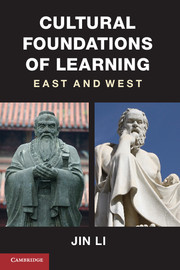
Cultural Foundations of Learning
Western and East Asian people hold fundamentally different beliefs about learning that influence how they approach child rearing and education. Reviewing decades of research, Dr Jin Li presents an important conceptual distinction between the Western mind model and the East Asian virtue model of learning. The former aims to cultivate the mind to understand the world, whereas the latter prioritizes the self to be perfected morally and socially. Tracing the cultural origins of the two large intellectual traditions, Li details how each model manifests itself in the psychology of the learning process, learning affect, regard of one's learning peers, expression of what one knows and parents' guiding efforts. Despite today's accelerated cultural exchange, these learning models do not diminish but endure.
eBook

The production-oriented approach to teaching university students English in China
The production-oriented approach (POA) has been developed over ten years to overcome the weaknesses in English instruction in tertiary education in Mainland China. The POA tries to integrate the strengths of Western instructional approaches with Chinese contextual features and consists of three components: (a) teaching principles; (b) teaching hypotheses; and (c) teacher-mediated teaching processes. The teaching principles include ‘learning-centered’, ‘learning-using integration’, and ‘whole-person education’, and the teaching hypotheses are ‘output-driven’, ‘input-enabled’, and ‘selective learning’. The teaching processes contain three phases, each mediated by the teacher: motivating, enabling, and assessing. The three principles set guidelines for the other two components; the three hypotheses serve as a theoretical basis for the teaching process; the three-phase teaching process reflects and illustrates the principles while testing the hypotheses.
Journal Article

Becoming a Visually Reflective Practitioner
Professional practice is increasingly becoming more complex, demanding, dynamic and diverse. This important and original new book considers how self-study using arts-based methods can enable purposeful reflection toward understanding and envisioning professional practice. Ideally for visual arts practitioners on all levels, this book presents a self-study model grounded in compelling research that highlights arts-based methods for examining four areas of professional practice: professional identities, work cultures, change and transitions and envisioning new pathways. Chapters address the components of the self-study model, artistic methods and materials, and strategies for interpreting self-study written and visual outcomes with the aim of goal setting. Each chapter includes visuals, references and end-of-chapter prompts to engage readers in critical and visual reflection. Appendices offer resources and guidelines for creating and assessing self-study outcomes. The fluctuating nature of professional practice necessitates the pursuit of discernment and clarity that can be achieved through an ongoing reflective practice. Self-study is a systematic and flexible methodology for purposeful reflection on professional practice that embraces dialogic, interpretive, rhizomatic and visual inquiry. Self-study can occur at any level of practice and in the context of work-related professional development, formal study or as a self-initiated inquiry. An arts-based self-study model for visual arts practitioners is explored and focuses on four intersectional components shaping professional practice: professional identities, work cultures and communities, transition and change within professional practice and envisioning new pathways for professional practice. The self-study model is grounded in contemporary theory, practice and compelling research, and embraces robust strategies for understanding the complexities of professional practice that can include dual, multiple, overlapping, hybrid and conflicting professional identities, tensions within work cultures and unexpected changes within professional practice. Each chapter focuses on a component of the self-study model and an area of professional practice, concluding with references and end-of-chapter prompts that are aimed to facilitate critical reflection-on-practice and the creation of written and visual responses. With visual arts practitioners in mind, various arts-based methods for self-study are discussed that highlight visual journaling as a key method for engaging in self-study. Interpretive research methods are discussed to guide readers in understanding the phases and processes for interpreting written and visual self-study outcomes. Processes are outlined to help readers determine key insights, themes, issues and questions from their self-study outcomes, how to use them in formulating new questions and articulating new professional goals. Several levels for interpretation are presented to offer readers options relative to their professional needs and aims. Throughout the text, charts and visuals serve to summarize and visualize key chapter points. Images by visual arts practitioners appear throughout the text and represent a wide range of artistic media, methods and approaches appropriate for self-study. The appendices provide additional resources for enhanced understanding of chapter concepts and key terms, guidelines and rubrics for writing reflections, creating visual responses and using a visual journal in the self-study process. Primary readership will be visual arts practitioners at all levels. Ideal for university level graduate courses or as a guide for individuals and small groups of practitioners who seek to engage in arts-based self-study as professional development.
eBook

Investigating the Local-scale Fluctuations of Groundwater Storage by Using Downscaled GRACE/GRACE-FO JPL Mascon Product Based on Machine Learning (ML) Algorithm
Groundwater storage is of grave significance for humanity by sustaining the required water for agricultural irrigation, industry, and domestic use. Notwithstanding the impressive contribution of the state-of-the-art Gravity Recovery and Climate Experiment (GRACE) to detecting the groundwater storage anomaly (GWSA), its feasibility for the characterization of GWSA variation hotspots over small scales is still a major challenge due to its coarse resolution. In this study, a spatial water balance approach is proposed to enhance the spatial depiction of groundwater storage and depletion changes that can detect the hotspots of GWSA variation. In this study, Random Forest Machine Learning (RFML) model was utilized to simulate fine-resolution (10 km) groundwater storage based on the coarse resolution (50 km) of GRACE observations. To this end, parameters including soil moisture, snow water, evapotranspiration, precipitation, surface runoff, surface elevation, and GRACE data were integrated into the RFML model. The results show that with a correlation of above 0.98, the RFML model is very successful in simulating the fine-resolution groundwater storage over the Western Anatolian Basin (WAB), Türkiye. The results indicate an estimated annual depletion rate of 0.14 km3/year for the groundwater storage of the WAB, which is equivalent to about 2.57 km3 of total groundwater depletion from 2003 to 2020. The findings also suggest that the downscaled GWSA is in harmony with the original GWSA in terms of temporal variations. The validation of the results demonstrates that the correlation is increased from 0.56 (for the GRACE-derived GWSA) to 0.60 (for the downscaled GWSA) over the WAB.
Journal Article

Cultural challenges eLearners from the GCC countries face when enrolled in Western educational institutions: A thematic literature review
This study provides an in-depth assessment of the cultural challenges eLearners from the Gulf Corporation Council (GCC) countries face when enrolled in Western higher education institutions. The study adopts an analytical approach by identifying two themes that incorporate reviewing some of the most significant literature related to this area of study. As theoretical frameworks, Hofstede’s popular cultural dimensions and Hall’s (1976) concept of low and high context cultures are considered. The purpose of this thematic review of the literature is to better understand challenges related to eLearning that eLearners from the GCC countries face when enrolled in Western educational institutions. In view of that, this study sheds light on two main questions: What are some of the challenges eLearners from the GCC countries face when enrolled in Western educational institutions? And what considerations should be taken into account when designing instructional materials for online courses targeting eLearners from the GCC Countries? The analysis revealed that GCC students face different types of eLearning barriers that are divided into two broad categories. The first is the general barriers and inconveniences, and the second is the challenges they face when enrolled in Western universities. This study also concluded that Western universities targeting students from the Arab countries in general, and the GCC countries in particular, need to place suitable inter-cultural plans to prepare for and effectively deal with the challenges analysed in the study. Recommendations on how to implement these preparatory plans for the GCC eLearners enrolled in Western programmes are also presented and highlighted.
Journal Article

Global research landscape of sustainability curricula implementation in higher education
Purpose
This paper aims to outline the global research landscape of sustainability curricula implementation processes in higher education. The focus is twofold and investigates where research that aims at integrating sustainability into the curriculum is happening and how the research area of curriculum change for sustainability is developing.
Design/methodology/approach
A systematic review of peer-reviewed case studies published in English in selected journals and edited volumes between 1990 and 2017 was carried out. Data (n = 270 publications) were analyzed via descriptive statistics and bibliometric analysis.
Findings
The study demonstrates that research on sustainability curricula implementation processes in higher education has produced a growing output in a broad range of journals. Nevertheless, the cross-country distribution is imbalanced, with most cases coming from the USA, Europe and Asia, but with the relatively highest density in Oceania. A citation network analysis revealed that the “Western world” is quite well interlinked, whereas other countries are not, indicating that sharing information between and learning from other cases is limited.
Research limitations/implications
The exclusion of non-English publications likely skewed the global distribution of the research landscape included in this study.
Social implications
These findings demonstrate the need for more research and funding for case studies in countries that have not yet been adequately examined.
Originality/value
This study offers the first systematic reflection on the current global research landscape in sustainability curricula implementation and can guide further research endeavors.
Journal Article

Towards a Global Water Use Scarcity Risk Assessment Framework: Integration of Remote Sensing and Geospatial Datasets
What are the main findings? * Ensemble machine learning was employed to generate multi-year global terrestrial water storage and water withdrawal by integrating remote sensing and geospatial datasets. * Big data and IPCC exposure-hazard-vulnerability paradigm were used to assess variation and evolution of global water scarcity risk over the past two decades. Ensemble machine learning was employed to generate multi-year global terrestrial water storage and water withdrawal by integrating remote sensing and geospatial datasets. Big data and IPCC exposure-hazard-vulnerability paradigm were used to assess variation and evolution of global water scarcity risk over the past two decades. What is the implication of the main finding? * Largest TWS losses and highest risk cluster in Asia and Africa imply that policy should prioritize storage buffering, withdrawal management and capacity building to curb widening water-security inequities. * A storage-aware remote sensing-driven EHV framework offers a consistent basis for global risk mapping, supporting operational early warning and transboundary planning while reducing dependence on model-only proxies. Largest TWS losses and highest risk cluster in Asia and Africa imply that policy should prioritize storage buffering, withdrawal management and capacity building to curb widening water-security inequities. A storage-aware remote sensing-driven EHV framework offers a consistent basis for global risk mapping, supporting operational early warning and transboundary planning while reducing dependence on model-only proxies. A storage-aware water-scarcity risk assessment framework coupling satellite remote sensing, geospatial datasets with the IPCC exposure-hazard-vulnerability (EHV) paradigm was designed to evaluate the spatiotemporal dynamics of global water scarcity risk over the past two decades. To achieve this, a performance-weighted ensemble machine learning approach was employed to reconstruct long-term terrestrial water storage (TWS) from satellite observations, augmented with glacier-mass calibration to improve reliability in cryosphere-affected regions. Global water withdrawal dataset was generated by integrating remote sensing, geospatial dataset, and machine learning to mitigate the dependency of parameterized land surface hydrological models and enable consistent risk mapping. Satellite-derived results reveal obvious TWS declines in Asia, Northern Africa, and North America, particularly in irrigated drylands and glacier-dominated regions. EHV paradigm and big datasets further identified high-water scarcity risk in Asia and Africa, especially in agricultural regions. Water stress has intensified in Africa over the past two decades, while a decreasing trend is observed in parts of Asia. Vulnerability levels in Asia and Africa are approximately eight times higher than those in other global regions. Results reveal a strong connection between water stress and socioeconomic factors in Asia and Africa, reflecting global disparities in water resource availability.
Journal Article

Contemporary trends in professional development of teachers: importance of recognising the context
PurposeWhereas the achievement of students has closely been linked with the quality of teachers and there is a bulk of literature supporting the need of teachers' preparation in enhancing their quality, professional development (PD) of teachers has been a central focus of reform initiatives in education across the globe. This paper aims at analysing the existing literature on PD of teachers to reflect on the models and characteristics of effective PD, and to highlight the importance of context in PD of teachers.Design/methodology/approachTo respond to the aim of the paper, a search in the field of pedagogy in Education Resource Information Centre (ERIC) was undertaken. The search strings used were “models of teachers' professional development”, “characteristics of teachers professional development” and “context in professional development” restricted to time period from 2000 to 2020.FindingsThe major argument this paper presents is that the models and characteristics of PD are relative and there is no uniform model to be implemented across contexts. Instead of debating the models and characteristics of effective PD, academics and practitioners have to be watchful to the context and the real needs of teachers in a particular context.Originality/valueThe paper critiques the generalisation of Western generated PD models to the developing world especially Pakistan which the existing research and literature is silent about.
Journal Article

Japanese university students’ longing for an idealized France and encounters with global English in Europe
Japanese college students’ akogare (meaning “longing”) for an idealized West has conventionally been researched and discussed under the assumption that the West is synonymous with Anglophone countries and that an encounter with the West is categorically an international experience. The present study provides new insights by exploring Japanese college students’ longing for an idealized France through a content analysis of blogs and reflective entries written by students during or after participating in a French study abroad program. The analysis reveals that Japanese students from prestigious universities display a high level of satisfaction irrespective of how well they are able to use French. This finding, which is intertwined with the nature of fun-oriented study abroad programs, is also related to the widespread use of English in Europe. The linguistic discovery reminds students of the overriding global status of English vis-à-vis French as a regional language. The study provides future research directions and pedagogical implication in light of (1) increasingly fierce competition for the securement of language course takers, which drives the institutional reproduction of language ideologies and the implementation of fun study abroad programs, and (2) the long-term effectiveness of such ideology-driven survival strategies amid the changing popularity of foreign languages in Japan and elsewhere.
Journal Article