
Catalogue Search | MBRL


Are you sure you want to remove the book from the shelf?

{{itemTitle}}
87
result(s) for
"Lebanon Intellectual life."
Sort by:

Precarious imaginaries of Beirut : a city's suspended now
This book investigates a shared experience of time and space in the post-civil-war city of Beirut:?the suspended now.? Based on the close analysis of a large corpus of cultural objects; including visual art, literature, architecture and cinema; the book argues that last decades have witnessed a gradual shift in understanding this temporality from being a transitional phase to a more durable experience of precariousness. The theoretically rich analyses take us on a journey through Beirut?s real and imagined geographies, from garbage dumps to real estate advertisements, and from subterranean spaces to martyr?s posters. For scholars of cultural analysis, urban studies, cultural geography and critical theory, the case of post-1990 Beirut offers a fascinating case of neoliberal urban renewal, which challenges existing theories. For scholars of Lebanon and Beirut, this study complements existing work on post-civil-war Lebanese cultural production rooted in trauma studies by its focus on the city?s continual exposure to violence.
Book

Printing Arab Modernity
Printing Arab Modernity presents printed books and pamphlets as important sites for visual, material, and cultural analysis in nineteenth-century Beirut, during a time of an emerging Arab modernity.
eBook

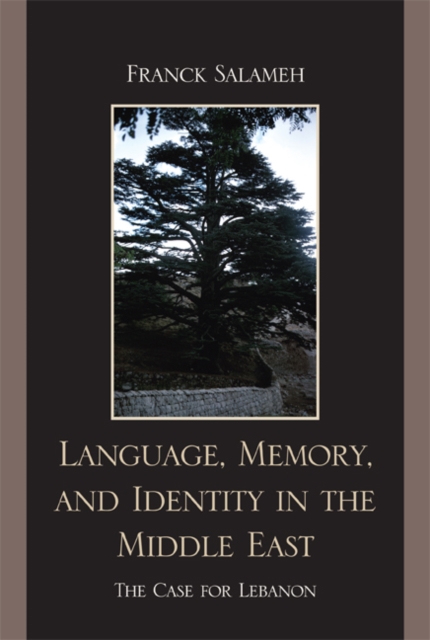
Language, memory, and identity in the Middle East
Since the West's very early flirtations with the modern Near East, and especially in the past 100 years of East-West relations, there has been considerable difficulty in understanding and defining the Middle East, the Arab world, pan-Arabism, Arab nationalism, and Middle Eastern identities in general. The Western impulse of conflating national identity with language, state, and ethnicity—often subsuming Arabic language into Arab ethnicity—has contributed to this misunderstanding and misreading of the region. For, while the Middle East can be accurately referred to by way of the generic \"Arab world\" label, the appellation itself is a misleading oversimplification that conceals an inherent diversity and multiplicity of Middle Eastern cultures, ethnicities, languages, and nationalities. And while there is certainly a dominant Arab ethnos, there are also significant numbers of Middle Eastern peoples and nationalities with historical memories and ethno-cultural bonds that challenge the dominant Arabist paradigm. Language, Memory, and Identity in the Middle East proposes a new reading of modern Middle Eastern history and suggests alternate solutions to the region's problems. The book is an attempt to rehabilitate and bring back to the fore of Middle East Studies the issue of language as a key factor in shaping (and misshaping) the region, with the hope of rediscovering a broader, more honest, and less ideologically tainted discussion on the Middle East. Language, Memory, and Identity in the Middle East has a special focus on Lebanon, a \"Christian homeland,\" because Lebanon has traditionally acted as the region's template for change and a barometer gauging its problems and charting its progress.
eBook

War and memory in Lebanon
\"From 1975 to 1990, Lebanon endured one of the most protracted and bloody civil wars of the twentieth century. Sune Haugbolle's timely and often poignant book chronicles the battle over ideas that emerged from the wreckage of that war. While the Lebanese state encouraged forgetfulness and political parties created sectarian interpretations of the war through cults of dead leaders, intellectuals and activists--inspired by the example of truth and reconciliation movements in different parts of the world--advanced the idea that confronting and remembering the war was necessary for political and cultural renewal. Through an analysis of different cultural productions--media, art, literature, film, posters, and architecture--the author shows how the recollection and reconstruction of political and sectarian violence that took place during the war have helped in Lebanon's healing process. He also shows how a willingness to confront the past influenced the popular uprising in Lebanon after the assassination of Prime Minister Rafiq Hariri\"--Provided by publisher.
Book

Standing by the Ruins:Elegiac Humanism in Wartime and Postwar Lebanon
Since the mid-1970s, Lebanon has been at the center of the worldwide rise in sectarian extremism. Its cultural output has both mediated and resisted this rise. Standing by the Ruins reviews the role of culture in supporting sectarianism, yet argues for the emergence of a distinctive aesthetic of resistance to it. Focusing on contemporary Lebanese fiction, film, and popular culture, this book shows how artists reappropriated the twin legacies of commitment literature and the ancient topos of standing by the ruinsto form a new elegiac humanismduring the tumultuous period of 1975 to 2005. It redirects attention to the critical role of culture in conditioning attitudes throughout society and is therefore relevant to other societies facing sectarian extremism.Standing by the Ruins is also a strong intervention in the burgeoning field of World Literature. Elaborating on the great Arabist Hilary Kilpatrick's crucial insight that ancient Arabic forms and topoi filter into modern literature, the author details how the standing by the ruinstopos-and the structure of feeling it conditions-has migrated over time. Modern Arabic novels, feature films, and popular culture, far from being simply cultural imports, are hybrid forms deployed to respond to the challenges of contemporary Arab society. As such, they can take their place within a World Literature paradigm: they are cultural products that travel and intervene in the world.
eBook

Printing Arab modernity : book culture and the American Press in nineteenth-century Beirut
During the nineteenth century, the American Mission Press in Beirut printed religious and secular publications written by foreign missionaries and Syrian scholars such as Nāṣīf al-Yāzijī and Buṭrus al-Bustānī, of later nahḍa fame. In a region where presses were still not prevalent, letterpress-printed and lithographed works circulated within a larger network that was dominated by manuscript production. In this book, Hala Auji analyzes the American Press publications as important visual and material objects that provide unique insights into an era of changing societal concerns and shifting intellectual attitudes of Syria's Muslim and Christian populations. Contending that printed books are worthy of close visual scrutiny, this study highlights an important place for print culture during a time of an emerging Arab modernity.
Book
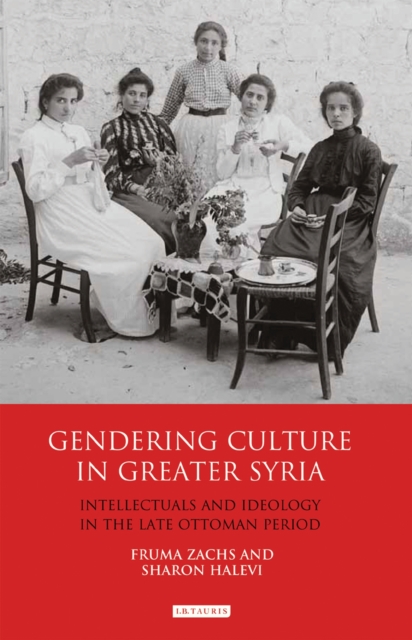
Gendering Culture In Greater Syria
The Nahda (lit. ‘the Awakening’) was one of the most significant cultural movements in modern Arab history. By focusing on the neglected role of women in the intellectual Islamic renaissance of the late Ottoman Period, Fruma Zachs and Sharon Halevi provide a refreshingly interdisciplinary exploration of gender and culture in the Arab World. Focusing mainly on Greater Syria, this book re-examines the cultural by-products of the Nahda - such as scientific debates, journal articles, essays, short stories and novels - and provides a new framework for rethinking the dynamics of cultural and social change in what today we know as Syria and Lebanon. The lasting impact of the Nahda is given an innovative and thoroughly unique interpretation, providing an indispensable perspective to studying the nuanced roles of the construction and development of gender ideologies in the nineteenth century Middle East. The authors explore contemporary ideas concerning modern gender roles in the Middle East, and the extent to which these emerged in nineteenth-century Greater Syria. How were these ideas incorporated into daily lives, consumer patterns and cultural activities?
eBook
The Making of a Syrian Identity: Intellectuals and Merchants in Nineteenth Century Beirut / By Fruma Zachs
Exploring the origins and development of the Syrian identity, during the 18th and 19th centuries, through the role of Christian Arab intellectuals and merchants, Ottomans and American missionaries, this volume examines its background, stages of evolution, and components. It shows that the contribution of these Christian Arabs, despite their relatively small number, lies in the processes they set in motion, being the first to promote territorial concepts along with a secular interpretation of Arab culture.This Syrian identity constitutes an innovative case study in the broader discipline of proto-national identity and the study of the development of local identities in Middle Eastern countries. It is also a vital basis for research of 20th century Syrian nationalism.
eBook

The making of a Syrian identity : intellectuals and merchants in nineteenth century Beirut
The book takes a close look at the origins and development of the Syrian identity, during the 18th and 19th centuries, through the role of Christian Arab intellectuals and merchants, Ottomans and American missionaries. It examines its background, stages of evolution, and components.
eBook