
Catalogue Search | MBRL


Are you sure you want to remove the book from the shelf?

{{itemTitle}}
613
result(s) for
"Lebensbedingungen"
Sort by:

Back to the Postindustrial Future
How does an urban community come to terms with the loss of its future? The former socialist model city of Hoyerswerda is an extreme case of a declining postindustrial city. Built to serve the GDR coal industry, it lost over half its population to outmigration after German reunification and the coal industry crisis, leading to the large-scale deconstruction of its cityscape. This book tells the story of its inhabitants, now forced to reconsider their futures. Building on recent theoretical work, it advances a new anthropological approach to time, allowing us to investigate the postindustrial era and the futures it has supposedly lost.
eBook

THE EFFECT OF SAVINGS ACCOUNTS ON INTERPERSONAL FINANCIAL RELATIONSHIPS: EVIDENCE FROM A FIELD EXPERIMENT IN RURAL KENYA
The welfare impact of expanding access to bank accounts depends on whether accounts crowd out pre-existing financial relationships, or whether private gains from accounts are shared within social networks. In this experiment, we provided free bank accounts to a random subset of 885 households. Across households, we document positive spillovers: treatment households become less reliant on grown children and siblings living outside their village, and become more supportive of neighbours and friends within their village. Within households, we randomised which spouse was offered an account and find no evidence of negative spillovers.
Journal Article

It's not like I'm poor : how working families make ends meet in a post-welfare world
The world of welfare has changed radically. As the poor trade welfare checks for low-wage jobs, their low earnings qualify them for a hefty check come tax time—a combination of the earned income tax credit and other refunds. For many working parents this one check is like hitting the lottery, offering several months' wages as well as the hope of investing in a better future. Drawing on interviews with 115 families, the authors look at how parents plan to use this annual cash windfall to build up savings, go back to school, and send their kids to college. However, these dreams of upward mobility are often dashed by the difficulty of trying to get by on meager wages. In accessible and engaging prose, It's Not Like I'm Poor examines the costs and benefits of the new work-based safety net, suggesting ways to augment its strengths so that more of the working poor can realize the promise of a middle-class life.
eBook
Inequality, Poverty, and the Intra-Household Allocation of Consumption in Senegal
Intra-household inequalities have long been a source of concern for policy design, but there is very little evidence about their effects. The current practice of ignoring inequality within households could lead to an underestimation of both overall inequality and poverty levels, as well as to the misclassification of some individuals with regard to their poverty status. Using a novel survey for Senegal in which consumption data were collected at a disaggregated level, this paper quantifies these various effects. In total, two opposing effects, one on mean and one on inequality, compensate each other in terms of the overall poverty rate, but individual poverty statuses are affected. Intra-household consumption inequalities account for 14 percent of inequality in Senegal. This study has also uncovered the fact that household structure and organization are key correlates of intra-household inequality and individual risk of poverty.
Paper


Living displacement
Focusing on two cases of resettlement in rural Cundinamarca, Colombia, this book examines how displaced campesinos make sense of their displacement and how displacement shapes their everyday lives. It is based on a ten-month fieldwork employing ethnographic methods working, living and sharing with the displaced and their host. The book calls for a longer time-frame analysis of the phenomenon of displacement, which considers people’s lives both pre- and post- physical relocation. It examines how violence and terror altered people’s sense of place and set off displacement process before they actually moved. It analyses the challenges the displaced are facing in their subsequent place-making endeavours, including the negotiation of social relations, consequences of categorization, engagement with the physical land, and memories of violence to challenge the notion that displacement starts with uprooting and terminates with resettlement or return.
eBook
ON THE DETERMINANTS OF SLUM FORMATION
We construct a simple model of a city with heterogeneous agents and housing choice to explain the determinants of slums, home to about one-third of the urban population in developing countries. The model supports the main empirical evidence regarding slum formation and is able quantitatively to assess the role of each determinant of slum growth. We show that urban poverty, inequality and rural–urban migration explain much of the variation in slum growth in Brazil from 1980 to 2000. Ex ante evaluation of the impacts of policy interventions shows that removing barriers to formalisation has a strong impact on slum reduction.
Journal Article
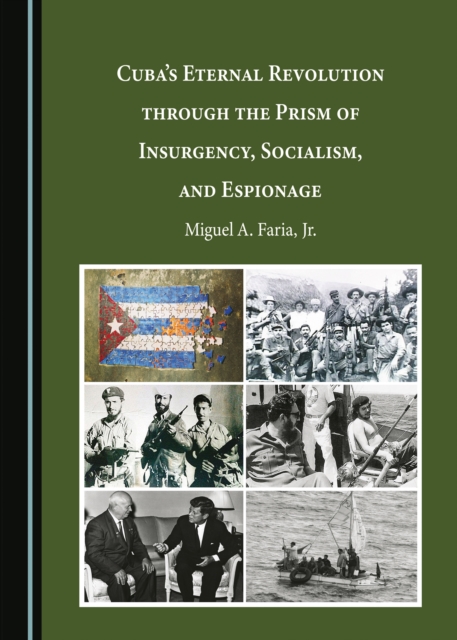
Cuba's Eternal Revolution Through the Prism of Insurgency, Socialism, and Espionage
This book not only relates the defining moments of the Cuban Revolution - such as the Moncada Barracks attack, the assault on Batista's Presidential Palace, the Bay of Pigs invasion, and the Cuban Missile Crisis - but also lesser-known events like the \"War Against the Bandits\"; the overseas adventures of Che Guevara in the Congo and Bolivia; Fidel Castro's possible prior knowledge of and involvement in JFK's assassination; Cuba's \"silent war against the environment\"; and ongoing foreign intelligence operations. The book contains information most readers and academicians may not be familiar with and utilizes major tomes as sources that have only been published in Spanish and so are not widely available to international audiences outside of Spain and Latin America. It will enlighten readers about the realities of the Cuban Revolution - its purported achievements as well as its definite shortcomings; its impact on world events in the last seven decades; and correct the record where needed - enhancing the fount of knowledge for further research by social scientists, historians, and political scientists.
eBook

What's Happened to Poverty and Inequality in Indonesia over Half a Century?
Indonesia has achieved moderately fast economic growth for most of the past 50 years. Has this growth translated into rising living standards? This is the question that is addressed in this paper. The conclusion is a qualified yes. The caveat is attached for two reasons: (i) philosophically, the definition of living standards remains a subject of considerable conjecture, and (ii) not all social indicators point in the same direction. I focus primarily on trends in measurable indicators of human welfare, particularly poverty and inequality. Combined with major improvements in the coverage and quality of the country's statistics, and a now extensive literature, it is possible to document, and in some cases explain, trends in living standards in some detail. I also investigate whether (and how) the sudden swing during 1999–2001 from an authoritarian and centralized regime to a democratic and decentralized era impacted significantly on these trends.
Journal Article

Performing ‘Initial Assessment’: Identifying the Latent Conditions for Error at the Front-Door of Local Authority Children's Services
This article draws attention to the faulty design elements at the front-door of children's local authority services, arguing that current attempts to increase safety, through the formalization of organizational procedures and their enactment by IT systems, may have had the contrary effect. We argue that the analysis of errors in organizational settings should focus on immanent systemic weaknesses, particularly the ‘latent conditions’ for error that generally increase the risk of failure. Reporting the findings from a two-year ESRC-funded ethnographic study, and examining the local adaptations of practice arising in the performance context of the ‘modernized’ front-door of children's services, we draw attention to the short-cuts that the current configuration of the initial assessment system appears to necessitate, given the immutable timescales and excessive audit requirements. New modes of governance can clearly play a central role in error management, but the design of an effective system needs to be based on the needs of users and on a thorough understanding of their working practices.
Journal Article