
Catalogue Search | MBRL


Are you sure you want to remove the book from the shelf?

{{itemTitle}}
24,652
result(s) for
"Lee, Robert E"
Sort by:


Trench Warfare under Grant and Lee
Continuing the study of field fortifications he began inField Armies and Fortifications in the Civil War, Earl J. Hess turns to the 1864 Overland campaign to cover battles from the Wilderness to Cold Harbor. A grueling form of trench warfare became a key feature of tactical operations during this phase of the war in Virginia.Drawing on meticulous research in primary sources and careful examination of trench remnants at the Wilderness, Spotsylvania, North Anna, Cold Harbor, and Bermuda Hundred, Hess describes Union and Confederate earthworks and how Grant and Lee used them in this new era of field entrenchments. According to Hess, the heavy reliance on earthworks by both armies in the Overland campaign was driven by Grant's relentless attacks against Lee, not by the widespread use of rifle muskets, as historians have previously argued. Entrenchments kept the armies within striking distance and compelled soldiers to dig in for protection. Despite suffering massive casualties, Grant seized control of the strategic initiative and retained it for the rest of the war in the eastern theater.Illustrated by rare, historic photographs and new detailed maps of the trench remnants, this book constitutes the second installment of a three-volume study of field fortifications in the eastern campaigns.
eBook

Who was Robert E. Lee?
\"Robert E. Lee seemed destined for greatness. His father was a Revolutionary War hero and at West Point he graduated second in his class! In 1861, when the Southern states seceded from the Union, Lee was offered the opportunity to command the Union forces. However, even though he was against the war, his loyalty to his home state of Virginia wouldn't let him fight for the North.\"--Amazon.com.
Book

Becoming Confederates
In Becoming Confederates, Gary W. Gallagher explores loyalty in the era of the Civil War, focusing on Robert E. Lee, Stephen Dodson Ramseur, and Jubal A. Early-three prominent officers in the Army of Northern Virginia who became ardent Confederate nationalists. Loyalty was tested and proved in many ways leading up to and during the war. Looking at levels of allegiance to their native state, to the slaveholding South, to the United States, and to the Confederacy, Gallagher shows how these men represent responses to the mid-nineteenth-century crisis. Lee traditionally has been presented as a reluctant convert to the Confederacy whose most powerful identification was with his home state of Virginia-an interpretation at odds with his far more complex range of loyalties. Ramseur, the youngest of the three, eagerly embraced a Confederate identity, highlighting generational differences in the equation of loyalty. Early combined elements of Lee's and Ramseur's reactions-a Unionist who grudgingly accepted Virginia's departure from the United States but later came to personify defiant Confederate nationalism. The paths of these men toward Confederate loyalty help delineate important contours of American history. Gallagher shows that Americans juggled multiple, often conflicting, loyalties and that white southern identity was preoccupied with racial control transcending politics and class. Indeed, understanding these men's perspectives makes it difficult to argue that the Confederacy should not be deemed a nation. Perhaps most important, their experiences help us understand why Confederates waged a prodigiously bloody war and the manner in which they dealt with defeat.
eBook

Lee : a biography
Biography of the Confederate general which makes use of personal letters to bring fresh insights into Lee's background and early life.
Book

Opposing the Second Corps at Antietam
With a tally of more than five thousand killed, twenty thousand wounded, and three thousand missing, the Battle of Antietam made September 17, 1862, the deadliest day of combat in American history. In Opposing the Second Corps at Antietam , Antietam scholar Marion V. Armstrong Jr. completes his magisterial study of Antietam begun in Unfurl Those Colors! by examining Robert E. Lee’s leadership at the climactic battle in the Confederate invasion of Union territory.
Eminent Civil War historians consider Antietam the turning point of the war. Hoping to maintain the initiative they had gained at the Second Battle of Bull Run, Confederate leaders looked to a stunning victory on Northern soil to sour Northern sentiment on the war as well as to coax European powers to recognize the fledgling Confederacy. Having examined McClellan’s command and role at Antietam in Unfurl Those Colors! , Armstrong now recounts in riveting detail Lee’s command decisions and their execution in the field, drawing on a superlative collection of first-person accounts by Confederate veterans to narrate the cataclysmic struggle between Lee and McClellan.
Armstrong sets the stage with a lively recap of the political and military events leading up to the early fall of 1862 and foreshadowing the conflagration to come on September 17. Each chapter then traces a critical section of the battle, the fight for the West Woods and the bloody engagement of the Sunken Road. Armstrong augments this collection with an exceptional set of maps, which will be valued by scholars, readers, and visitors to the battlefield. These unique maps delineate troop movements in intervals as brief as fifteen minutes, bringing to life the fluid, mutable lines that characterize the glory and horror of Antietam.
Either together with Unfurl Those Colors! or as a stand-alone account of the Confederate side of the battle, Opposing the Second Corps at Antietam provides the fullest possible understanding of the experience of Confederate soldiers at Antietam.
eBook

The great partnership : Robert E. Lee, Stonewall Jackson, and the fate of the Confederacy
The story of the unique relationship between Lee and Jackson, two leaders who chiseled a strategic path forward against the odds and almost triumphed.
Book
The enduring relevance of Robert E. Lee
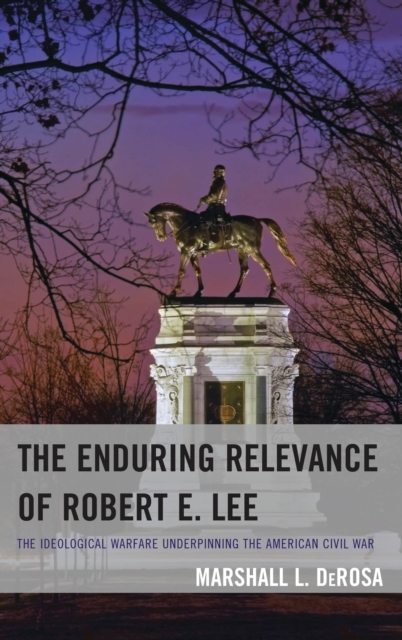
The sesquicentennial of the American Civil War presents a unique opportunity to consider the motivation behind General Robert E. Lee’s efforts to defend the Confederacy against his once beloved United States. What will be learned from this book is that General Lee was following in the footsteps of his idol General George Washington. General Lee was not fighting to perpetuate and expand slavery, self-aggrandizement, or military glory. He was fighting for the 1776 principles of government based upon the consent of the governed, the 1789 principles of the rule of law, and for a Judeo-Christian based civilization. While Lee’s military genius and commitment to duty are widely acknowledged, his political acumen is, for the most part, underrated. Master of the art of politics as much as war, which is politics by other means, Lee considered both normative arts concerned with the happiness and noble actions of the citizens. In fact, Lee’s successes and failures on the battlefield were due in large measure to his worldview that if the Confederacy were to survive its citizenry must act nobly. According to Lee, it is in noble actions that human happiness is to be achieved. For Lee, the soldier and citizen performing their respective duties were on the paths to individual happiness and, ultimately, a free and independent CSA. In The Enduring Relevance of Robert E. Lee Marshall L. DeRosa uses the American Civil War and the figure of Robert E. Lee to consider the role of political leadership under extremely difficult circumstances and the proper response to those circumstances. DeRosa examines Lee as a politician rather than just a military leader and finds that many of Lee’s assertions are still relevant today. DeRosa reveals Lee’s insights and his awareness that the victory of the Union over the Confederacy placed America on the path towards the demise of government based upon the consent of the governed, the rule of law, and the Judeo-Christian American civilization.
eBook

A Small but Spartan Band
A unit that saw significant action in many of the engagements of the Civil War’s eastern theater. Until this work, no comprehensive study of the Florida units that served in Robert E. Lee’s Army of Northern Virginia (ANV) had been attempted, and problems attend the few studies of particular Florida units that have appeared. Based on more than two decades of research, Waters and Edmonds have produced a study that covers all units from Florida in the ANV, and does so in an objective and reliable fashion. Drawn from what was then a turbulent and thinly settled frontier region, the Florida troops serving in the Confederacy were never numerous, but they had the good or bad luck of finding themselves at crucial points in several significant battles such as Gettysburg where their conduct continues to be a source of contention. Additionally, the study of these units and their service permits an examination of important topics affecting the Civil War soldier: lack of supplies, the status of folks at home, dissension over civilian control of soldiers and units from the various Confederate states, and widespread and understandable problems of morale. Despite the appalling conditions of combat, these soldiers were capable of the highest courage in combat. This work is an important contribution to the record of Lee’s troops, ever a subject of intense interest.
eBook

Death of an Assassin
From the depths of German and American archives comes a story one soldier never wanted told. The first volunteer killed defending Robert E. Lee’s position in battle was really a German assassin. After fleeing to the United States to escape prosecution for murder, the assassin enlisted in a German company of the Pennsylvania Volunteers in the Mexican-American War and died defending Lee’s battery at the Siege of Veracruz in 1847. Lee wrote a letter home, praising this unnamed fallen volunteer defender. Military records identify him, but none of the Americans knew about his past life of crime.
Before fighting with the Americans, Lee’s defender had assassinated Johann Heinrich Rieber, mayor of Bönnigheim, Germany, in 1835. Rieber’s assassination became 19th-century Germany’s coldest case ever solved by a non–law enforcement professional and the only 19th-century German murder ever solved in the United States. Thirty-seven years later, another suspect in the assassination who had also fled to America found evidence in Washington, D.C., that would clear his own name, and he forwarded it to Germany. The German prosecutor Ernst von Hochstetter corroborated the story and closed the case file in 1872, naming Lee’s defender as Rieber’s murderer.
Relying primarily on German sources, Death of an Assassin tracks the never-before-told story of this German company of Pennsylvania volunteers. It follows both Lee’s and the assassin’s lives until their dramatic encounter in Veracruz and picks up again with the surprising case resolution decades later.
This case also reveals that forensic ballistics—firearm identification through comparison of the striations on a projectile with the rifling in the barrel—is much older than previously thought. History credits Alexandre Laccasagne for inventing forensic ballistics in 1888. But more than 50 years earlier, Eduard Hammer, the magistrate who investigated the Rieber assassination in 1835, used the same technique to eliminate a forester’s rifle as the murder weapon. A firearms technician with state police of Baden-Württemberg tested Hammer’s technique in 2015 and confirmed its efficacy, cementing the argument that Hammer, not Laccasagne, should be considered the father of forensic ballistics.
The roles the volunteer soldier/assassin and Robert E. Lee played at the Siege of Veracruz are part of American history, and the record-breaking, 19th-century cold case is part of German history. For the first time, Death of an Assassin brings the two stories together.
eBook