
Catalogue Search | MBRL


Are you sure you want to remove the book from the shelf?

{{itemTitle}}
26,681
result(s) for
"Legal Personnel"
Sort by:

American Immunity
In 1955 the Supreme Court ruled that veterans of the U.S. armed forces could not be courtmartialed for overseas crimes that were not detected until after they had left military service. Territorial limitations placed such acts beyond the jurisdiction of civilian courts, and there was no other American court in which they could be adjudicated. As a result, a jurisdictional gap emerged that for decades exempted former troops from prosecution for war crimes. “This was not merely a theoretical possibility,” Patrick Hagopian writes. Over a dozen former soldiers who participated in the My Lai massacre did in fact “get away with murder.” Further court rulings expanded the gap to cover civilian employees and contractors that accompanied the armed forces. In American Immunity, Hagopian places what he calls the “superpower exemption” in the context of a longstanding tension between international law and U.S. sovereignty. He shows that despite the U.S. role in promulgating universal standards of international law and forming institutions where those standards can be enforced, the United States has repeatedly refused to submit its own citizens and troops to the jurisdiction of international tribunals and failed to uphold international standards of justice in its own courts. In 2000 Congress attempted to close the jurisdictional gap with passage of the Military Extraterritorial Jurisdiction Act. The effectiveness of that legislation is still in question, however, since it remains unclear how willing civilian American juries will be to convict veterans for conduct in foreign war zones.
eBook

The Portable Lawyer for Mental Health Professionals
Everything you need to legally safeguard your mental health practice
Fully revised, The Portable Lawyer for Mental Health Professionals, Third Edition identifies, explores, and presents solutions to both the simple and complex legal questions that mental health practices must deal with daily. Written by Thomas Hartsell Jr. and Barton Bernstein—attorneys and therapists specializing in legal issues concerning mental health—this essential guide arms professionals with the expert knowledge needed to avoid a legal violation, or to know how to handle a situation if a complaint is filed.
With downloadable sample forms and contracts—including the new Informed Consent for Psychological Testing and Professional Limited Liability Member Agreement forms—this complete resource features step-by-step guidance, helpful case studies, and \"legal light bulbs\" to alert clinicians to warning signs and help them steer clear of legally questionable situations.
New to the Third Edition:
* Coverage of how to conduct business in a digital world, including how to handle confidentiality issues surrounding electronic health records and cloud computing, distance therapy, and maintaining a professional client-therapist relationship in a Facebook world
* Vital information on a variety of associations' ethics guidelines
* A look at the Health Information Technology for Economic and Clinical Health (HITECH) Act
* Considerations for using or not using evidence-based treatments
* New information on working with minors and dealing with homicidal clients
Convenient and comprehensive, The Portable Lawyer for Mental Health Professionals, Third Edition is the quick-reference resource that mental health professionals, graduate students, attorneys, and clients alike can rely on to make informed legal decisions.
eBook
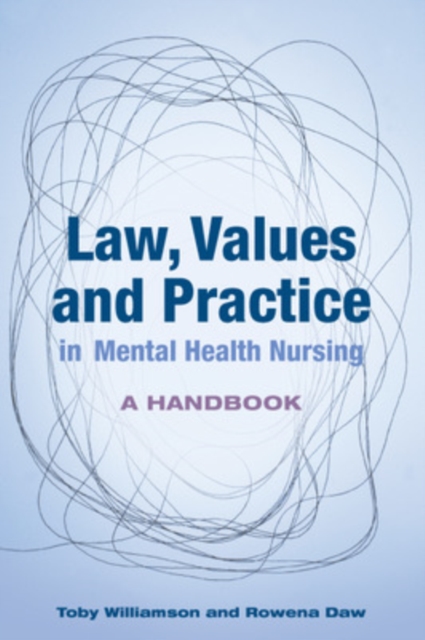
Law, values and practice in mental health nursing: a handbook
Mental health nurses need to work within the law to ensure good, legal care for their patients, while at the same time being guided by appropriate values. This practical handbook for mental health nurses offers an accessible and invaluable guide to mental health law and values based practice.Written in an accessible and friendly way, the book covers the different stages of mental healthcare delivery in a range of healthcare settings. The book includes guidance on: The Human Rights ActThe Mental Capacity Act 2005The Deprivation of Liberty safeguardsThe revised Mental Health ActAdmitting people to hospitalDischarging people into the communityWorking with those in care homesWorking with children and young peopleThe chapters include case studies based on real life, to show how nurses can deal with complex and daunting scenarios in practice. The book includes clear explanations of all relevant legislation as well as step-by-step guidance on how to deal with situations where mental health law applies.This book is suitable for those preparing to qualify as well as those already qualified and working in a range of healthcare settings. An essential text, this book will empower nurses to practise with confidence. \"I welcome this book as its integration of values based practice and legislation into the complex world of decision making in mental health services clarifies many issues. This book is sure to become essential reading for students of mental health nursing.\" Ian Hulatt, Mental Health Advisor, Royal College of Nursing UK \"This is an invaluable guide for all professionals working in mental health services, written by two people who have unparalleled understanding of mental health and mental capacity law. It should help practitioners understand both the intricacies of the law and how to retain a person-centred approach when applying it.\" Paul Farmer, Chief Executive, Mind \"An impressive and enlightening book that spans law, ethics, values and practice. With the help of realistic scenarios it explains and applies the law with clarity and great practical understanding. It will inform and reassure those struggling with the often painful dilemmas confronted over the course of providing nursing care to service users with mental disabilities.\" Genevra Richardson, Professor of Law, King's College London, UK
eBook

Legal issues in social work, counseling, and mental health : guidelines for clinical practice in psychotherapy
This book covers a broad range of topics, including providing testimony, responding to subpoenas, dealing with an attorney, influencing the legal system, and understanding the legal side of the business of psychotherapy. This book will help demystify the North American legal system, thereby empowering psychotherapists to work with it and within it.
eBook

Gender Harassment
This study challenges the common legal and organizational practice of privileging sexual advance forms of sex-based harassment, while neglecting gender harassment. Survey data came from women working in two male-dominated contexts: the military and the legal profession. Their responses to the Sexual Experiences Questionnaire (SEQ) revealed five typical profiles of harassment: low victimization, gender harassment, gender harassment with unwanted sexual attention, moderate victimization, and high victimization. The vast majority of harassment victims fell into one of the first two groups, which described virtually no unwanted sexual advances. When compared to non-victims, gender-harassed women showed significant decrements in professional and psychological well-being. These findings underscore the seriousness of gender harassment, which merits greater attention by both law and social science.
Journal Article

Gays and the Military
In April 1987 Joseph C. Steffan, one of the ten highest ranking midshipmen in his class at the U.S. Naval Academy, and only six weeks from graduation, was denied his diploma and forced to resign his commission because he answered \"Yes, sir\" to the question, \"I'd like your word, are you a homosexual?\" Six years later his cause, and that of other gay men and lesbians seeking to serve their country by enlistment in the military, has become the subject of intense national controversy. This unusual and innovative work, based on the litigation strategy and court papers filed in the case ofJoseph C. Steffan v. Richard Cheney, Secretary of Defense, et al., brings the resources of clinical psychiatry, clinical and social psychology, cultural history and political science to bear upon the fundamental questions at issue: How is sexual orientation determined? How and why have socially prejudiced stereotypes about male and female homosexuals developed? Why have gays faced special obstacles in defending themselves against discrimination? How much political power do gays have?
Marc Wolinsky and Kenneth Sherrill argue that gays constitute a politically powerless class that has been unjustly deprived of its constitutional right to equal protection under the law. They have collected here the affidavits filed on behalf of Joseph Steffan in his suit against the United States government, together with the counter-arguments of the Department of Defense and the extraordinary opinion of the U.S. District Court for the District of Columbia. Whatever the outcome of the case, presently on appeal to the United States Court of Appeals for the District of Columbia Circuit, this book will stand as a lasting and indispensable guide to the sources of sexual discrimination.
eBook

Identification of Psycho-Socio-Judicial Trajectories and Factors Associated With Posttraumatic Stress Disorder in People Over 15 Years of Age Who Recently Reported Sexual Assault to a Forensic Medical Center: Protocol for a Multicentric Prospective Study Using Mixed Methods and Artificial Intelligence
Background:Sexual assault (SA) can lead to a range of adverse effects on physical, sexual, and mental health, as well as on one’s social life, financial stability, and overall quality of life. However, not all people who experience SA will develop negative functional outcomes. Various risk and protective factors can influence psycho-socio-judicial trajectories. However, how these factors influence trauma adaptation and the onset of early posttraumatic stress disorder (PTSD) is not always clear.Objective:Guided by an ecological framework, this project has 3 primary objectives: (1) to describe the 1-year psycho-socio-judicial trajectories of individuals recently exposed to SA who sought consultation with a forensic practitioner; (2) to identify predictive factors for the development of PTSD during the initial forensic examination using artificial intelligence; and (3) to explore the perceptions, needs, and experiences of individuals who have been sexually assaulted.Methods:This longitudinal multicentric cohort study uses a mixed methods approach. Quantitative cohort data are collected through an initial questionnaire completed by the physician during the first forensic examination and through follow-up telephone questionnaires at 6 weeks, 3 months, 6 months, and 1 year after the SA. The questionnaires measure factors associated with PTSD, mental, physical, social, and overall functional outcomes, as well as psycho-socio-judicial trajectories. Cohort participants are recruited through their forensic examination at 1 of the 5 participating centers based in France. Eligible participants are aged 15 or older, have experienced SA in the last 30 days, are fluent in French, and can be reached by phone. Qualitative data are gathered through semistructured interviews with cohort participants, individuals who have experienced SA but are not part of the cohort, and professionals involved in their psycho-socio-judicial care.Results:Bivariate and multivariate analyses will be conducted to examine the associations between each variable and mental, physical, social, and judicial outcomes. Predictive analyses will be performed using multiple prediction algorithms to forecast PTSD. Qualitative data will be integrated with quantitative data to identify psycho-socio-judicial trajectories and enhance the prediction of PTSD. Additionally, data on the perceptions and needs of individuals who have experienced SA will be analyzed independently to gain a deeper understanding of their experiences and requirements.Conclusions:This project will collect extensive qualitative and quantitative data that have never been gathered over such an extended period, leading to unprecedented insights into the psycho-socio-judicial trajectories of individuals who have recently experienced SA. It represents the initial phase of developing a functional artificial intelligence tool that forensic practitioners can use to better guide individuals who have recently experienced SA, with the aim of preventing the onset of PTSD. Furthermore, it will contribute to addressing the existing gap in the literature regarding the accessibility and effectiveness of support services for individuals who have experienced SA in Europe. This comprehensive approach, encompassing the entire psycho-socio-judicial continuum and taking into account the viewpoints of SA survivors, will enable the generation of innovative recommendations for enhancing their care across all stages, starting from the initial forensic examination.International Registered Report Identifier (IRRID):DERR1-10.2196/46652
Journal Article
Behind the Mask of Method
Debate about how to best interpret the Constitution often revolves around interpretive methodologies (e.g., originalism or expansive interpretation). This article examines whether individuals' political orientation influences the methodologies they prefer to use to interpret the Constitution. We study this proposed relationship using a survey of federal law clerks and an experimental study with college students. The survey results indicate that, compared to conservatives, liberal clerks prefer the current meaning or the most plausible appealing meaning of the constitutional text, while conservatives prefer the original meaning of the text. Liberal clerks also prefer to interpret the Constitution much more expansively. The second study manipulates the policy implications of expansive interpretation and finds this manipulation differentially affects liberals' and conservatives' expansiveness preferences.
Journal Article


Judicial systems in transition economies : assessing the past, looking to the future
Judicial Systems in Transition Economies looks at the experience of countries in Central and Eastern Europe and the Baltics (CEE) and the Commonwealth of Independent States (CIS) as they reform their legal and judicial institutions to fit the needs of a market economy. The study shows, rather disturbingly, that less progress has been made in judicial reform than in most other areas of institutional reform in these countries.The transition from socialism to capitalism requires a fundamental reorientation of legal and judicial institutions. This study reviews the environment preceding reforms, forces that provoked and supported them, and the reform agendas undertaken in these countries since 1990. Against this background, it exposes the impact of reforms, implementation gaps, and the underlying determinants of success and failure.The report examines how courts have performed, and reveals their impact on public opinion and the business environment. It provides insight into linkages among reforms as well as linkages between reforms and public demand for a fair judiciary. The authors show that while each country presents different challenges and opportunities, certain lessons apply in most settings. Their insights and data would be useful to policy makers, judicial personnel, and those involved in reforming judiciaries.The study draws on numerous data sources. These include the World Bank, the European Bank for Reconstruction and Development (EBRD, the American Bar AssociationCentral European and Eurasian Law Initiative (ABACEELI), the World Values Survey, the World Economic Forum, and the University of Strathclyde.
eBook