
Catalogue Search | MBRL


Are you sure you want to remove the book from the shelf?

{{itemTitle}}
7,099
result(s) for
"Legislative histories"
Sort by:

Law and custom in Korea : comparative legal history
\"This book sets forth the evolution of Korea's law and legal system from the Chosen dynasty through the colonial and postcolonial modern periods. This is the first book in English that comprehensively studies Korean legal history in comparison with European legal history, with particular emphasis on customary law. Korea's passage to Romano-German civil law under Japanese rule marked a drastic departure from its indigenous legal tradition. The transplantation of modern civil law in Korea was facilitated by Japanese colonial jurists who created a Korean customary law; this constructed customary law served as an intermediary regime between tradition and the demands of modern law. The transformation of Korean law by the forces of Westernisation points to new interpretations of colonial history and presents an intriguing case for investigating the spread of law on a global level. In-depth discussions of French customary law and Japanese legal history also provide a solid conceptual framework suitable for comparing European and East Asian legal traditions\"-- Provided by publisher.
Book

A legislative history of the Taiwan Relations Act
As 1979 dawned, President Jimmy Carter extended diplomatic recognition to the People’s Republic of China. upending longstanding U.S. foreign policy in Asia. For thirty years after the triumph of Mao’s revolution, the United States continued to recognize the claim of the Republic of China, based on Taiwan, to govern the entire country. Intricate economic and cultural relations existed between Washington and Taipei, backed by a Mutual Defense Treaty. While Carter withdrew from the treaty, satisfying a core Chinese condition for diplomatic relations, he presented Congress with legislation to allow other ties with Taiwan to continue unofficially. Many in Congress took issue with the President. Generally supportive of his policy to normalize relations with China, they worried about Taiwan’s future. Believing Carter’s legislation was incomplete, especially regarding Taiwan’s security, they held extensive hearings and lengthy debates, substantially strengthening the bill. The President ensured the measure comported with the terms of normalization. He negotiated with Congress to produce legislation he could sign and Beijing could at least tolerate. Although the final product enjoyed broad consensus in Congress, fights over amendments were fierce, and not always to the President’s advantage. Passage of the Taiwan Relations Act stabilized America’s position in Asia and its situation with Taipei, while allowing the new China to be properly launched. Now in its fourth decade, the Act remains highly impactful on the leading bilateral relationship in the world.The United States Constitution makes Congress the President’s partner in shaping American foreign policy. The Taiwan Relations Act of 1979 vividly demonstrates how robust congressional engagement and inter-Branch cooperation leads to stronger and more durable policy outcomes, which enjoy a greater degree of public acceptance.
eBook

American Founding Son
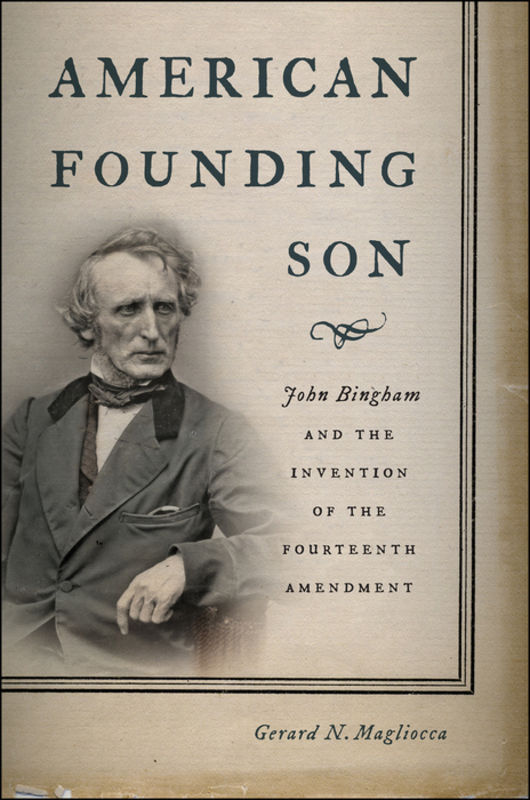
John Bingham was the architect of the rebirth of the United States following the Civil War. A leading antislavery lawyer and congressman from Ohio, Bingham wrote the most important part of the Fourteenth Amendment to the Constitution, which guarantees fundamental rights and equality to all Americans. He was also at the center of two of the greatest trials in history, giving the closing argument in the military prosecution of John Wilkes Booth's co-conspirators for the assassination of Abraham Lincoln and in the impeachment of President Andrew Johnson. And more than any other man, Bingham played the key role in shaping the Union's policy towards the occupied ex-Confederate States, with consequences that still haunt our politics.American Founding Sonprovides the most complete portrait yet of this remarkable statesman. Drawing on his personal letters and speeches, the book traces Bingham's life from his humble roots in Pennsylvania through his career as a leader of the Republican Party. Gerard N. Magliocca argues that Bingham and his congressional colleagues transformed the Constitution that the Founding Fathers created, and did so with the same ingenuity that their forbears used to create a more perfect union in the 1780s. In this book, Magliocca restores Bingham to his rightful place as one of our great leaders.Gerard N. Maglioccais the Samuel R. Rosen Professor at Indiana University Robert H. McKinney School of Law. He is the author of three books on constitutional law, and his work on Andrew Jackson was the subject of an hour-long program on C-Span'sBook TV.
eBook

Delegation and accountability in parliamentary democracies
Parliamentary democracy is the most common way of organizing delegation and accountability in contemporary democracies. Yet knowledge of this type of regime has been incomplete and often unsystematic. Delegation and Accountability in Parliamentary Democracies offers new conceptual clarity on the topic. Taking principal-agent theory as its framework, the work illustrates how a variety of apparently unrelated representation issues can now be understood. This procedure allows scholarship to move well beyond what have previously been cloudy and confusing debates aimed at defining the virtues and perils of parliamentarism. This new empirical investigation includes all 17 West European parliamentary democracies. These countries are compared in a series of cross-national tables and figures, and 17 country chapters provide a wealth of information on four discrete stages in the delegation process: delegation from voters to parliamentary representatives, delegation from parliament to the prime minister and cabinet, delegation within the cabinet, and delegation from cabinet ministers to civil servants. Each chapter illustrates how political parties serve as bonding instruments, which align incentives and permit citizen control of the policy process. This is complemented by a consideration of external constraints, such as courts, central banks, corporatism, and the European Union, which can impinge on national-level democratic delegation. The concluding chapters go on to consider how well the problems of delegation and accountability are solved in these countries. Delegation and Accountability in Parliamentary Democracies provides an unprecedented guide to contemporary European parliamentary democracies. As democratic governance is transformed at the dawn of the twenty-first century, it illustrates the important challenges faced by the parliamentary democracies of Western Europe.
eBook

The Evolution of American Legislatures
The institutional development of American legislatures, beginning with the first colonial assembly of 1619, has been marked by continuity as well as change. Peverill Squire draws upon a wealth of primary sources to document this institutional history. Beginning with the ways in which colonial assemblies followed the precedents of British institutions, Squire traces the fundamental ways they evolved to become distinct. He next charts the formation of the first state legislatures and the Constitutional Congress, describes the creation of territorial and new state legislatures, and examines the institutionalization of state legislatures in the nineteenth century and their professionalization since 1900.
With his conclusion, Squire discusses the historical trajectory of American legislatures and suggests how they might further develop over the coming decades. While Squire's approach will appeal to historians, his focus on the evolution of rules, procedures, and standing committee systems, as well as member salaries, legislative sessions, staff, and facilities, will be valuable to political scientists and legislative scholars.
eBook

On the Idea of Potency
Emanuele Castrucci bridges the two seemingly unrelated worlds of classical Greek philosophy and Jewish biblical exegesis. He connects them through the historical nexus of Christianity, which has marked the destiny of Western philosophy across the political, philosophical and jurisprudential horizons.
eBook

The Fault Lines of Farm Policy
At the intersection of the growing national conversation about our food system and the long-running debate about our government's role in society is the complex farm bill. American farm policy, built on a political coalition of related interests with competing and conflicting demands, has proven incredibly resilient despite development and growth.InThe Fault Lines of Farm PolicyJonathan Coppess analyzes the legislative and political history of the farm bill, including the evolution of congressional politics for farm policy. Disputes among the South, the Great Plains, and the Midwest form the primordial fault line that has defined the debate throughout farm policy's history. Because these regions formed the original farm coalition and have played the predominant roles throughout, this study concentrates on the three major commodities produced in these regions: cotton, wheat, and corn. Coppess examines policy development by the political and congressional interests representing these commodities, including basic drivers such as coalition building, external and internal pressures on the coalition and its fault lines, and the impact of commodity prices. This exploration of the political fault lines provides perspectives for future policy discussions and more effective policy outcomes.
eBook

BACKDOOR PURPOSIVISM
It has become standard among statutory interpretation commentators to declare that, “We are all textualists now.” The comment stems from the observation that in the modern, post-Scalia era, all of the Justices on the U.S. Supreme Court pay significant attention to statutory text when construing statutes and, relatedly, that legislative history use by the Court as a whole has declined since its heyday in the 1970s. The account of textualism’s triumph is so prevalent that some scholars have declared purposivism—or at least traditional purposivism—essentially defunct. Two prominent textualist scholars in particular have suggested that there is a “new purposivism” at work on the modern Court and that this purposivism is textually constrained, limiting its focus to the means identified in the text of the statute rather than the underlying policy objectives motivating the statute—or, alternately, using purpose as a threshold consideration in determining whether a statute’s text is ambiguous in the first place.
This Article challenges the conventional “purposivism is dead or dying” narrative in two important ways. First, relying on data from an empirical analysis of 499 Roberts Court statutory interpretation cases decided between 2006 and 2017, it argues that traditional purposivism is alive and well on the modern Supreme Court. That is, while purposivist Justices in the modern era do pay attention to text and invoke textual canons in a way that their 1970s purposivist counterparts did not, modern purposivists have not abandoned the traditional purposive approach of identifying a statute’s policy objective and adopting the construction that best fits that objective. On the contrary, modern purposivists regularly invoke statutory purpose, intent, and legislative history—even if the Court as a whole does not. Second, and perhaps more importantly, the Court’s textualist Justices have been quietly engaging in a form of purposive analysis that comes closer to traditional purposivism than scholars and jurists have recognized. That is, the textualist Justices regularly have been using pragmatic reasoning, as well as traditional textual canons such as noscitur a sociis and the whole act rule, to impute a specific intent or policy goal to Congress. This practice, which I call “backdoor purposivism,” goes beyond using text as the best evidence of statutory purpose and entails significant judicial guesswork and construction of legislative purpose and intent.
The Article suggests that, in the end, there may be less distance between textualists and purposivists than the old debates suggest—but because textualists have embraced purpose and intent in unexpected ways, rather than because, or merely because, purposivists have become more text focused. It concludes by advocating that both textualists and purposivists employ interpretive resources outside their preferred toolkit to check the accuracy of their initial statutory readings and to curb the influence of their inherent personal biases.
Journal Article
A Rule of Law
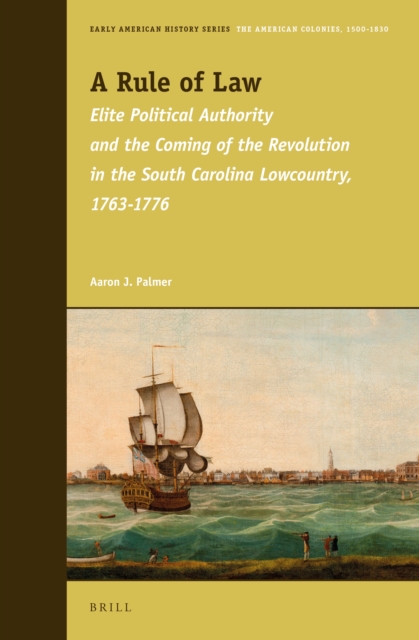
A Rule of Law offers a fresh examination of how South Carolina's colonial elite ruled through a host of institutions beyond the legislature and jealously guarded this rule against all encroachment in the period leading to the American Revolution.
eBook