
Catalogue Search | MBRL


Are you sure you want to remove the book from the shelf?

{{itemTitle}}
80,080
result(s) for
"Leisure industry"
Sort by:


The Economics of Recreation, Leisure and Tourism
This textbook describes the relevance of economics to the tourism and leisure industries, helping you to pass an economics module as part of a tourism, recreation or sport management degree.
It applies economic theory to a range of tourism industry issues at the consumer, business, national and international level by using topical examples to give the theory real-world context. The author explains the impact of the global economic crisis and the importance of understanding what has happened over the course of previous economic business cycles to prepare for what may happen in the future. Contrasting evidence is put forward to provide a sense of the dynamics of world economies.
1. Introduction Part 1: Organisations and markets 2. Organisations 3. Markets Part 2: Further issues of demand and supply 4. Demand: Time Preference 5. Elasticity and Forecasting 6. Supply and Costs Part 3: Markets in Practice 7. Market Structure and Pricing 8. Market Intervention Part 4: The External Operating Environment 9. The Competitive, Technological, Political and Sociocultural Environment 10. The Macro-Economic Environment Politics and Socio-culture Part 5: Investment 11. Investment in the Private Sector 12. Investment in the Public Sector Part 6: Economic Impacts 13. Income, Employment and Prices 14. Economic Development and Regeneration Part 7: The Global Economy 15. The Balance of Payments and Exchange Rates 16. Globalisation Part 8: Environmental Economics 17. Environmental Impacts 18. Sustainability 19. Critique 20. Critique, Alternative Perspectives and Change 21. Political, and Social Economy?
eBook

Key concepts in leisure
\"Leisure studies encompasses the broadest range of leisure and sports pursuits and marries management, administration and sports, as well as customer service. Key Concepts in Leisure presents an indispensable guide to the key themes and concepts in this rapidly developing, fast-paced and demanding industry\"--Provided by publisher.
Book

Spatial Distribution, Accessibility, and Influencing Factors of the Tourism and Leisure Industry in Qingdao, China
Analysing the spatial distribution patterns of the urban tourism and leisure industry is crucial for meeting the dual demands of residents and visitors for a better quality of life. Most existing studies on spatial distribution characteristics and the accessibility of leisure tourism have been carried out individually and lack the relationship between the tourism and leisure industry and accessibility. Based on Qingdao’s POI data, spatial visualisation methods and Geodetector are used to explore spatial distribution, accessibility, and influencing factors. (1) It is found that the overall and various types of the tourism and leisure industry in Qingdao exhibit clustered distribution, with an imbalance between coastal and inland areas. (2) There are notable spatial disparities in overall accessibility within Qingdao, with most regions falling within the 70-min isochrone. The spatial distribution of accessibility at the county level aligns with the overall accessibility patterns. (3) Various factors influence the spatial distribution of the tourism and leisure industry. Per capita disposable income is the primary factor affecting the spatial layout of Qingdao’s tourism and leisure industry. After interacting with other factors, GDP per capita and tourist trips become key influencing factors. These findings can promote the sustainable development of urban tourism in Qingdao and provide a valuable reference for other cities.
Journal Article

Handbook on the economics of leisure
Surprisingly, the field of leisure economics is not, thus far, a particular integrated or coherent one. In this volume, a wide ranging body of international scholars get to grips with this issue, taking in the traditional income/leisure choice model of textbook microeconomics and Becker's allocation of time model along the way.
Book
Researching Tourism, Leisure and Hospitality for Dissertations and Theses
Writing a dissertation can be a daunting topic - Researching Tourism, Leisure and Hospitality for Dissertations and Theses 2nd edn is a unique text that takes away the stress, worry and confusion by providing a step-by-step, user friendly guide to all you need to know to successfully research and compile your dissertation or thesis. Now in its second edition, this bestselling text has been fully revised and updated, and now includes two new chapters looking at conducting mixed methods research, as well as analysing mixed methods research. • Clearly links research processes with the presentation of these in the writing of dissertations and theses. • Draws on the work of undergraduate, postgraduate and PhD students the author has supervised, over 30 years to provide examples of dissertation/theses material. • Uses case studies/examples based on the author's own peer reviewed research. • Written in an accessible style. • Presents tried and tested student activities. It provides a discussion of research approaches, looking at key differences and similarities. A critical evaluation of these different approaches is provided and, importantly, a discussion on selecting the appropriate approach(es) for your dissertation. It takes the reader from the initial idea and topics, through the literature review, methodology, presenting and analysing results and successfully making conclusions. Unlike other texts available, this book includes case studies based on the author's own research, as well as students' work, to demonstrate different research approaches and techniques, providing an opportunity for criticism and a discussion on 'learning from mistakes.' A must-have text for all students on how best to conduct research, compile your findings and to present them in the resulting dissertation.
eBook

Advances in hospitality and leisure. Volume 15
\"Advances in Hospitality and Leisure (AHL), a peer-reviewed research journal, has been published annually since 2004. AHL is indexed in Scopus and included in the Australian Business Deans Council (ABDC) journal quality list. International in focus, the series attempts to divulge innovative methods of inquiry so as to inspire new research topics that are vital and have been in large neglected in the context of hospitality, tourism, and leisure. It strives to address the needs of the populace willing to disseminate seminal ideas, concepts, and theories derived from scholarly inquiries. This fifteenth annual volume includes eight full papers and three research notes. Most articles deploy either a quantitative or qualitative approach to data collection while two present conceptual models. The scholarly works covered in the volume are contributed by reputable researchers from five nations. The authors of this publication come from America, Europe, Asia, Pacific, and Africa. Potential readers may retrieve useful articles to outline new research agendas, suggest viable topics for a dissertation work, and augment the knowledge of the new subjects of learning.\"--Back cover.
BOOK


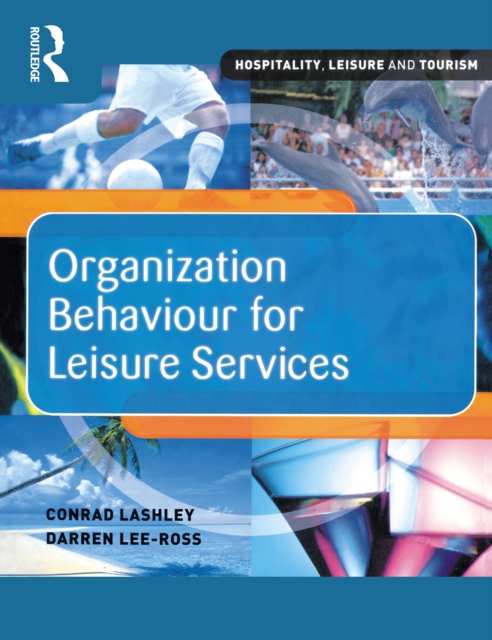
Organization behaviour for leisure services
Organization Behaviour for Leisure Services provides the reader with the conceptual tools necessary for analysing organizational behaviour in the context of hospitality, leisure and tourism provision, and understaanding events in order to take appropriate management action.Taking the view that leisure services involve an array of industry sectors - they are related, for instance, to work-time spent eating, drinking and staying away from home, as well as the more obvious recreational pursuits - the text uses examples and case studies from a wide range of international businesses such as hotels, restaurants, museums, shopping malls and sports stadia. Specific examples used are from Marriotts, McDonald's, Trafford Centre and many more. With a user-friendly structure and style, the text is an ideal introduction to the fundamental issues involved - perfect for students and managers alike.
This book discusses and questions a number of key elements, including:
The individual and the organization
Groups in the organization
Organizational structures and behaviour
Management within the organization
Commercial hospitality, leisure and tourism in a service context
There is a Tutor Resource pack available to lecturers who adopt this text. Accredited lecturers can request access to download this material by going to http://books.elsevier.com/academic/defaultmanuals.asp? to request access.
eBook