
Catalogue Search | MBRL


Are you sure you want to remove the book from the shelf?

{{itemTitle}}
92,250
result(s) for
"Lenses"
Sort by:


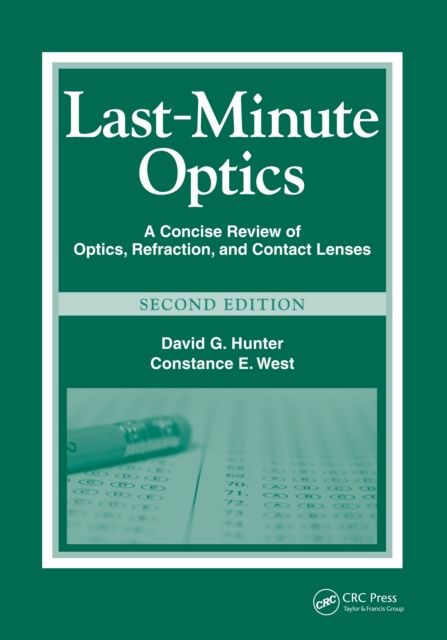
Last-Minute Optics
The popular optics review manual, Last-Minute Optics: A Concise Review of Optics, Refraction, and Contact Lenses, has been revised and updated into a Second Edition. This unique resource boils down the overwhelming subject matter of clinical optics and refraction, helping the ophthalmologist cover the essentials in a single review manual. The content is based upon the practical experience of two clinically active experts who lecture on ophthalmic optics around the world.
This updated Second Edition by Drs. David G. Hunter and Constance E. West includes new questions added to selected chapters and a new chapter covering refractive surgery, as well as a key chapter that helps you evaluate patients with symptoms related directly to optical or refractive concerns. The complex concepts of optics are revealed in easy-to-understand explanations enhanced by simple illustrations.
Last-Minute Optics, Second Edition allows you to test your knowledge while increasing your understanding of optics. Designed in a clear, concise, question-and-answer format, this book allows for self-assessment and a chance to test your understanding before you read the answer.
Features of the Second Edition:
Written in a light and approachable style to make optics accessible and understandable
Unique question-and-answer format allows for self-assessment while studying to identify areas where more work is needed
Perfect for limited study time
Includes real-life examples that are clinically relevant
Numerous practical tips to help enhance clinical practice
Includes 223 questions and answers
Whether you're an ophthalmologist, ophthalmic technician, resident, or student, reviewing the optics facts and concepts is easier with Last-Minute Optics: A Concise Review of Optics, Refraction, and Contact Lenses, Second Edition.
eBook



IOL Power
IOL Power by Kenneth J. Hoffer, MD will be the definitive resource worldwide for ophthalmologists who strive to increase the accuracy for all IOL calculations, especially for multifocal IOLs and overcoming the challenges that arise when treating patients that have had laser refractive surgery, such as RK, PRK, LASIK, and LASEK.
Inside the pages of IOL Power, Dr. Hoffer is joined by some of the most respected international physicians and physicists in the field of IOL power such as Aramberri, Haigis, Norrby, Olsen and Shammas. Together their expertise, spanning over 35 years, makes even the most difficult subjects easy to understand.
This volume will become the definitive reference source on the subject of IOL power calculation.
Some topics include:
Ultrasound velocities for axial length measurement
Optical AL (IOLMaster and Lenstar) in difficult eyes
Manual and automatic keratometry and instrumentation
Topography & Scheimpflug camera corneal power
Value of theoretic formulas
Formula personalization
Multifocal and toric IOLs
Aspheric IOLs
Effect of IOL tilt on astigmatism
Chapters Cover:
All aspects of obtaining the most accurate biometry
Available modern calculation formulas
Latest instruments
Problems that can arise, how to prevent and repair them
IOL Power by Kenneth J. Hoffer, MD is structured in a logical manner so as to cover every facet of IOL power from the basics to the most complicated subjects to achieve the most accurate and precise calculations and should be in the hands of all ophthalmic surgeons, technicians, residents and students.
eBook


Ultra-Low Surface Brightness Imaging with the Dragonfly Telephoto Array
We describe the Dragonfly Telephoto Array, a robotic imaging system optimized for the detection of extended ultra-low surface brightness structures. The array consists of eight Canon 400 mm f/2.8 L IS II USM telephoto lenses coupled to eight science-grade commercial CCD cameras. The lenses are mounted on a common framework and are coaligned to simultaneously image the same position on the sky. The system provides an imaging capability equivalent to a 0.4 m aperture f/1.0 refractor with a 2.6° × 1.9° field of view. The system is driven by custom software for instrument control and robotic operation. Data is collected with noncommon optical paths through each lens, and with careful tracking of sky variations in order to minimize systematic errors that limit the accuracy of background estimation and flat-fielding. The system has no obstructions in the light path, optimized baffling, and internal optical surfaces coated with a new generation of antireflection coatings based on subwavelength nanostructures. As a result, the array's point-spread function has a factor of ∼10 less scattered light at large radii than well-baffled reflecting telescopes. The Dragonfly Telephoto Array is capable of imaging extended structures to surface brightness levels below μB = 30 mag arcsec-2 in ∼10 h integrations (without binning or foreground star removal). This is considerably deeper than the surface brightness limit of any existing wide-field telescope. At present, no systematic errors limiting the usefulness of much longer integration times have been identified. With longer integrations (50-100 h), foreground star removal, and modest binning, the Dragonfly Telephoto Array is capable of probing structures with surface brightnesses below μB = 32 mag arcsec-2. The detection of structures at these surface brightness levels may hold the key to solving the \"missing substructure\" and \"missing satellite\" problems of conventional hierarchical galaxy formation models. The Dragonfly Telephoto Array is therefore executing a fully automated multiyear imaging survey of a complete sample of nearby galaxies in order to undertake the first census of ultrafaint substructures in the nearby universe.
Journal Article