
Catalogue Search | MBRL


Are you sure you want to remove the book from the shelf?

{{itemTitle}}
29
result(s) for
"Lernsoftware"
Sort by:

The construction of (good) parents (as professionals) in/through learning platforms
The increasing platformization of contemporary education is reshaping schooling in a multitude of ways, including the relationship parents have with their children's education. While a growing number of research is revealing the influential impacts platforms have on various educational professions, few scholars have so far looked at how parents are designed, made visible and normatively regulated (e.g., as being/becoming professional) in/through specific platforms, also because associating parents with educational professionality seems much less self-evident than for groups such as teachers or principals. As we argue in this contribution, drawing on ongoing discussions from the field of parenthood, studies offers fruitful inspiration to not only better understand what parental (educational) professionalization means, but equally how it can be brought together with research on parental platformization. Building on that literature framework, we then illuminate what we see when employing such an approach empirically, using two distinct learning platforms as case studies - ClassDojo, a classroom and behavior management platform used mainly in anglophone countries, and Antolin, a reading enhancement platform used in German schools. Drawing on the initial findings from both case studies, we conclude with a suggested research agenda around 'platformized parents' and offer a framework of questions to guide its advancement. (DIPF/Orig.).
Journal Article

The construction of (good) parents (as professionals) in/through learning platforms
The increasing platformization of contemporary education is reshaping schooling in a multitude of ways, including the relationship parents have with their children's education. While a growing number of research is revealing the influential impacts platforms have on various educational professions, few scholars have so far looked at how parents are designed, made visible and normatively regulated (e.g., as being/becoming professional) in/through specific platforms, also because associating parents with educational professionality seems much less self-evident than for groups such as teachers or principals. As we argue in this contribution, drawing on ongoing discussions from the field of parenthood, studies offers fruitful inspiration to not only better understand what parental (educational) professionalization means, but equally how it can be brought together with research on parental platformization. Building on that literature framework, we then illuminate what we see when employing such an approach empirically, using two distinct learning platforms as case studies - ClassDojo, a classroom and behavior management platform used mainly in anglophone countries, and Antolin, a reading enhancement platform used in German schools. Drawing on the initial findings from both case studies, we conclude with a suggested research agenda around 'platformized parents' and offer a framework of questions to guide its advancement. (DIPF/Orig.).
Journal Article

The Business of Innovating Online
The Business of Innovating Online responds to a critical need for concrete narratives of innovation success that can serve as a foundation for administrators and leaders who are in need of practical guidance as they scale and grow their online learning organizations.
Through specific examples and practical suggestions from experienced e-learning leaders, readers will be introduced to concrete strategies for how to create a climate of creativity and innovation that can lead to more successful and scalable online programs and initiatives. The Business of Innovating Online demystifies the relationship between business, creativity, and innovation by describing the logistics required to create an agile online education enterprise. Topics discussed will include:
Defining innovation and creativity for online education and e-learning
Knowing when and how to innovate
Creating a culture of innovation
Effectively leading innovation
Collaborative innovation
Making innovation stick and transitioning innovative strategies into day-to-day practice
Assuring quality in the midst of innovation
Staffing structures/administrative stability to support creativity and innovation
The Business of Innovating Online provides both novice and experienced online education administrators with a comprehensive overview of a range of online innovations, how they came to be created, the components that led to their success, and concrete steps that they can take to create a more innovative culture for their own e-learning organization.
eBook

Determining a framework for institutional support of instructors engaged in distance education programmes using the multiple-criteria decision-making method
Distance education (DE) has a unique potential to ensure continuity of education in extraordinary circumstances such as pandemics and earthquakes, in addition to its advantages such as flexibility in terms of time and space and self-paced learning options. Institutional support provided for instructors engaged in DE programmes is one of the factors which directly affect the efficiency of DE and the quality of the education provided. This study aimed to determine the criteria of institutional support offered to DE instructors through document analysis, and to reveal the importance weights of those criteria by using the method of multi-criteria decision-making (MCDM). The author examined the standards published by a number of accreditation institutions and international educational organisations for DE, and determined the importance weights of those criteria by applying an analytic hierarchy process (AHP). She determined seven support criteria, namely (in order of importance): (1) technical training and orientation; (2) teaching material and resource support; (3) technical support; (4) professional development support; (5) support during the course; (6) evaluation and report submission support; and (7) career development, incentives and financial support. In presenting her study, the author provides an effective evaluation framework for DE support systems which includes a comprehensive set of indicators based on a literature review and feedback from experts.
Journal Article
Eva-CBTM: Evaluation of Computer Based Online Training Programs for Mathematics
Long description: Eva-CBTM is a project for the Evaluation of Computer Based programs for learning and Teaching Mathematics.
The idea of Eva-CBTM is to develop a complete system for such an evaluation which is valid, reliable and objective.
The evaluation system is based on a process oriented view at computer based practicing of mathematics. The system has the following components: assessment, assistance resp. help, architecture of the system, system of choosing exercises, and degrees of freedom. The consideration of thematic completeness plays an important role in the evaluation process.
In the first two chapters over 60 platforms for learning and practicing mathematics are presented in short, 15 of them are fully evaluated.
Chapter III discusses the potential of platforms for presenting more complex tasks, for instance problem solving or modeling.
Chapter IV describes a method to measure the didactical comprehensiveness of CBTM-platforms, i.e., the depth in which a certain topic is dealt with in exercises.
Long description:
eBook

Das schulische Üben mit digitalen Medien - und was das für den Unterricht bedeutet
Unterrichtsentwicklung ist ein bedeutsamer Teil von Schulentwicklung und findet aktuell in großem Maße durch die zunehmende Digitalisierung von Schulen statt. Dabei wird einerseits systematisch eine Infrastruktur aufgebaut, aber andererseits die konkrete Umsetzung den einzelnen Schulen mehr oder weniger überlassen. Bisher gibt es wenige Arbeiten, die sich mit den sich verändernden Unterrichtsstrukturen beim Einsatz digitaler Medien selbst auseinandersetzen. Der Beitrag geht dieser Frage mit dem Fokus auf das Üben im Unterricht nach: Wie gestaltet sich das Üben, wenn es über digitale Medien erfolgt? Anhand von Unterrichtsprotokollen aus einem Mathematikunterricht der 6. Klasse wird rekonstruktionslogisch analysiert, inwieweit die Feedbacksysteme den Schüler*innen bei der Bearbeitung der Aufgaben helfen bzw. wie sie mit den automatisierten Antworten umgehen. Es wird abschließend diskutiert, inwieweit diese Prozesse Auswirkungen auf die Theorie von Unterrichten haben könnten. (DIPF/Orig.).
Classroom development is a significant part of school development and is currently taking place through digitization. In Germany, an infrastructure is being systematically built up, but the concrete implementation is left to the individual schools. There have been just a few studies that deal with the changing teaching structures when using digital media. This paper focus on how teaching is structured when it takes place via learning software. On the basis of lesson protocols from a 6th grade mathematics class in Germany, an analysis is performed using structural hermeneutics methods to investigate to what extent the feedback systems help the students process the tasks and how they deal with the automated answers. Finally, we discuss to what extent these processes could have an impact on the theory of teaching. (DIPF/Orig.).
Journal Article

Exploring Advanced Euclidean Geometry with GeoGebra
Exploring Advanced Euclidean Geometry with GeoGebra provides an inquiry-based introduction to advanced Euclidean geometry. It utilizes dynamic geometry software, specifically GeoGebra, to explore the statements and proofs of many of the most interesting theorems in the subject. Topics covered include triangle centers, inscribed, circumscribed, and escribed circles, medial and orthic triangles, the nine-point circle, duality, and the theorems of Ceva and Menelaus, as well as numerous applications of those theorems. The final chapter explores constructions in the Poincaré disk model for hyperbolic geometry. The book can be used either as a computer laboratory manual to supplement an undergraduate course in geometry or as a standalone introduction to advanced topics in Euclidean geometry.
eBook
Gamification with moodle
This book describes how teachers can use Gamification design within the Moodle Learning Management System. Game elements can be included in course design by using, badges, rubrics, custom grading scales, forums, and conditional activities. Moodle courses do not have to be solo-learning experiences that replicate Distance Education models. The Gamification design process starts by profiling players and creating levels of achievement towards meeting learning outcomes. Each task is defined, valued, and sequenced. Motivation loops are devised to keep the momentum going. In a gaming studio, this approach would require a team of specialists with a large budget and time frames. Preparing for a class rarely has these optimal conditions. The approach used in this book is to introduce game elements into the course design gradually. First, apply gamification to just one lesson and then build up to gamifying a series of lessons over a term. Each example will indicate the difficulty level and time investment. Try it out to see what is most effective with your learners and choose wisely in your use of technology. By the end of this book, you will be able to create Moodle courses that incorporate choice, communication, challenge, and creativity.
eBook

E-learning and the science of instruction : proven guidelines for consumers and designers of multimedia learning
The essential e-learning design manual, updated with the latest research, design principles, and examplese-Learning and the Science of Instructionis the ultimate handbook for evidence-based e-learning design. Since the first edition of this book, e-learning has grown to account for at least 40% of all training delivery media. However, digital courses often fail to reach their potential for learning effectiveness and efficiency. This guide provides research-based guidelines on how best to present content with text, graphics, and audio as well as the conditions under which those guidelines are most effective. This updated fourth edition describes the guidelines, psychology, and applications for ways to improve learning through personalization techniques, coherence, animations, and a new chapter on evidence-based game design. The chapter on the Cognitive Theory of Multimedia Learning introduces three forms of cognitive load which are revisited throughout each chapter as the psychological basis for chapter principles. A new chapter on engagement in learning lays the groundwork for in-depth reviews of how to leverage worked examples, practice, online collaboration, and learner control to optimize learning. The updated instructor's materials include a syllabus, assignments, storyboard projects, and test items that you can adapt to your own course schedule and students.Co-authored by the most productive instructional research scientist in the world, Dr. Richard E. Mayer, this book distills copious e-learning research into a practical manual for improving learning through optimal design and delivery.Get up to date on the latest e-learning researchAdopt best practices for communicating information effectivelyUse evidence-based techniques to engage your learnersReplace popular instructional ideas, such as learning styles with evidence-based guidelinesApply evidence-based design techniques to optimize learning gamese-Learning continues to grow as an alternative or adjunct to the classroom, and correspondingly, has become a focus among researchers in learning-related fields. New findings from research laboratories can inform the design and development of e-learning. However, much of this research published in technical journals is inaccessible to those who actually design e-learning material. By collecting the latest evidence into a single volume and translating the theoretical into the practical, e-Learning and the Science of Instructionhas become an essential resource for consumers and designers of multimedia learning.
eBook
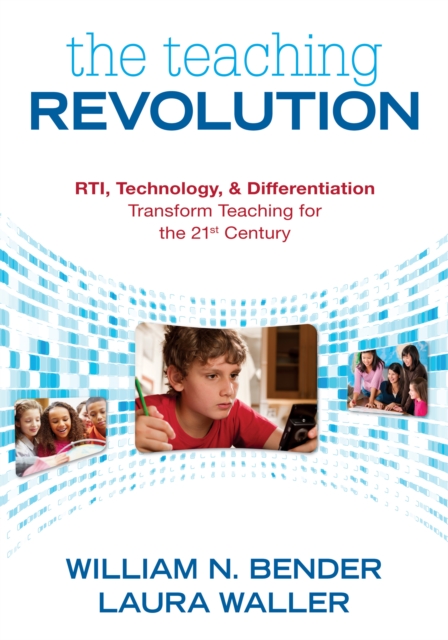
The teaching revolution
The book challenges educators to imagine schools the way they should be, with a \"big picture\" vision that includes student-driven curricula, interconnectivity, and targeted responsiveness to students' individual needs. The authors provide a futuristic and provocative discussion on combining three major instructional innovations - RTI, technology, and differentiation. Drawing on the growing 21st-century skills movement, the text engagingly weaves these three areas into a vision for school transformation that includes: Utilizing mobile technologies, Web-based instruction, and social media; RTI that benefits all students and whole schools in their improvement efforts; Project-based learning focused on answering real-world questions. The symbiosis of RTI, technology, and differentiated instruction is so impactful that is will soon dramatically reform teaching. (Orig.).
eBook