
Catalogue Search | MBRL


Are you sure you want to remove the book from the shelf?

{{itemTitle}}
11,138
result(s) for
"Letter writing"
Sort by:

Sincerely, you : letter-writing to change the world
\"This guidebook tells the story of the creation of Savannah's Soldiers, a school-based letter-writing foundation, and provides real-world letter writing advice for young readers\"-- Provided by publisher.
Book

The Culture of Letter-Writing in Pre-Modern Islamic Society
This book presents a unique analysis of letter writing in the Middle Islamic period. This was an important aspect of intellectual life among the ruling classes in that period and it can tell us a great deal about the cultural history of the time. The author sets epistolography within a wider context, drawing on similarities between Islamic modes of letter writing and those of Western cultures. He ties in the crucial notion of the power of the pen in Islamic society with epistemological trends and relationships of dependency among the bureaucracy.
eBook

Ship of dolls
It's 1926, and the one thing eleven-year-old Lexie Lewis wants more than anything is to leave Portland, where she is living with her strict grandparents, and rejoin her mother, a carefree singer in San Francisco. Lexie's class has been raising money to ship a doll to the children of Japan in a friendship exchange, and when Lexie learns that the girl who writes the best letter to accompany the doll will be sent to the farewell ceremony in San Francisco, she knows she just has to be the winner.
Book

Reading the Letters of Pliny the Younger
This is the first general introduction to Pliny's Letters published in any language, combining close readings with broader context and adopting a fresh and innovative approach to reading the letters as an artistically structured collection. Chapter 1 traces Pliny's autobiographical narrative throughout the Letters; Chapter 2 undertakes detailed study of Book 6 as an artistic entity; while Chapter 3 sets Pliny's letters within a Roman epistolographical tradition dominated by Cicero and Seneca. Chapters 4 to 7 study thematic letter cycles within the collection, including those on Pliny's famous country villas and his relationships with Pliny the Elder and Tacitus. The final chapter focuses on the 'grand design' which unifies and structures the collection. Four detailed appendices give invaluable historical and scholarly context, including a helpful timeline for Pliny's life and career, detailed bibliographical help on over 30 popular topics in Pliny's letters and a summary of the main characters mentioned in the Letters.
eBook

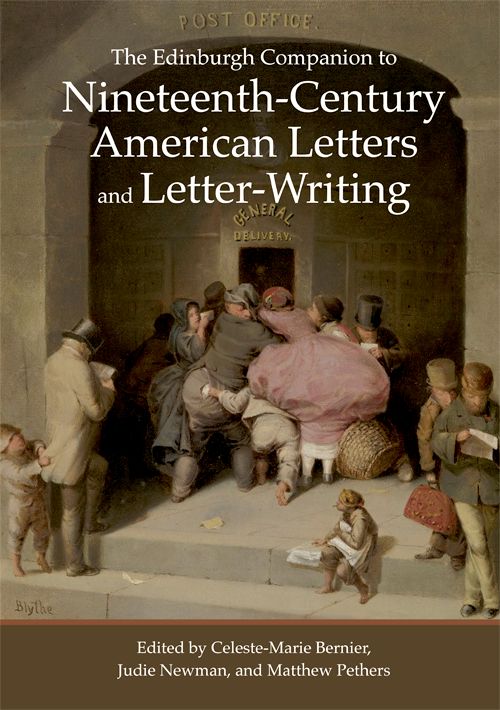
The Edinburgh Companion to Nineteenth-Century American Letters and Letter-Writing
This comprehensive study by leading scholars in an important new field-the history of letters and letter writing-is essential reading for anyone interested in nineteenth-century American politics, history or literature.
eBook

Writing a business letter
\"Writing is an important skill that kids use almost every day. The goal of the Write it Right series is to make kids writing experts. Writing a Business Letter is full of tips and tricks to help kids craft a professional letter, from forming an opinion to addressing the envelope. This book includes a table of contents, glossary, index, author biography, activities, and instructions\"-- Provided by publisher.
Book

Authors of Their Lives
2008 United States Postal System's Rita Lloyd Moroney Award
In the era before airplanes and e-mail, how did immigrants keep in touch with loved ones in their homelands, as well as preserve links with pasts that were rooted in places from which they voluntarily left? Regardless of literacy level, they wrote letters, explains David A. Gerber in this path-breaking study of British immigrants to the U.S. and Canada who wrote and received letters during the nineteenth century.
Scholars have long used immigrant letters as a lens to examine the experiences of immigrant groups and the communities they build in their new homelands. Yet immigrants as individual letter writers have not received significant attention; rather, their letters are often used to add color to narratives informed by other types of sources.
Authors of Their Lives analyzes the cycle of correspondence between immigrants and their homelands, paying particular attention to the role played by letters in reformulating relationships made vulnerable by separation. Letters provided sources of continuity in lives disrupted by movement across vast spaces that disrupted personal identities, which depend on continuity between past and present. Gerber reveals how ordinary artisans, farmers, factory workers, and housewives engaged in correspondence that lasted for years and addressed subjects of the most profound emotional and practical significance.
eBook

In My Power
In My Powertells the story of letter writing and communications in the creation of the British Empire and the formation of the United States. In an era of bewildering geographical mobility, economic metamorphosis, and political upheaval, the proliferation of letter writing and the development of a communications infrastructure enabled middle-class Britons and Americans to rise to advantage in the British Atlantic world.
Everyday letter writing demonstrated that the blessings of success in the early modern world could come less from the control of overt political power than from the cultivation of social skills that assured the middle class of their technical credentials, moral deserving, and social innocence. In writing letters, the middle class not only took effective action in a turbulent world but also defined what they believed themselves to be able to do in that world. Because this ideology of agency was extended to women and the youngest of children in the eighteenth century, it could be presented as universalized even as it was withheld from Native Americans and enslaved blacks.
Whatever the explicit purposes behind letter writing may have been-educational improvement, family connection, business enterprise-the effect was to render the full terms of social division invisible both to those who accumulated power and to those who did not. The uncontested power that came from letter writing was, Konstantin Dierks provocatively argues, as important as racist violence to the rise of the white middle class in the British Atlantic world.
eBook