
Catalogue Search | MBRL


Are you sure you want to remove the book from the shelf?

{{itemTitle}}
48
result(s) for
"Lettering in art."
Sort by:

The typographic universe : letterforms found in nature, the built world and human imagination
A celebration of the world of letters found or created in unexpected places: natural, artificial, and urban alike. Even non-graphic designers know that type is everywhere: fonts and typefaces fill everything we consume or inhabit. They communicate, inform, sell, explain ... and yet finding serendipitous letterforms in the least likely locations can also excite and inspire. Once experienced, it is impossible not to see letters in anything from forests to housing projects, from leaves to brickwork. The eye becomes accustomed to seeing a world built of letters. Unlike most books on typography that present the \"best\"; and most refined examples, the object here is to reveal the \"lost\" or \"unseen\" typographies in nature and our cities. From machine-made and sculptural forms to flora and fauna, from the fading ghost types on buildings from a pre-digital age to the subterranean forms found beneath our urban centers, from crowd-sourced creations to the popular vernacular, there is a universe of letterforms all around us.
Book
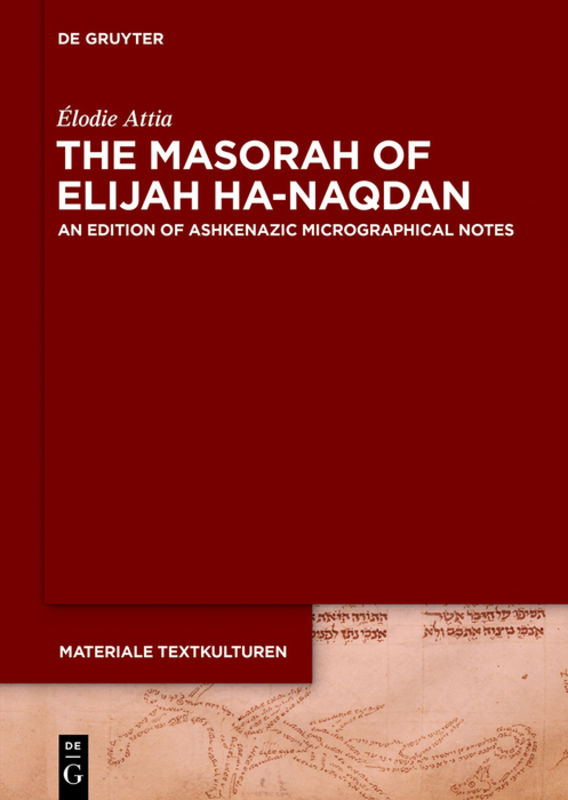
The Masorah of Elijah ha-Naqdan
Following Levita's statement, the Masorah transmitted by medieval illuminated manuscripts was generally considered as less significant for the study of the biblical and masoretical knowledge in the Jewish world. The biblical codices produced in Ashkenaz were considerably disregarded compared to Spanish codices. Challenging this assertion, this work engages in a reflection on the link between the standard Eastern tradition and the Ashkenazic biblical text-culture of the 13 th century.
Élodie Attia provides an edition of thirteen cases taken from MS Vat. Ebr. 14, offering the oldest series of Masoretic notes written inside figurative and ornamental designs. Its critical apparatus offers an unprecedented comparison with the oldest Eastern and Ashkenazic sources to evaluate if the scribe paid more attention to aesthetic details than to the textual contents.
In an unexpected way, the Masoretic notes of Elijah ha-Naqdan, even written in figurative forms, show a close philological link with the Masorah of the eastern Tiberian sources and prove that the presence of figurative elements neither represents a loss nor a distortion of Masoretic knowledge, but rather illustrates a development in the Masoretic tradition.
eBook

Line, form, qi : calligraphic art from the Fondation INK collection
\"Featuring more than 30 artists, Line, Form, Qi highlights contemporary works that range from the traditional to the deeply experimental. The publication features predominantly Chinese artists, along with Vietnamese, Taiwanese, Japanese and Korean artists working mainly with Chinese characters. The themes reflect significant trends and innovations in contemporary calligraphic art, including abstraction of the character, performance and phenomenological practice, and the exploration of alternative or nontraditional materials and calligraphy methods such as incense burn drawing and lithography. This publication also addresses different through lines from premodern calligraphy to contemporary practice, reflecting the evolution of the Chinese language from pictograph to ideograph and beyond.\"-- description from https://www.artbook.com/9781636811581.html, accessed 20250604.
BOOK

Is There No Black in the Woman Question? Virago Press and the Issue of Collective Black Female Authorship
This article explores the space of Black women's collective voice within the British feminist printing industry. It employs Western theory (primarily Pierre Bourdieu's fields of production) to reflect how a publishing organ—indebted to forwarding second-wave feminism—could silence the praxis and polyvocality of Britain's burgeoning womanism. Initially conscious of the power dynamic between publisher and author(s)—a power dynamic that is exacerbated by the contested identities of being both Black and woman in Britain—\"Is There No Black in the Woman Question?\" ends with an excavation into the dissenting potentialities of Black women's lettering. It examines networks of circulation, consecration, and production that operate outside the hegemonic world-system and, undermining the fixity of core-periphery models, highlights Black British women's voices in The Heart of the Race: Black Women's Lives in Britain (1985). Consequently, \"Is There No Black in the Woman Question?\" hopes to offer ways of approaching, reading, and worlding Black texts that acknowledge their existence within and without Western processes. Which is to say, an approach that recognizes the admixture, the diasporic, the conversation: what it means to be both Black and British.
Journal Article

Calligraphy and Architecture in the Muslim World
This major reference work covers all aspects of architectural inscriptions in the Muslim world: the artists and their patrons, what inscriptions add to architectural design, what materials were used, what their purpose was and how they infuse buildings with meaning.
eBook

Blake Writes Backward
Early in his career as an engraver, William Blake developed a means of lettering on copper printing plates, using a sharply pointed tool to incise letters and numbers backward so that they would appear in the proper orientation when printed. Blake’s drypoint retrography was similar to techniques employed by other engravers, but his lettering is sufficiently distinctive to use in identifying his graphic work. He subsequently adapted the letterforms used in this technique to other graphic processes such as relief and intaglio etching of texts, most notably the words in many of his illuminated books.
Journal Article

The Berkeley Plato
This book explores the provenance of the so-called Berkeley Herm of Plato, a sculptural portrait that Stephen G. Miller first encountered over thirty years ago in a university storage basement. The head, languishing since its arrival in 1902, had become detached from the body, or herm, and had been labeled a fake. In 2002, while preparing another book, Miller—now an experienced archaeologist—needed an illustration of Plato, remembered this piece, and took another look. The marble, he recognized immediately, was from the Greek islands, the inscription appeared ancient, and the ribbons visible on the head were typical of those in Greek athletic scenes. The Berkeley Plato, rich in scientific, archaeological, and historical detail, tells the fascinating story of how Miller was able to authenticate this long-dismissed treasure. His conclusion, that it is an ancient Roman copy possibly dating from the time of Hadrian, is further supported by art conservation scientist John Twilley, whose essay appears as an appendix. Miller's discovery makes a significant contribution to the worlds of art history, philosophy, archaeology, and sports history and will serve as a starting point for new research in the back rooms of museums.
eBook


Archigraphy
Schrift am Bau und im ffentlichen Raum prgt unser Umfeld. Den Kern des Buches bilden aktuelle Archigrafien, die exemplarisch fr Strategien stehen, wie Architektur durch grafische Elemente angereichert werden kann. Die konstruktiven, materiellen oder visuellen Methoden werden so fr eigene Entwrfe nutzbar. Eine Sammlung von Beschriftungstechniken und Hinweise zum Projektmanagement machen das Buch zu einem Werkzeug fr Architekten und Grafiker.
eBook

Drawing Type
Part inspiration and part workbook, the images of hand-drawn type will inspire and excite any designer to draw and explore type. Drawing Type features real-world projects and sketchbooks of well-known type designers, including interviews about their processes.
eBook