
Catalogue Search | MBRL


Are you sure you want to remove the book from the shelf?

{{itemTitle}}
9
result(s) for
"Lexicographers Great Britain Biography."
Sort by:

The right word : Roget and his thesaurus
The story of \"shy young Peter Mark Roget, [for whom] books were the best companions--and it wasn't long before Peter began writing his own book. But he didn't write stories; he wrote lists. Peter took his love for words and turned it to organizing ideas and finding exactly the right word to express just what he thought. His lists grew and grew, eventually turning into one of the most important reference books of all time\"--Amazon.com.
BOOK


The Life of Samuel Johnson, LL.D
This is the first and only scholarly edition of Sir John Hawkins's Life of Samuel Johnson, LL.D., a work that has not been widely available in complete form for more than two hundred years. Published in 1787, some four years before James Boswell's biography of Johnson, Hawkins's Life complements, clarifies, and often corrects numerous aspects of Boswell's Life. Samuel Johnson (1709-84) is the most significant English writer of the second half of the eighteenth century; indeed, this period is widely known as the Age of Johnson. Hawkins was Johnson's friend and legal adviser and the chief executor of his will. He knew Johnson longer and in many respects better than other biographers, including Boswell, who made unacknowledged use of Hawkins's Life and helped orchestrate the critical attacks that consigned the book to obscurity. Sir John Hawkins had special insight into Johnson's mental states at various points in his life, his early days in London, his association with the Gentleman's Magazine, and his political views and writings. Hawkins's use of historical and cultural details, an uncommon literary device at the time, produced one of the earliest \"life and times\" biographies in our language. The Introduction by O M Brack, Jr., covers the history of the composition, publication, and reception of the Life and provides a context in which it should be read. Annotations address historical, literary, and linguistic uncertainties, and a full textual apparatus documents how Brack arrived at this definitive text of Hawkins's Life.
eBook
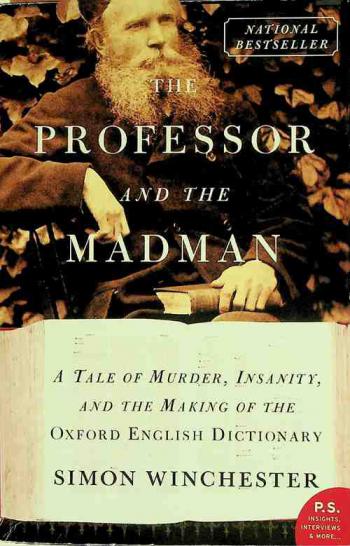
The professor and the madman : a tale of murder, insanity, and the making of the Oxford English dictionary
\"The creation of the Oxford English Dictionary began in 1857, took seventy years to complete, drew from tens of thousands of brilliant minds, and organized the sprawling language into 414,825 precise definitions. But hidden within the rituals of its creation is a fascinating and mysterious story - a story of two remarkable men whose strange twenty-year relationship lies at the core of this historic undertaking.\" \"Professor James Murray, an astonishingly learned former schoolmaster and bank clerk, was the distinguished editor of the OED project. Dr. William Chester Minor, an American surgeon from New Haven, Connecticut, who had served in the Civil War, was one of thousands of contributors who submitted illustrative quotations of words to be used in the dictionary. But Minor was no ordinary contributor. He was remarkably prolific, sending thousands of neat, handwritten quotations from his home in the small village of Crowthorne, fifty miles from Oxford. On numerous occasions Murray invited Minor to visit Oxford and celebrate his work, but Murray's offer was regularly-and mysteriously-refused.\" \"Thus the two men, for two decades, maintained a close relationship only through correspondence. Finally, in 1896, after Minor had sent nearly ten thousand definitions to the dictionary but had still never traveled from his home, a puzzled Murray set out to visit him. It was then that Murray finally learned the truth about Minor-that, in addition to being a masterful wordsmith, Minor was also a murderer, clinically insane-and locked up in Broadmoor, England's harshest asylum for criminal lunatics.\"--Jacket
Book

Samuel Johnson and the Journey into Words
Popular readings of Johnson as a dictionary-maker often depict him as a writer who both laments — and attempts to control — the state of the language. This book looks at the range of Johnson’s writings on, and the complexity of his thinking about, language and lexicography, not least with reference to the difficulties of power when exerted over the ‘sea of words’. Dictionary-making, for Johnson, came to be seen as a long and difficult voyage round the world of the English language. While such images play their own role in lexicographical tradition, Johnson would, as this volume explores, also make them very much his own. Johnson’s metaphors can invite us to consider — and reconsider — the processes by which a dictionary might be made and the kind of destination it might seek, as well as the state of language that might be reached by such endeavours. For Johnson, where the dictionary-maker might go, and what should be accomplished along the way, can raise a range of pertinent and perhaps troubling questions. Paying close attention to Johnson’s attitudes to language change, loanwords, usage, spelling, history, and authority, this volume engages with the evolution of his ideas about the nature, purpose, and methods of lexicography and the limits of the power the dictionary-maker might assume. While Johnson, of necessity, repeatedly probes problems of meaning and use, related issues of control, and obedience, and variation and change, can often be equally prominent, alongside his commitment to evidence, and the uses to which this might be put.
eBook


\His Proper Business\: Johnson's Adjustment to Society
Dislocation in Samuel Johnson's writing is discussed. Johnson's knowledge that he did not belong to the social world can be seen alongside his knowledge that he is one of Locke's ideal auditors.
Journal Article