
Catalogue Search | MBRL


Are you sure you want to remove the book from the shelf?

{{itemTitle}}
167
result(s) for
"Liberalism Arab countries."
Sort by:


Nationalism and Liberal Thought in the Arab East
This book explores the complex relationship between nationalism and liberal thought in the Arab East during the first half of the twentieth century. Examining this formative period through reformist Islam, Arab secularism and Arab literature, the book situates major shifts in the political ideologies and practices of Arab liberals within a historical context.
Contributions from renowned scholars in the field show how rather than fundamentally contradicting each other, these two schools of thought are closely linked. Many key demands of liberalism - most notably constitutionalism, the rule of law, individual rights, and popular participation - have been central to the nationalist agenda, while other issues have proven more controversial: inter-confessional tolerance, secularism, and the goals of state-sponsored education. Although a strong nation-state was pivotal to the nationalist imagination during most of the twentieth century, a powerful critique of unchecked state power took shape as Arab countries experienced a half-century of authoritarian government. In analyzing these issues, the chapters demonstrate how the rise and fall of liberalism across the region was not determined solely by religion or culture, but by the ideas of influential intellectuals and politicians.
Advancing our understanding of political ideology and practice in the Arab East, this volume will be of great interest to students and scholars of political science, history and the Middle East.
Introduction Part I: Nationalism and Liberal Thought 1. The role of traditional religious scholars in Iraqi politics from the Young Turk period until 1920: the example of Yusuf al-Suwaydi Thomas Eich 2. Who is \"liberal\" in 1930s Iraq? Education as a contested terrain in a nascent public sphere Peter Wien 3. Liberal champions of pan-Arabism: Syria’s second Íizb al-Sha'b Fred H. Lawson 4. Nation, state, and democracy in the writings of Zaki al-Arsuzi Dalal Arsuzi-Elamir 5. Nationalism as a cause: Arab nationalism in the writings of Ghassan Kanafani Orit Bashkin Part II: Arab intellectuals and liberal thought 6. Modernity, romanticism, and religion: contradictions in the writings of Farah Antun Alexander Flores 7. Progress and liberal thought in al-Hil'al, al-Man'ar, and al-Muqta'aaf before World War I Thomas Philipp 8. Liberal democracy versus fascist totalitarianism in Egyptian intellectual discourse: the case of Salama Musa and 'al-Majalla al-JadÐda' Israel Gershoni 9. The \"failure\" of radical nationalism and the \"silence\" of liberal thought in the Arab world Christoph Schumann
Christoph Schumann is Professor of Politics and Contemporary History of the Middle East at the University of Erlangen-Nuremberg, Germany. His research focuses on political ideologies in the Middle East and Muslims in the West, and he has previously written on the topics of liberalism in the Mediterranean and radical nationalism in Syria and Lebanon.
eBook

Arabic Thought Beyond the Liberal Age : Towards an Intellectual History of the Nahda
\"What is the relationship between thought and practice in the domains of language, literature and politics? Is thought the only standard by which to measure intellectual history? How did Arab intellectuals change and affect political, social, cultural and economic developments from the eighteenth to the twentieth centuries? This volume offers a fundamental overhaul and revival of modern Arab intellectual history. Using Hourani's Arabic Thought in the Liberal Age, 1798-1939 (Cambridge, 1962) as a starting point, it reassesses Arabic cultural production and political thought in the light of current scholarship and extends the analysis beyond Napoleon's invasion of Egypt and the outbreak of World War II. The chapters offer a mixture of broad-stroke history on the construction of 'the Muslim world,' and the emergence of the rule of law and constitutionalism in the Ottoman empire, as well as case studies on individual Arab intellectuals that illuminate the transformation of modern Arabic thought\"-- Provided by publisher.
BOOK
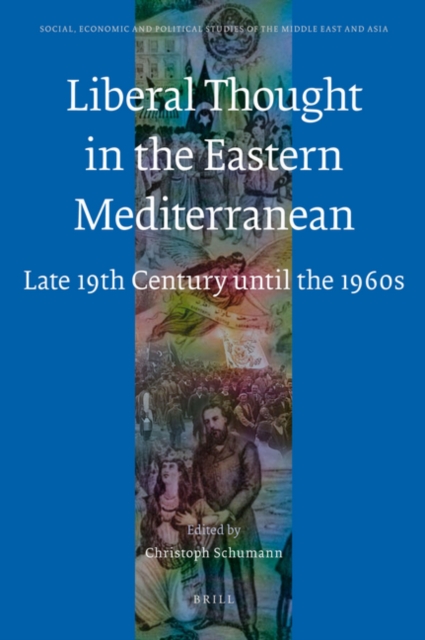
Liberal Thought in the Eastern Mediterranean
This volume analyzes a century of intellectual debates, political ideologies, and literary media in order to track the emergence, spread and decline of liberal thought as a response to both authoritarian rule and Westernization in the Eastern Mediterranean.
eBook

Zionism in Arab discourses
Zionism in Arab discourses presents a ground-breaking study of the Arab-Israeli conflict. Through analyses of hundreds of texts written by Arab Islamists and liberals from the late-nineteenth century to the 'Arab Spring', the book demonstrates that the Zionist enterprise has played a dual function of an enemy and a mentor. Islamists and liberals alike discovered, respectively, in Zionism and in Israeli society qualities they sought to implement in their sown homelands. Focusing on Palestinian, Egyptian, Syrian and Jordanian political discourses, this study uncovers fascinating and unexpected Arab points of views on different aspects of Zionism; from the first Zionist Congress to the First Lebanon War; from gardening in the early years of Tel Aviv to women's service in the Israeli Defence Forces; from the role of religion in the creation of the state to the role of democracy in its preservation. This study presents the debates between and within contesting Arab ideological trends on a conflict that has shaped, and is certain to continue and shape, one of the most complicated regions in the world.
eBook

Egypt after Mubarak
Which way will Egypt go now that Husni Mubarak's authoritarian regime has been swept from power? Will it become an Islamic theocracy similar to Iran? Will it embrace Western-style liberalism and democracy?Egypt after Mubarakreveals that Egypt's secularists and Islamists may yet navigate a middle path that results in a uniquely Islamic form of liberalism and, perhaps, democracy. Bruce Rutherford draws on in-depth interviews with Egyptian judges, lawyers, Islamic activists, politicians, and businesspeople. He utilizes major court rulings, political documents of the Muslim Brotherhood, and the writings of Egypt's leading contemporary Islamic thinkers. Rutherford demonstrates that, in post-Mubarak Egypt, progress toward liberalism and democracy is likely to be slow.
Essential reading on a subject of global importance, this edition includes a new introduction by Rutherford that takes stock of the Arab Spring and the Muslim Brotherhood's victories in the 2011-2012 elections.
eBook

The American University of Beirut : Arab nationalism and liberal education
No detailed description available for \"The American University of Beirut\".
eBook
Zionism in Arab discourses
Zionism in Arab discourses presents a ground-breaking study of the Arab-Israeli conflict. Through analyses of hundreds of texts written by Arab Islamists and liberals from the late-nineteenth century to the 'Arab Spring', the book demonstrates that the Zionist enterprise has played a dual function of an enemy and a mentor. Islamists and liberals alike discovered, respectively, in Zionism and in Israeli society qualities they sought to implement in their sown homelands. Focusing on Palestinian, Egyptian, Syrian and Jordanian political discourses, this study uncovers fascinating and unexpected Arab points of views on different aspects of Zionism; from the first Zionist Congress to the First Lebanon War; from gardening in the early years of Tel Aviv to women's service in the Israeli Defence Forces; from the role of religion in the creation of the state to the role of democracy in its preservation. This study presents the debates between and within contesting Arab ideological trends on a conflict that has shaped, and is certain to continue and shape, one of the most complicated regions in the world.
eBook

The Arab Spring: Why the Surprising Similarities with the Revolutionary Wave of 1848?
Prominent scholars have highlighted important similarities between the Arab Spring of 2011 and the “revolutions” of 1848: Both waves of contention swept with dramatic speed across whole regions, but ended up yielding rather limited advances toward political liberalism and democracy. I seek to uncover the causal mechanisms that help account for these striking parallels. Drawing on my recent analysis of 1848, I argue that contention spread so quickly because many people in a wide range of countries drew rash inferences from the downfall of Tunisia's dictator. Applying cognitive heuristics that psychologists have documented, they overrated the significance of the Tunisian success, overestimated the similarities with the political situation in their own country, and jumped to the conclusion that they could successfully challenge their own autocrats. This precipitation prompted protests in many settings that actually were much less propitious; therefore problems abounded. Cognitive shortcuts held such sway because Arab societies were weakly organized and repressed and thus lacked leaders from whom common people could take authoritative cues. The decision whether to engage in emulative contention fell to ordinary citizens, who—due to limited information access and scarce experience—were especially susceptible to the simple inferences suggested by cognitive heuristics.
Journal Article

The Abraham Accords and Normalization between Arab Countries and Israel: The Impact of the Gaza-Israeli War of 2023
The Abraham Accords signed in 2020, which provided for the establishment of diplomatic ties and normalization of relations between Israel and the UAE, Bahrain, Morocco, and Sudan, were of great importance in the peaceful settlement of the Arab-Israeli conflict. The signing of the agreements not only established diplomatic relations between Israel and those Arab countries but also opened new opportunities for broad cooperation in various economic spheres. The Gaza-Israel conflict that began in October 2023 has intensified anti-Israel sentiment in Arab public circles and hindered the establishment of relations between Arab countries and Israel as envisioned by the Abraham Accords. Nevertheless, there have been no significant changes in political decision-making, and no agreements have been suspended or revoked. The article discusses the normalization process between Arab countries and Israel, as well as the impact of the outbreak and expansion of the Gaza-Israel conflict in 2023 on this normalization. The author argues that despite the rising tension and strong Arab resentments regarding Israeli military operations in Gaza and Lebanon, the normalization process is likely to survive. Some economic deals have been delayed, but all parties have confirmed their commitment to upholding the agreements.
Journal Article