
Catalogue Search | MBRL


Are you sure you want to remove the book from the shelf?

{{itemTitle}}
25,248
result(s) for
"Liberalism History."
Sort by:

Why liberalism failed
\"Of the three dominant ideologies of the twentieth century--fascism, communism, and liberalism--only the last remains. This has created a peculiar situation in which liberalism's proponents tend to forget that it is an ideology and not the natural end-state of human political evolution. As Patrick Deneen argues in this provocative book, liberalism is built on a foundation of contradictions: it trumpets equal rights while fostering incomparable material inequality; its legitimacy rests on consent, yet it discourages civic commitments in favor of privatism; and in its pursuit of individual autonomy, it has given rise to the most far-reaching, comprehensive state system in human history.Here, Deneen offers an astringent warning that the centripetal forces now at work on our political culture are not superficial flaws but inherent features of a system whose success is generating its own failure.\"--Publisher's description.
Book

The Making of Modern Liberalism
The Making of Modern Liberalismis a deep and wide-ranging exploration of the origins and nature of liberalism from the Enlightenment through its triumphs and setbacks in the twentieth century and beyond. The book is the fruit of the more than four decades during which Alan Ryan, one of the world's leading political thinkers, has reflected on the past of the liberal tradition--and worried about its future.
Tracing the emergence of liberalism as articulated by some of its greatest proponents, including Locke, Tocqueville, Mill, Dewey, Russell, Popper, Berlin, and Rawls, the book explores key themes such as the meaning and nature of freedom, individual rights, and tolerance. It also examines how property rights fit within liberal thinking, how work and freedom are connected, and how far liberal freedoms are compatible with a socialized economy.
This is essential reading for anyone interested in political theory or the history of liberalism.
eBook


Enlightenment in the colony
Enlightenment in the Colony opens up the history of the \"Jewish question\" for the first time to a broader discussion--one of the social exclusion of religious and cultural minorities in modern times, and in particular the crisis of Muslim identity in modern India. Aamir Mufti identifies the Hindu-Muslim conflict in India as a colonial variation of what he calls \"the exemplary crisis of minority\"--Jewishness in Europe. He shows how the emergence of this conflict in the late nineteenth century represented an early instance of the reinscription of the \"Jewish question\" in a non-Western society undergoing modernization under colonial rule. In so doing, he charts one particular route by which this European phenomenon linked to nation-states takes on a global significance.
eBook

What was liberalism? : the past, present and promise of a noble idea
\"In the vertiginous era of Trump and Marine le Pen, liberalism's status is challenged. There is a widespread fear that liberal values, long taken for granted, are now in danger -- not only from authoritarian countries abroad, but also from a loss of faith inside the liberal world. What happened? Why did liberalism lose the majority support it once enjoyed? And what is so precious about liberalism in the first place? In What Was Liberalism?, award-winning journalist and author James Traub tackles these questions by examining the history of liberalism, from the American and French revolutions through the writings of John Stuart Mill and early-twentieth-century American progressives to liberalism's midcentury triumph in the West, its shaky present, and its uncertain future. Liberalism, Traub shows, began with a commitment to individual liberty, but it didn't end there. Over time, liberals sought to balance freedom of speech and action with goods like justice and equality, opposing both economic exploitation and totalitarianism. Partly as a result, the relationship between liberalism and democracy also evolved. Many nineteenth-century liberals were deeply worried about the democracy's illiberal effects, but by the middle of the twentieth century, liberalism had become the consensus faith of a wide swath of Americans and Europeans, both left and right. Yet even as the liberal West emerged victorious from the Cold War, liberalism's broad majoritarian foundations were crumbling, falling prey to accelerating economic inequality and the vexing challenges of race and immigration. Traub explores how illiberalism burned out of sight like an underground fire, and how it exploded into view in Europe and the United States in recent decades\"-- Provided by publisher.
Book

Liberal Beginnings
The book examines the origins and development of the modern liberal tradition and explores the relationship between republicanism and liberalism between 1750 and 1830. The authors consider the diverse settings of Scotland, the American colonies, the new United States, and France and examine the writings of six leading thinkers of this period: Adam Smith, Adam Ferguson, James Madison, Thomas Paine, Germaine de Staël, and Benjamin Constant. The book traces the process by which these thinkers transformed and advanced the republican project, both from within and by introducing new elements from without. Without compromising civic principles or abandoning republican language, they came to see that unrevised, the republican tradition could not grapple successfully with the political problems of their time. By investing new meanings, arguments, and justifications into existing republican ideas and political forms, these innovators fashioned a doctrine for a modern republic, the core of which was surprisingly liberal.
eBook

The lost history of liberalism : from ancient Rome to the twenty-first century
\"The Lost History of Liberalism challenges our most basic assumptions about a political creed that has become a rallying cry - and a term of derision - in today's increasingly divided public square. Taking readers from ancient Rome to today, Helena Rosenblatt traces the evolution of the words \"liberal\" and \"liberalism,\" revealing the heated debates that have taken place over their meaning. In this timely and provocative book, Rosenblatt debunks the popular myth of liberalism as a uniquely Anglo-American tradition centered on individual rights. It was only during the Cold War and America's growing world hegemony that liberalism was refashioned into an American ideology focused so strongly on individual freedoms.\"-- Book jacket.
Book
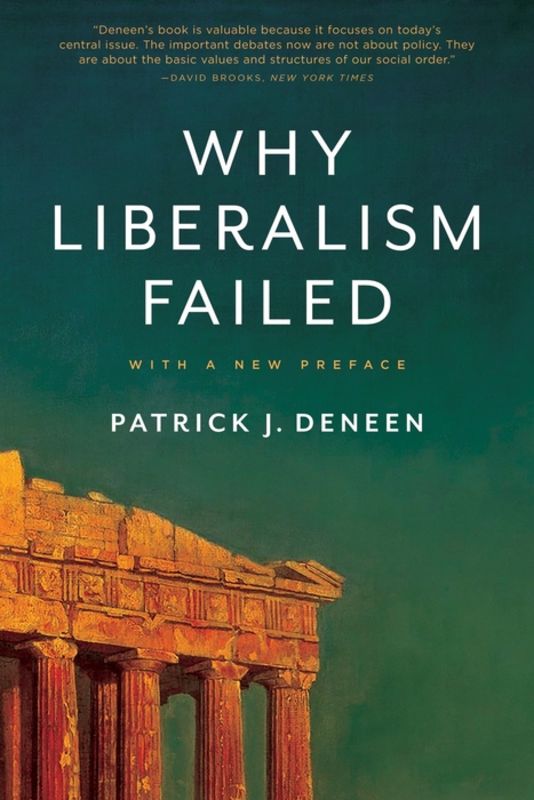
Why Liberalism Failed
\"One of the most important political books of 2018.\"-Rod Dreher,American ConservativeOf the three dominant ideologies of the twentieth century-fascism, communism, and liberalism-only the last remains. This has created a peculiar situation in which liberalism's proponents tend to forget that itisan ideology and not the natural end-state of human political evolution. As Patrick Deneen argues in this provocative book, liberalism is built on a foundation of contradictions: it trumpets equal rights while fostering incomparable material inequality; its legitimacy rests on consent, yet it discourages civic commitments in favor of privatism; and in its pursuit of individual autonomy, it has given rise to the most far-reaching, comprehensive state system in human history. Here, Deneen offers an astringent warning that the centripetal forces now at work on our political culture are not superficial flaws but inherent features of a system whose success is generating its own failure.
eBook

Liberal moments : reading liberal texts
\"Liberalism has been one of the leading incarnations of political thought for the past two centuries and it was also the first form of political theory to acquire a truly global reach. This volume examines the work of the most pivotal thinkers in the liberal tradition, starting with Montesquieu and proceeding to a wide range of authors from the French Revolution to the present. The book is distinctive in encompassing the wide spectrum of views historically encompassed by liberalism, revealing its geographical as well as intellectual scope by including conceptions of liberalism formed in Latin America, the Middle East and Asia. Twenty-four chapters cover thinkers including Madame de Stael, Alexis de Tocqueville, Abraham Lincoln, John Stuart Mill Ahmad Faris al-Shidyaq, John Dewey, Hu Shih, Hannah Arendt and John Rawls. Each chapter offers a commentary on a short critical passage from the author concerned. Essayists use their chosen passage to explore the meaning and significance of the author's work for both the historical tradition of liberalism and for political thought more generally. The book is organized chronologically, building up a richly detailed overview of the tradition of liberalism and its key writings. The book will be an indispensible companion to courses on liberal thought, on political ideologies and on the history of political thought and will be of interest to students and scholars of politics, philosophy and history. \"-- Provided by publisher.
Book

Victorian literature and the Victorian state : character and governance in a liberal society
Studies of Victorian governance have been profoundly influenced by Discipline and Punish, Michel Foucault's groundbreaking genealogy of modern power. Yet, according to Lauren Goodlad, Foucault's analysis is better suited to the history of the Continent than to nineteenth-century Britain, with its decentralized, voluntarist institutional culture and passionate disdain for state interference. Focusing on a wide range of Victorian writing—from literary figures such as Charles Dickens, George Gissing, Harriet Martineau, J. S. Mill, Anthony Trollope, and H. G. Wells to prominent social reformers such as Edwin Chadwick, Thomas Chalmers, Sir James Kay-Shuttleworth, and Beatrice Webb—Goodlad shows that Foucault's later essays on liberalism and \"governmentality\" provide better critical tools for understanding the nineteenth-century British state.
Victorian Literature and the Victorian State delves into contemporary debates over sanitary, education, and civil service reform, the Poor Laws, and the century-long attempt to substitute organized charity for state services. Goodlad's readings elucidate the distinctive quandary of Victorian Britain and, indeed, any modern society conceived in liberal terms: the elusive quest for a \"pastoral\" agency that is rational, all-embracing, and effective but also anti-bureaucratic, personalized, and liberatory. In this study, impressively grounded in literary criticism, social history, and political theory, Goodlad offers a timely post-Foucauldian account of Victorian governance that speaks to the resurgent neoliberalism of our own day.
eBook