
Catalogue Search | MBRL


Are you sure you want to remove the book from the shelf?

{{itemTitle}}
17
result(s) for
"Libraries History To 400."
Sort by:


The Idea of the Library in the Ancient World
The Idea of the Library in the Ancient World takes the reader not just to Alexandria, the home of the famed library of Greco‐Roman antiquity, but far beyond it. Reading across antiquity from the fifth century BCE to the ninth century CE with Photius, the Byzantine scholar, this study recognizes that ‘library’ in antiquity comes in various forms and shapes. It can be a building with books, but it can also be individual people and individual books themselves. Its functions in antiquity are also numerous. The library is an instrument of power, of memory, of which it has various modes; it is an articulation of a political ideal, an art gallery, a place for social intercourse. The book indirectly raises issues about the contemporary library as a collection and in this way it demonstrates that antiquity offers insight into the topics that the library now raises.
eBook


Ancient Libraries
The circulation of books was the motor of classical civilization. However, books were both expensive and rare, and so libraries - private and public, royal and civic - played key roles in articulating intellectual life. This collection, written by an international team of scholars, presents a fundamental reassessment of how ancient libraries came into being, how they were organized and how they were used. Drawing on papyrology and archaeology, and on accounts written by those who read and wrote in them, it presents new research on reading cultures, on book collecting and on the origins of monumental library buildings. Many of the traditional stories told about ancient libraries are challenged. Few were really enormous, none were designed as research centres, and occasional conflagrations do not explain the loss of most ancient texts. But the central place of libraries in Greco-Roman culture emerges more clearly than ever.
eBook

Ancient libraries and Renaissance humanism : the De bibliothecis of Justus Lipsius
The De Bibliothecis of Justus Lipsius was the first monograph on library history. In Ancient Libraries and Renaissance Humanism, Hendrickson presents a critical edition with introductory studies, a Latin text, English translation, and a substantial historical commentary.
eBook
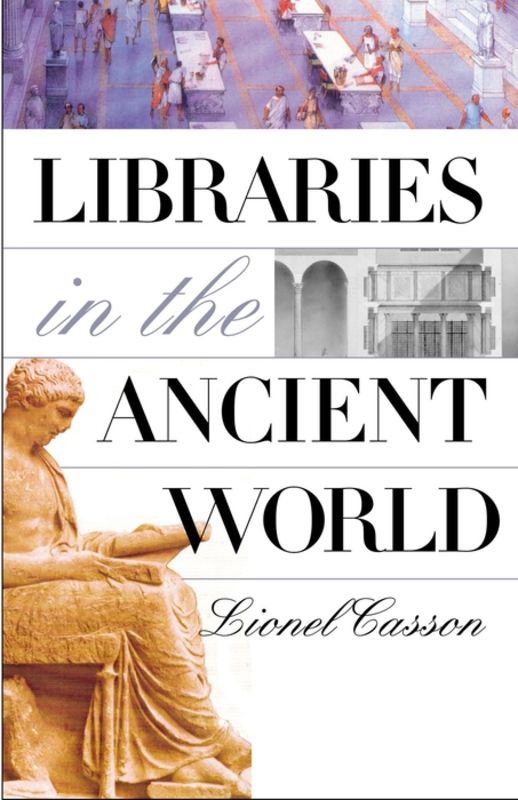
Libraries in the Ancient World
This delightful book tells the story of ancient libraries from their very beginnings, when \"books\" were clay tablets and writing was a new phenomenon. Renowned classicist Lionel Casson takes us on a lively tour, from the royal libraries of the most ancient Near East, through the private and public libraries of Greece and Rome, down to the first Christian monastic libraries. To the founders of the first public libraries of the Greek world goes the credit for creating the prototype of today's library buildings and the science of organizing books in them.
Casson recounts the development of ancient library buildings, systems, holdings, and patrons, addressing questions on a wide variety of topics, such as:
• What was the connection between the rise in education and literacy and the growth of libraries?
• Who contributed to the early development of public libraries, especially the great library at Alexandria?
• What did ancient libraries include in their holdings?
• How did ancient libraries acquire books?
• What was the nature of publishing in the Greek and Roman world?
• How did different types of users (royalty, scholars, religious figures) and different kinds of \"books\" (tablets, scrolls, codices) affect library arrangements?
• How did Christianity transform the nature of library holdings?
Just as a library yields unexpected treasures to a meandering browser, this entertaining book offers to its perusers the surprising history of the rise and development of ancient libraries-a fascinating story never told before.
eBook

Christianity and the transformation of the book : Origen, Eusebius, and the library of Caesarea
When early Christians began to study the Bible, and to write their own history and that of the Jews whom they claimed to supersede, they used scholarly methods invented by the librarians and literary critics of Hellenistic Alexandria. But Origen and Eusebius, two scholars of late Roman Caesarea, did far more. Both produced new kinds of books, in which parallel columns made possible critical comparisons previously unenvisioned, whether between biblical texts or between national histories. Eusebius went even farther, creating new research tools, new forms of history and polemic, and a new kind of library to support both research and book production.
Christianity and the Transformation of the Book combines broad-gauged synthesis and close textual analysis to reconstruct the kinds of books and the ways of organizing scholarly inquiry and collaboration among the Christians of Caesarea, on the coast of Roman Palestine. The book explores the dialectical relationship between intellectual history and the history of the book, even as it expands our understanding of early Christian scholarship. Christianity and the Transformation of the Book attends to the social, religious, intellectual, and institutional contexts within which Origen and Eusebius worked, as well as the details of their scholarly practices--practices that, the authors argue, continued to define major sectors of Christian learning for almost two millennia and are, in many ways, still with us today.,
eBook


What Happened to the Ancient Library of Alexandria?
This book aims at presenting a new discussion of primary sources by renowned scholars of the long disputed question of What Happened to the Ancient Library of Alexandria? The treatment includes a brilliant presentation of cultural Alexandrian life in late antiquity.
eBook