
Catalogue Search | MBRL


Are you sure you want to remove the book from the shelf?

{{itemTitle}}
7
result(s) for
"Library architecture Qatar"
Sort by:

‘Globalizing the Local, Localizing the Global’: Writing Space in the Arab Gulf Region
The United Arab Emirates (UAE) and Qatar are taking the lead in the urbanization boom that is drastically transforming the spatial fabric of the Arab Gulf region. Embedded in the ambitious urban development projects launched by the UAE and Qatar is an endeavour to ‘bring the world to the Arab Gulf region’. To this end, these two states are engaged in a process of collecting and borrowing antique objects and canonized artefacts, as well as reproducing and duplicating some internationally celebrated architectural sites and spaces. While some consider these projects to be ‘part of strategies to prepare for the post-oil era’, others hold that ‘Arab Gulf States aim to strengthen or … creatively (re)construct identitarian patterns’.1 It can be argued that Arab Gulf cities should be looked at as ‘political actors’ due to ‘the functions they fulfill as spatial command posts for globalized capitalism’.2 The production and organization of social space, in this sense, cannot be seen as a ‘dead’ or passive category with no influence over various dimensions of lived experience, including thought, politics and economy. Juxtaposing the UAE’s and Qatar’s urbanization projects with the nineteenth-century phenomenon of world exhibitions and fairs, this article takes the Louvre Abu Dhabi and Villaggio Mall as case studies to investigate the modalities of knowledge generated through processes of cultural and spatial (re)production and the impact of the latter on the construction of personhood and lived experience in the Arab Gulf region.
Journal Article


Working globally: The human networks of transnational architectural projects
This chapter and its diagrams/images will elaborate on the expanded human networks that form around transnational building projects in Latin America, the Middle East, and Asia. The work that architects perform on these projects is situated within legal and customary relationships between architects, clients, technical consultants, and contractors. These networks of professionals and patrons are considered to be the primary actors that “make architecture happen.” However, it is increasingly evident that to produce architecture, other actors also participate in the process in various ways. Recent local and international activism around issues of migrant construction labor abuse on the construction sites of signature architectural projects in places like Abu Dhabi have exposed the problems of working globally. With the globalization of the architectural profession, architects can no longer not account for the actors that participate in and are impacted by the processes of building architecture. Three case studies will create a comprehensive imprint of a global project whose human networks stretch around the world. Its scope will consider which actors are typically excluded from such documentation and how their inclusion might transform our understanding of architectural work.
Book Chapter


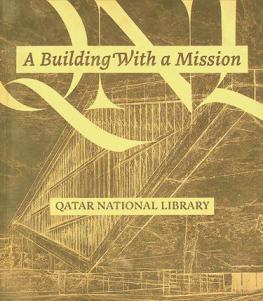
Der Bau der neuen Nationalbibliothek von Katar
Die neue Nationalbibliothek von Katar wurde vom niederländischen Architekten Rem Koolhaas entworfen und am 16. April 2018 eröffnet. Die Bibliothek hat nicht nur eine außergewöhnliche äußere Form, sie hat vor allem innen eine Plaza, die über 20 000 Quadratmeter groß ist und neben den Terrassen mit Büchern und den Vitrinen in der historischen Sammlung eine Vielzahl anregender Arbeitsplätze und Besprechungsbereiche besitzt. Auch eine Kinderbibliothek und viele neuartige Innovationsräume machen diese Bibliothek zu einem Erlebnis für jedermann.
Magazine Article