
Catalogue Search | MBRL


Are you sure you want to remove the book from the shelf?

{{itemTitle}}
8,133
result(s) for
"Library of Congress"
Sort by:
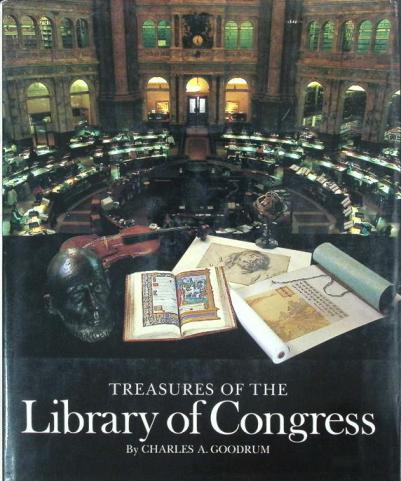
Treasures of the Library of Congress
\"Treasures of the Library of Congress\" is a lavishly illustrated and meticulously researched survey of the vast holdings within the world’s largest library. Authored by Charles A. Goodrum—a long-time staff member and historian of the institution—the volume serves as a curated journey through the Library's most significant cultural, historical, and artistic artifacts. Rather than a dry inventory, the work provides the \"biography\" of the objects, explaining how they came to the Library and their pivotal role in the American and global narrative. It captures the essence of the Library of Congress as both the \"nation’s memory\" and a universal repository of human knowledge.
BOOK

Cruising the Library
Cruising the Library examines the ways in which library classifications have organized sexuality and sexual perversion. The author studies the Library of Congress Subject Headings and Classification, as well as the Library of Congress's Delta Collection, a restricted collection of obscenity until 1964.
eBook


On the State of Genre/Form Vocabulary: A Quantitative Analysis of LCGFT Data in WorldCat
The purpose of this paper is to report on a quantitative analysis of the LCGFT vocabulary within a large set of MARC bibliographic data retrieved from the OCLC WorldCat database. The study aimed to provide a detailed analysis of the outcomes of the LCGFT project, which was launched by the Library of Congress (LC) in 2007. Findings point to a moderate increase in LCGFT use over time; however, the vocabulary has not been applied to the fullest extent possible in WorldCat. Further, adoption has been inconsistent between the various LCGFT disciplines. These and other findings discussed here suggest that retrospective application of the vocabulary using automated means should be investigated by catalogers and other technical services librarians. Indeed, as the data used for the analysis show somewhat uneven application of LCGFT, and with nearly half a billion records in WorldCat, it remains a certainty that much of LCGFT’s full potentials for genre/form access and retrieval will remain untapped until innovative solutions are introduced to further increase overall vocabulary usage in bibliographic databases.
Journal Article

Photographic memory : the album in the age of photography
\"... traces the rise of the album from the turn of the century to the present day, showcasing some of the most important examples in the history of the medium, as collected by the Library of Congress.\"--Provided by publisher.
Book

Cruising the Library
Cruising the Library offers a highly innovative analysis of the history of sexuality and categories of sexual perversion through a critical examination of the Library of Congress and its cataloging practices. Taking the publication of Eve Kosofsky Sedgwick's Epistemologies of the Closet as emblematic of the Library's inability to account for sexual difference, Melissa Adler embarks upon a detailed critique of how cataloging systems have delimited and proscribed expressions of gender, sexuality, ethnicity, and race in a manner that mirrors psychiatric and sociological attempts to pathologize non-normative sexual practices and civil subjects.
Taking up a parallel analysis, Adler utilizes Roderick A. Ferguson's Aberrations in Black as another example of how the Library of Congress fails to account for, and thereby \"buries,\" difference. She examines the physical space of the Library as one that encourages forms of governmentality as theorized by Michel Foucault while also allowing for its utopian possibilities. Finally, she offers a brief but highly illuminating history of the Delta Collection. Likely established before the turn of the twentieth century and active until its gradual dissolution in the 1960s, the Delta Collection was a secret archive within the Library of Congress that housed materials confiscated by the United States Post Office and other federal agencies. These were materials deemed too obscene for public dissemination or general access. Adler reveals how the Delta Collection was used to regulate difference and squelch dissent in the McCarthy era while also linking it to evolving understandings of so-called perversion in the scientific study of sexual difference.
Sophisticated, engrossing, and highly readable, Cruising the Library provides us with a critical understanding of library science, an alternative view of discourses around the history of sexuality, and an analysis of the relationship between governmentality and the cataloging of research and information-as well as categories of difference-in American culture.
eBook

Thomas Jefferson builds a library
Thomas Jefferson loved to read and collect books on almost every subject. He built his first library as a young man, and kept on building until his book collection helped to create the Library of Congress in Washington, D.C., the world's largest library.
BOOK

The Geopolitics of Culture
Through the lens of James Billington and the institution
he led as Librarian of Congress during a key period of US-Russian
relations, The Geopolitics of
Culture examines culture as a neglected area
of US foreign policy. Billington advised presidents and
members of Congress and mobilized the resources of the Library of
Congress to promote reform in Russia. He believed that rather than
preaching to the Russians, the United States should expose the
rising generation of Russian leaders to what was best in America
and encourage them to rediscover positive elements in pre-Bolshevik
Russian culture.
The Geopolitics of Culture is the first book to
chronicle Billington's influence on US engagement with Russia as it
transitioned from communism to democracy under Gorbachev and
Yeltsin and back to authoritarianism under Yeltsin and Putin.
Drawing on published and archival sources (including recently
released papers) and interviews with current and retired Library of
Congress staff members, John Van Oudenaren casts new light on this
era.
Billington's efforts led to a remarkable degree of cooperation
between the Library of Congress and Russian cultural and political
institutions. Yet these efforts ultimately failed as Putin turned
back toward authoritarianism. The experience of the Library of
Congress during this period nonetheless holds important lessons for
today. Billington believed that a transition to democracy in Russia
was essential if the United States was to head off the geopolitical
nightmare of a Eurasia dominated by an alliance of hostile
authoritarian powers. The \"geopolitics of culture\" thus remains a
challenge for US foreign policy.
eBook