
Catalogue Search | MBRL


Are you sure you want to remove the book from the shelf?

{{itemTitle}}
5
result(s) for
"Libretto -- Translating"
Sort by:

Music, Text and Translation
Expanding the notion of translation, this book specifically focuses on the transferences between music and text. The concept of 'translation' is often limited solely to language transfer. It is, however, a process occurring within and around most forms of artistic expression. Music, considered a language in its own right, often refers to text discourse and other art forms. In translation, this referential relationship must be translated too. How is music affected by text translation? How does music influence the translation of the text it sets? How is the sense of both the text and the music transferred in the translation process? Combining theory with practice, the book questions the process and role translation has to play in a musical context. It provides a range of case studies across interdisciplinary fields. It is the first collection on music in translation that is not restricted to one discipline, including explorations of opera libretti, surtitling, art song, musicals, poetry, painting, sculpture and biography, alongside looking at issues of accessibility.
eBook
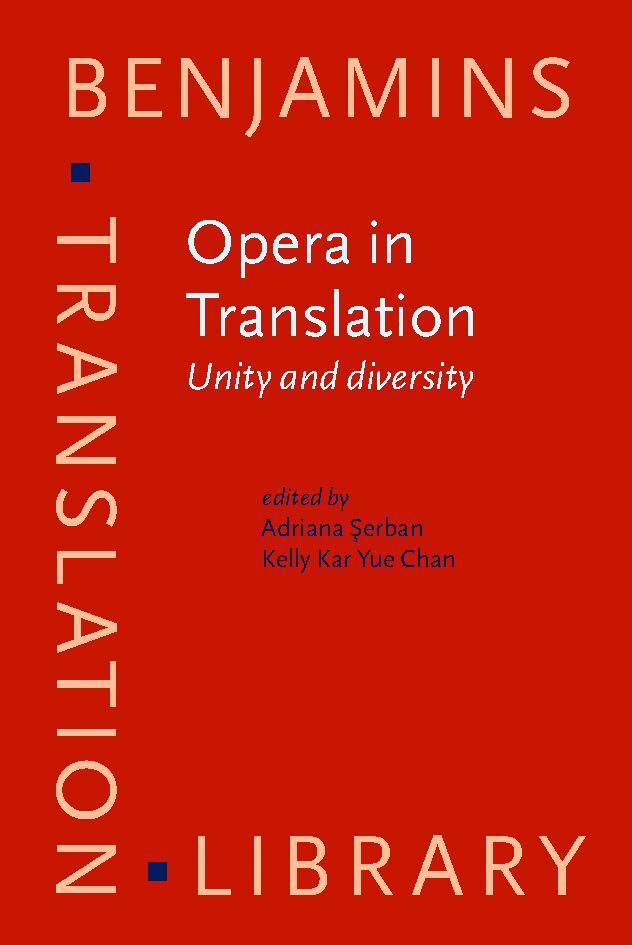
Opera in translation : unity and diversity
This volume covers aspects of opera translation within the Western world and in Asia, as well as some of opera's many travels between continents, countries, languages and cultures-and also between genres and media. The concept of 'adaptation' is a thread running through the sixteen contributions, which encompass a variety of composers, operas, periods and national traditions. Sung translation, libretto translation, surtitling, subtitling are discussed from a range of theoretical and methodological perspectives. Exploration of aspects such as the relationship between language and music, multimodality, intertextuality, cultural and linguistic transfer, multilingualism, humour, identity and stereotype, political ideology, the translator's voice and the role of the audience is driven by a shared motivation: a love of opera and of the beauty it has never ceased to provide through the centuries, and admiration for the people who write, compose, perform, direct, translate, or otherwise contribute to making the joy of opera a part of our lives.
eBook


Lending an Ear to Mozart’s Operas. Stanisław Barańczak’s Poetic Translation Experiments
The paper Lending an Ear to Mozart’s Operas. Stanisław Barańczak’s Poetic Translation Experiments examines the issues of intermediality, in particular the relationships between music and literature in mixed creative genres fusing disparate media of expression. The brief study discusses the connections and inter-dependencies between the music by Wolfgang Amadeus Mozart, Italian libretti by Lorenzo Da Ponte, their translation by Stanisław Barańczak and his unique quasi-translation (‘fonety’). The article presents interdisciplinary interpretations of selected vocal translations (excerpts from the libretti of ‘Don Giovanni’ and ‘The Marriage of Figaro’) and ‘fonety’ – Barańczak’s own genre created at the boundary where linguistic witticisms and vocal translation meet. The Italian text by Da Ponte is often treated as quasi una musica – as a sound material free from the referential ballast of language (semantics). Barańczak offers the music lover a new means of aural reception in the buffo style, illuminating a path to discovering anew the artistic potential of musical masterpieces.
Journal Article

Chinese \Chuanqi\ Opera in English: Directing \The West Wing\ with Modern Music
Part of a lab theatre experiment, this chuanqi opera production was an attempt to revive audience experience of the golden age of Chinese xiqu through text parallelism and music parallelism. Text parallelism requires the matching translation of the lingual features of a chuanqi text into its English double; such features include colloquial lexis, dense rhyming, language parallelism, and a measure of compensation in the adoptive language for the lost tonal patterns of the original. Music parallelism mimics the Ming China practice of employing music contemporary to the audience and composing the libretto to existing popular melodies.
Journal Article