
Catalogue Search | MBRL


Are you sure you want to remove the book from the shelf?

{{itemTitle}}
984,071
result(s) for
"Life control"
Sort by:
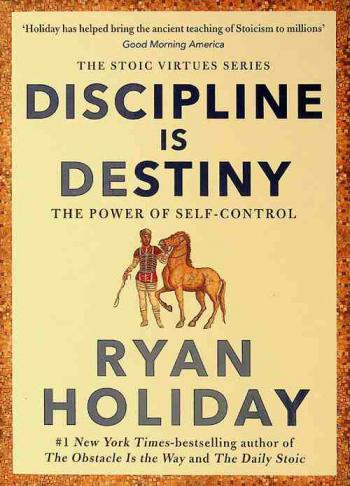
Discipline is destiny : the power of self-control
\"Following the bestselling Courage is Calling , this is the second book in a new series. This time: self-control. The inscription on the Oracle of Delphi says: 'Nothing in excess.' C.S. Lewis described temperance as going to the 'right length but no further.' Easy to say, hard to practice - and if it was tough in 300 BC, or in the 1940s, it feels all but impossible today. Yet it's the most empowering and important virtue any of us can learn. Without self-discipline, all our plans fall apart. Here, Ryan Holiday shows how to cultivate willpower, moderation and self-control in our lives. From Aristotle and Marcus Aurelius, to Toni Morrison and Queen Elizabeth II, he illuminates the great exemplars of its practice and what we can learn from them. Moderation is not about abstinence: it is about self-respect, focus and balance. Without it, even the most positive traits become vices. But with it, happiness and success are assured: the key is not more but finding the right amount\"--Publisher's description.

Human-Wildlife Conflict Management
The latest edition of this classic guide details how to understand and resolve a broad array of human-wildlife conflicts.This new edition of Human-Wildlife Conflict Management updates our understanding of the human dimensions, as well as biological and ecological concepts, underlying human-wildlife conflicts. While it provides wildlife professionals and students with the knowledge and adaptive management strategies to resolve such conflicts, it uniquely explores negative interactions with a wide range of wildlife taxa beyond those typically covered in traditional wildlife damage management, including invasive plants, invertebrates, and fish.Designed to help students and natural resource practitioners gain a deeper understanding of how to successfully avoid and resolve conflict between humans and wildlife, it is informed by author Russell F. Reidinger's decades of teaching students and professionals how to anticipate and manage human-wildlife conflicts, as well as his experience leading a national research program devoted to this work.The book covers important human-wildlife topics such as:• individual-, population-, and ecosystem-level effects• survey techniques• management methods• human dimensions• economic issues• legal and political aspects• damage management strategiesFeaturing explanations of important terminology and pertinent biological and ecological concepts, Reidinger also shares the latest research, provides a plethora of real-world examples, and includes suggestions for additional resources.
eBook


Are older workers more active copers? Longitudinal effects of age-contingent coping on strain at work
This study addresses coping processes as explanation of age-related differences in strain experience. Based on the life-span theory of control, we posit that older workers employ more active problem-focused and more active emotion-focused coping strategies than younger workers, which should mediate age effects on strain at work. The correlation between age and passive avoidance coping, in contrast, is expected to be qualified by external resources such as job control. Hypotheses were tested in a two-wave panel study (8 months lag) with 634 workers (age range 16–65 years). Job demands were considered as control variables. As predicted, older as compared with younger workers reported more active problem-focused coping, which mediated age differences on strain in the longitudinal analysis. No mediation was found for active emotion-focused coping. Moreover, age-contingent effects of passive avoidance coping were moderated by job control. When job control was low, younger as compared with older workers reported more avoidance coping, which in turn decreased strain in the longitudinal analysis. Finally, reverse longitudinal effects of age-contingent strain on active problem-focused and active emotion-focused coping provide initial evidence for age-contingent resource spirals. Together, the results reveal specific strengths of older workers for stress management at work.
Journal Article


CONTROL OVER ONE’S LIFE DURING THE COVID EPIDEMIC: A CASE STUDY OF MULTI-APARTMENT BUILDINGS IN LJUBLJANA
We examined the changing sense of control over one’s life during epidemics. Using original survey data during the first lockdown in May 2020 our case study focuses on Ljubljanas multi-apartment buildings (MAB) which, due to the physical proximity of the residents and the common spaces/facilities represent a distinct case with its particular threats (infection spread) and potential resources (neighbourly support) for coping with epidemic-related problems. We found a dramatic drop in perceived control over ones life, from 75% of respondents in usual times to 35% during the pandemic. Accounting for a range of epidemic-associated occurrences in the building and among the residents our regression analysis shows their significant impact on residents sense of control that highly exceeding those of the quality of life and of basic socio-demographic characteristics. While our case study demonstrates that the specific setting of an MAB can provide a valuable layer of human action in times of crisis, further research is needed to permit generalisations. Keywords: pandemic, perceived control over one’s life, ontological security, multi-apartment buildings, wellbeing, control over one’s life
Journal Article

On freedom
\"In this pathbreaking book, New York Times bestselling author Cass Sunstein asks us to rethink freedom. He shows that freedom of choice isn't nearly enough. To be free, we must also be able to navigate life. People often need something like a GPS device to help them get where they want to go--whether the issue involves health, money, jobs, children, or relationships. In both rich and poor countries, citizens often have no idea how to get to their desired destination. That is why they are unfree. People also face serious problems of self-control, as many of them make decisions today that can make their lives worse tomorrow. And in some cases, we would be just as happy with other choices, whether a different partner, career, or place to live--which raises the difficult question of which outcome best promotes our well-being. Accessible and lively, and drawing on perspectives from the humanities, religion, and the arts, as well as social science and the law, On Freedom explores a crucial dimension of the human condition that philosophers and economists have long missed--and shows what it would take to make freedom real.\"--Page [2] of cover.
Book

The Cooperation Paradox
Dominant American online platforms like Amazon Alexa or Google Assistant have become Life Control Interfaces (LCIs), which facilitate consumers’ online interactions and influence what consumers do and do not see and buy. These platforms operate outside of EU regulation, and create significant costs for traditional European firms in a wide range of industries. These platforms can reduce firms’ access to customers, can charge for enabling access to customers, or can charge for access to essential data on firms’ customers. Since these platforms enjoy monopoly power there is little restraint on their charges, which indirectly increase consumers’ prices. We propose that regulators encourage the formation of a consortium to offer a single integrated EU-based Life Control Interface (EuLCI). This consortium would increase the number of EuLCIs from zero to one, and thus would actually increase consumer choice. We call cooperation that enhances rather than limits choice The Cooperation Paradox.
Journal Article

The Serengeti rules : the quest to discover how life works and why it matters
\"How does life work? How does nature produce the right numbers of zebras and lions on the African savanna, or fish in the ocean? How do our bodies produce the right numbers of cells in our organs and bloodstream? In [this book], ... Sean Carroll tells the stories of the pioneering scientists who sought the answers to such simple yet profoundly important questions, and shows how their discoveries matter for our health and the health of the planet we depend upon\"--Dust jacket flap.
Book

Age and Life Satisfaction
Researchers investigating the relationship between age and life satisfaction have produced conflicting answers, via disputes over whether to include individual-level control variables in regression models. Most scholars believe there is a ‘U-shaped’ relationship, with life satisfaction falling towards middle age and subsequently rising. This position emerges mainly in research that uses control variables (for example, for income and marital status). This approach is incorrect. Regression models should control only ‘confounding’ variables; that is, variables that are causally prior to the dependent variable and the core independent variable of interest. Other individual-level variables cannot determine one’s age; they are not confounders and should not be controlled. This article applies these points to data from the World Values Survey. A key finding is that there is at best a negligible post-middle-age rise in life satisfaction – and the important implication is that there cannot then be a U-shaped relationship between age and life satisfaction.
Journal Article