
Catalogue Search | MBRL


Are you sure you want to remove the book from the shelf?

{{itemTitle}}
1,800
result(s) for
"Life sciences - Political aspects - United States"
Sort by:

Life as Surplus
Focusing on the period between the 1970s and the present, Life as Surplus is a pointed and important study of the relationship between politics, economics, science, and cultural values in the United States today. Melinda Cooper demonstrates that the history of biotechnology cannot be understood without taking into account the simultaneous rise of neoliberalism as a political force and an economic policy. From the development of recombinant DNA technology in the 1970s to the second Bush administration's policies on stem cell research, Cooper connects the utopian polemic of free-market capitalism with growing internal contradictions of the commercialized life sciences.
The biotech revolution relocated economic production at the genetic, microbial, and cellular level. Taking as her point of departure the assumption that life has been drawn into the circuits of value creation, Cooper underscores the relations between scientific, economic, political, and social practices. In penetrating analyses of Reagan-era science policy, the militarization of the life sciences, HIV politics, pharmaceutical imperialism, tissue engineering, stem cell science, and the pro-life movement, the author examines the speculative impulses that have animated the growth of the bioeconomy.
At the very core of the new post-industrial economy is the transformation of biological life into surplus value. Life as Surplus offers a clear assessment of both the transformative, therapeutic dimensions of the contemporary life sciences and the violence, obligation, and debt servitude crystallizing around the emerging bioeconomy.
eBook


Food politics
We all witness, in advertising and on supermarket shelves, the fierce competition for our food dollars. In this engrossing exposé, Marion Nestle goes behind the scenes to reveal how the competition really works and how it affects our health. The abundance of food in the United States--enough calories to meet the needs of every man, woman, and child twice over--has a downside. Our over-efficient food industry must do everything possible to persuade people to eat more--more food, more often, and in larger portions--no matter what it does to waistlines or well-being. Like manufacturing cigarettes or building weapons, making food is big business. Food companies in 2000 generated nearly
eBook

Intimate Enemies
In the aftermath of a civil war, former enemies are left living side by side-and often the enemy is a son-in-law, a godfather, an old schoolmate, or the community that lies just across the valley. Though the internal conflict in Peru at the end of the twentieth century was incited and organized by insurgent Senderistas, the violence and destruction were carried out not only by Peruvian armed forces but also by civilians. In the wake of war, any given Peruvian community may consist of ex-Senderistas, current sympathizers, widows, orphans, army veterans-a volatile social landscape. These survivors, though fully aware of the potential danger posed by their neighbors, must nonetheless endeavor to live and labor alongside their intimate enemies. Drawing on years of research with communities in the highlands of Ayacucho, Kimberly Theidon explores how Peruvians are rebuilding both individual lives and collective existence following twenty years of armed conflict.Intimate Enemiesrecounts the stories and dialogues of Peruvian peasants and Theidon's own experiences to encompass the broad and varied range of conciliatory practices: customary law before and after the war, the practice ofarrepentimiento(publicly confessing one's actions and requesting pardon from one's peers), a differentiation between forgiveness and reconciliation, and the importance of storytelling to make sense of the past and recreate moral order. The micropolitics of reconciliation in these communities present an example of postwar coexistence that deeply complicates the way we understand transitional justice, moral sensibilities, and social life in the aftermath of war. Any effort to understand postconflict reconstruction must be attuned to devastation as well as to human tenacity for life.
eBook

The Politics of Fashion in Eighteenth-Century America
In eighteenth-century America, fashion served as a site of contests over various forms of gendered power. Here, Kate Haulman explores how and why fashion--both as a concept and as the changing style of personal adornment--linked gender relations, social order, commerce, and political authority during a time when traditional hierarchies were in flux.In the see-and-be-seen port cities of Boston, New York, Philadelphia, and Charleston, fashion, a form of power and distinction, was conceptually feminized yet pursued by both men and women across class ranks. Haulman shows that elite men and women in these cities relied on fashion to present their status but also attempted to undercut its ability to do so for others. Disdain for others' fashionability was a means of safeguarding social position in cities where the modes of dress were particularly fluid and a way to maintain gender hierarchy in a world in which women's power as consumers was expanding. Concerns over gendered power expressed through fashion in dress, Haulman reveals, shaped the revolutionary-era struggles of the 1760s and 1770s, influenced national political debates, and helped to secure the exclusions of the new political order.
eBook

Fields and Streams
Examining the science of stream restoration, Rebecca Lave argues that the neoliberal emphasis on the privatization and commercialization of knowledge has fundamentally changed the way that science is funded, organized, and viewed in the United States.Stream restoration science and practice is in a startling state. The most widely respected expert in the field, Dave Rosgen, is a private consultant with relatively little formal scientific training. Since the mid-1990s, many academic and federal agency-based scientists have denounced Rosgen as a charlatan and a hack. Despite this, Rosgen's Natural Channel Design approach, classification system, and short-course series are not only accepted but are viewed as more legitimate than academically produced knowledge and training. Rosgen's methods are now promoted by federal agencies including the Environmental Protection Agency, the U.S. Forest Service, the U.S. Fish and Wildlife Service, and the Natural Resources Conservation Service, as well as by resource agencies in dozens of states.Drawing on the work of Pierre Bourdieu, Lave demonstrates that the primary cause of Rosgen's success is neither the method nor the man but is instead the assignment of a new legitimacy to scientific claims developed outside the academy, concurrent with academic scientists' decreasing ability to defend their turf. What is at stake in the Rosgen wars, argues Lave, is not just the ecological health of our rivers and streams but the very future of environmental science.
eBook

Chicanx Utopias
Amid the rise of neoliberalism, globalization, and movements for
civil rights and global justice in the post-World War II era,
Chicanxs in film, music, television, and art weaponized culture to
combat often oppressive economic and political conditions. They
envisioned utopias that, even if never fully realized, reimagined
the world and linked seemingly disparate people and places. In the
latter half of the twentieth century, Chicanx popular culture
forged a politics of the possible and gave rise to utopian dreams
that sprang from everyday experiences.
In Chicanx Utopias , Luis Alvarez offers a broad study
of these utopian visions from the 1950s to the 2000s. Probing the
film Salt of the Earth , brown-eyed soul music, sitcoms,
poster art, and borderlands reggae music, he examines how Chicanx
pop culture, capable of both liberation and exploitation, fostered
interracial and transnational identities, engaged social movements,
and produced varied utopian visions with divergent possibilities
and limits. Grounded in the theoretical frameworks of Walter
Benjamin, Stuart Hall, and the Zapatista movement, this book
reveals how Chicanxs articulated pop cultural utopias to make sense
of, challenge, and improve the worlds they inhabited.
eBook

Immigrants, evangelicals, and politics in an era of demographic change
As immigration from Asia and Latin America reshapes the demographic composition of the U.S., some analysts have anticipated the decline of conservative white evangelicals’ influence in politics. Yet Donald Trump captured a larger share of the white evangelical vote in the 2016 election than any candidate in the previous four presidential elections. Why has the political clout of white evangelicals persisted at a time of increased racial and ethnic diversity? In Immigrants, Evangelicals, and Politics in an Era of Demographic Change, political scientist Janelle Wong examines a new generation of Asian American and Latino evangelicals and offers an account of why demographic change has not contributed to a political realignment. Asian Americans and Latinos currently constitute more than one in every seven evangelicals, and their churches are among the largest, fastest growing organizations in their communities. While evangelical identity is associated with conservative politics, Wong draws from national surveys and interviews to show that non-White evangelicals express political attitudes that are significantly less conservative than those of their white counterparts. Black, Asian American, and Latino evangelicals are much more likely to support policies such as expanded immigration rights, increased taxation of the wealthy, and government interventions to slow climate change. As Wong argues, non-White evangelicals’ experiences as members of racial or ethnic minority groups often lead them to adopt more progressive political views compared to their White counterparts. However, despite their growth in numbers, non-White evangelicals — particularly Asian Americans and Latinos — are concentrated outside of swing states, have lower levels of political participation than White evangelicals, and are less likely to be targeted by political campaigns. As a result, White evangelicals dominate the evangelical policy agenda and are overrepresented at the polls. Also, many White evangelicals have adopted even more conservative political views in response to rapid demographic change, perceiving, for example, that discrimination against Christians now rivals discrimination against racial and ethnic minorities. Wong demonstrates that immigrant evangelicals are neither “natural” Republicans nor “natural” Democrats. By examining the changing demographics of the evangelical movement, Immigrants, Evangelicals, and Politics in an Era of Demographic Change sheds light on an understudied constituency that has yet to find its political home. JANELLE S. WONG is professor of American Studies at the University of Maryland.
eBook

Partisanship, health behavior, and policy attitudes in the early stages of the COVID-19 pandemic
To study the U.S. public's health behaviors, attitudes, and policy opinions about COVID-19 in the earliest weeks of the national health crisis (March 20-23, 2020).
We designed and fielded an original representative survey of 3,000 American adults between March 20-23, 2020 to collect data on a battery of 38 health-related behaviors, government policy preferences on COVID-19 response and worries about the pandemic. We test for partisan differences COVID-19 related policy attitudes and behaviors, measured in three different ways: party affiliation, intended 2020 Presidential vote, and self-placed ideological positioning. Our multivariate approach adjusts for a wide range of individual demographic and geographic characteristics that might confound the relationship between partisanship and health behaviors, attitudes, and preferences.
We find that partisanship-measured as party identification, support for President Trump, or left-right ideological positioning-explains differences in Americans across a wide range of health behaviors and policy preferences. We find no consistent evidence that controlling for individual news consumption, the local policy environment, and local pandemic-related deaths erases the observed partisan differences in health behaviors, beliefs, and attitudes. In further analyses, we use a LASSO regression approach to select predictors, and find that a partisanship indicator is the most commonly selected predictor across the 38 dependent variables that we study.
Our analysis of individual self-reported behavior, attitudes, and policy preferences in response to COVID-19 reveals that partisanship played a central role in shaping individual responses in the earliest months of the COVID-19 pandemic. These results indicate that partisan differences in responding to a national public health emergency were entrenched from the earliest days of the pandemic.
Journal Article
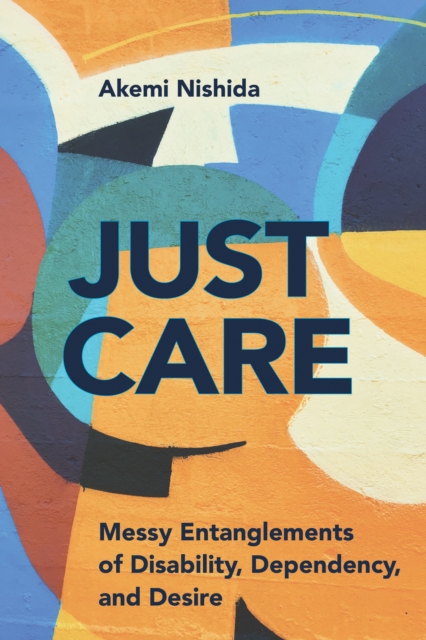
Just care : messy entanglements of disability, dependency, and desire
Just Care is Akemi Nishida's thoughtful examination of care injustice and social justice enabled through care. The current neoliberal political economy has turned care into a business opportunity for the healthcare industrial complex and a mechanism of social oppression and control. Nishida analyzes the challenges people negotiate whether they are situated as caregivers, receivers, or both. Also illuminated is how people with disabilities come together to assemble community care collectives and bed activism (resistance and visions emerging from the space of bed) to reimagine care as a key element for social change.
The structure of care, Nishida writes, is deeply embedded in and embodies the cruel social order—based on disability, race, gender, migration status, and wealth—that determines who survives or deteriorates. Simultaneously, many marginalized communities treat care as the foundation of activism. Using interviews, focus groups, and participant observation with care workers and people with disabilities, Just Care looks into lives unfolding in the assemblage of Medicaid long-term care programs, community-based care collectives, and bed activism. Just Care identifies what care does, and asks: How can we activate care justice or just care where people feel cared affirmatively and care being used for the wellbeing of community and for just world making?
eBook