
Catalogue Search | MBRL


Are you sure you want to remove the book from the shelf?

{{itemTitle}}
81,553
result(s) for
"Linguistic analysis (Linguistics)"
Sort by:


Constructions Collocations Patterns
This volume, which has textbook character, is intended to provide an in-depth introduction to different theoretical and methodological research frameworks concerned with the role of item-specific grammatical and lexical behaviour.
eBook

The prosody of formulaic sequences : corpus and discourse
\"To apply the same approaches to analysing spoken and written formulaic language is problematic; to do so masks the fact that the contextual meaning of spoken formulaic language is encoded, to a large extent, in its prosody. In The Prosody of Formulaic Sequences, Phoebe Lin offers a new perspective on formulaic language, arguing that while past research often treats formulaic language as a lexical phenomenon, the phonological aspect of it is a more fundamental facet. This book draws its conclusions from three original, empirical studies of spoken formulaic language, assessing intonation unit boundaries as well as features such as tempo and stress placement. Across all studies, Lin considers questions of methodology and conceptual framework. The corpus-based descriptions of prosody outlined in this book not only deepen our understanding of the nature of formulaic language but have important implications for English Language Teaching and automatic speech synthesis\"-- Provided by publisher.
Book
Kategorisierungsmodelle und Prototypizität Bei Abstrakta
Long description:
Die Prototypentheorie kann je nach Schwerpunktsetzung sowohl den linguistischen Forschungsfeldern der Empirischen Semantik bzw. Lexikologie als auch der Psycholinguistik zugerechnet werden. Letztere Zuordnung begründet sich darin, dass die Idee der Prototypikalität, wie sie erstmals von Eleanor Rosch und ihren Kollegen in den 1970er Jahren entwickelt wurde, untrennbar verknüpft ist mit dem Phänomen der Kategorisierung, also einem kognitionspsychologischen Bereich. Jeder Mensch, der seine Umwelt durch einen oder mehrere Sinne wahrnimmt, kategorisiert automatisch. Diese Erkenntnis ist eine in der Biologie und Psychologie mittlerweile unumstößliche Gewissheit und die Vorteile dieses Automatismus lassen sich auf zwei grundlegende Aspekte reduzieren: Ökonomie und Selbstschutz. Die Schlussfolgerung aus dieser Kategorisierungstendenz unseres Geistes ist, dass sich dieses Prinzip auch auf unsere Sprache übertragen lässt, so man der Grundannahme folgt, dass Sprache unsere Perzeption der Wirklichkeit widerspiegelt.
Die vorliegende Arbeit erweitert den allgemeinen Forschungsstand dahingehend, dass sie einen umfassenden historischen Überblick über die unterschiedlichen Modelle zur Erfassung von Exemplarität bzw. Typikalität in semantischen Kategorien bietet und diese vergleichend gegenüberstellt. Zugleich soll der aktuelle Forschungsstand zum Thema Prototypentheorie erfasst und abgebildet und seine momentanen Zielsetzungen und Erkenntnisse kritisch hinterfragt werden. Zweitens liegt der Kerninhalt in einer empirischen Datenerhebung, die sowohl mittels Online-Fragebögen als auch durch direkte Befragung innerhalb einer Reaktionszeitmessung erfolgt. Zielsetzung ist dabei, bislang als komplizierte Peripherie erachtete und empirisch vernachlässigte Wortarten - Abstrakta aus den Bereichen Emotion und Verbrechen - zu analysieren, um so die Transferenz und Generalisierbarkeit der klassischen (konkreten) Prototypen-Stimuli (Möbel, Früchte, Tiere, etc.) in einer Weise zu überprüfen, wie dies bislang nicht in der aktuellen Literatur vorliegt.
eBook


Practical corpus linguistics : an introduction to corpus-based language analysis
This is the first book of its kind to provide a practical and student-friendly guide to corpus linguistics that explains the nature of electronic data and how it can be collected and analyzed. * Designed to equip readers with the technical skills necessary to analyze and interpret language data, both written and (orthographically) transcribed * Introduces a number of easy-to-use, yet powerful, free analysis resources consisting of standalone programs and web interfaces for use with Windows, Mac OS X, and Linux * Each section includes practical exercises, a list of sources and further reading, and illustrated step-by-step introductions to analysis tools * Requires only a basic knowledge of computer concepts in order to develop the specific linguistic analysis skills required for understanding/analyzing corpus data
eBook

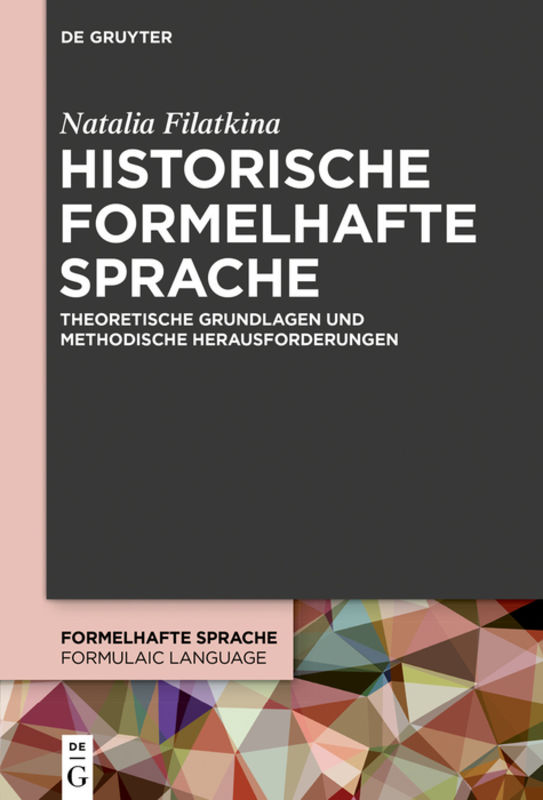
Historische formelhafte Sprache
Die Reihe bietet ein Forum für gebrauchs- und korpusbasierte Studien, die sprachliche, kognitive und konzeptuelle Vorgeformtheit auf allen sprachlichen Ebenen und außersprachlicher Natur in den Mittelpunkt der theoretischen und methodischen Betrachtungen im synchronen wie diachronen Schnitt rücken.
eBook