
Catalogue Search | MBRL


Are you sure you want to remove the book from the shelf?

{{itemTitle}}
12,973
result(s) for
"Literary ethics."
Sort by:

Learning about plagiarism
\"Introduces readers to the media literacy skills needed to understand plagiarism. Includes a hands-on activity related to media literacy\"-- Provided by publisher.
Book

Sustainable Literary Competence: Connecting Literature Education to Education for Sustainability
Ecocritical scholarship has always had pedagogical ambitions. It is commonly assumed that education based on ecocritical readings of literature will change the attitudes and actions of pupils and students and thus contribute to forming environmentally aware and sustainable citizens. However, this article proposes an alternative view on the interaction between sustainability and literature education. Based on a critical discussion of “ecocritical orthodoxy,” this meta-theoretical study uses affect theory in conjunction with Rita Felski’s proposal for postcritical reading to argue that literature education needs to take the polysemy of literary texts and the unpredictability of readers’ encounters with such texts into account. By linking this to a specified set of sustainability competences and a dialogic concept of literary competence, the aim of the main discussion is to highlight the many potentially fertile overlaps between literature education and the competences needed in a sustainable citizen. Here, Timothy Clark’s thoughts on the Anthropocene as threshold concept, and Timothy Clark’s views on irony are important parts of the theoretical framework. Moreover, such a framework for sustainable literary competence could help to argue for the value of literature education and genuine literary competence.
Journal Article

Transgression in Korea : beyond resistance and control
\"Since the turn of the millennium South Korea has continued to grapplewith transgressions that shook the nation to its core. Following the serial killings of Korea's raincoat killer, the events that led to the dissolution of the United Progressive Party, the criminal negligence of the owner and also the crew members of the sunken Sewol Ferry, as well as the political scandals of 2016, there has been much public debate about morality, transparency, and the law in South Korea. Yet, despite its prevalence in public discourse, transgression in Korea has not received proper scholarly attention. Transgression in Korea challenges the popular conceptions of transgression as resistance to authority, the collapse of morality, and an attempt at self- empowerment. Examples of transgression from premodern, modern, and contemporary Korea are examined side by side to underscore the possibility of reading transgression in more ways than one. These examples are taken from a devotional screen from medieval Korea, trickster tales from the late Choson period, reports about flesheating humans, newspaper articles about same- sex relationships from colonial Korea, and films about extramarital affairs, wayward youths, and a vengeful vigilante. Bringing together specialists from various disciplines such as history, art history, anthropology, premodern literature, religion, and film studies, the context- sensitive readings of transgression provided in this book suggest that transgression and authority can be seen as forming something other than an antagonistic relationship\"-- Provided by publisher.
Book
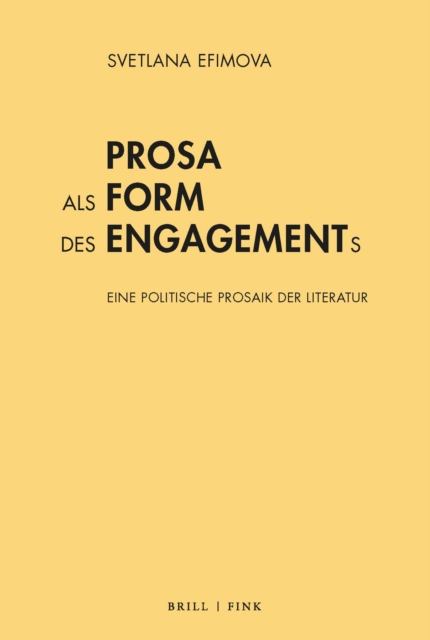
Prosa als Form des Engagements: Eine politische Prosaik der Literatur
Dieses Buch verortet eine politische Dimension der Literatur auf der Formebene des Prosaschreibens: Die Prosa vermittelt zwischen kunstlerischer und sozialer Rede sowie zwischen literarischen und politischen Ordnungsformen.Der erste Teil des Buches verfolgt Reflexionen uber das Prosaschreiben in der russischen Literatur zwischen den 1820er Jahren und der Gegenwart, macht komparatistische Ausblicke und stellt fest: Mit dem Prosaschreiben wird immer wieder eine engagierte Haltung der Literatur innerhalb der Gesellschaft verbunden. Dieser historische Diskurs korrespondiert mit der theoretischen Tradition, ein ethisch-politisches Potenzial in der literarischen Prosaform zu erkennen (Jean-Paul Sartre, Roland Barthes, Michail Bachtin, Jacques Ranciere). Im zweiten Teil des Buches wird durch Einzellekturen eine literarische Asthetik des Widerspruchs herausgearbeitet, die mit dem politischen Konzept der Prosa zusammenhangt.
eBook


Plagiarism in higher education
\"This candid treatment of plagiarism in higher education identifies causes of academic dishonesty and offers practical solutions\". -- Contents: A brief history of plagiarism -- Contextualizing and defining plagiarism in higher education -- Intentionality, textuality, and other complicating factors -- A multi-stakeholder systems approach to plagiarism : the 4M framework -- Evaluation and assessment -- Self-plagiarism -- Academic file sharing : sharing is caring and other myths -- Contract cheating : outsourced academic work -- Diversity, equity, and inclusion -- Recognizing, reporting, and resolving plagiarism -- Plagiarism by professors and researchers -- Conclusion : contemplating the future of plagiarism.
eBook

George Eliot and Money : Economics, Ethics and Literature
\"Unlike other Victorian novelists George Eliot rarely incorporated stock market speculation and fraud into her plots, but meditations on money, finance and economics, in relation both to individual ethics and to wider social implications, infuse her novels\"-- Provided by publisher.
BOOK


