
Catalogue Search | MBRL


Are you sure you want to remove the book from the shelf?

{{itemTitle}}
89,163
result(s) for
"Literary genres"
Sort by:


Dangerous bodies
Through an investigation of the body and its oppression by the church, the medical profession and the state, this book reveals the actual horrors lying beneath fictional horror in settings as diverse as the monastic community, slave plantation, operating theatre, Jewish ghetto and battlefield trench. The book provides original readings of canonical Gothic literary and film texts including The Castle of Otranto, The Monk, Frankenstein, Dracula and Nosferatu. This collection of fictionalised dangerous bodies is traced back to the effects of the English Reformation, Spanish Inquisition, French Revolution, Caribbean slavery, Victorian medical malpractice, European anti-Semitism and finally warfare, ranging from the Crimean up to the Vietnam War. The endangered or dangerous body lies at the centre of the clash between victim and persecutor and has generated tales of terror and narratives of horror, which function to either salve, purge or dangerously perpetuate such oppositions. This ground-breaking book will be of interest to academics and students of Gothic studies, gender and film studies and especially to readers interested in the relationship between history and literature.
eBook


Women and the Gothic
This collection of newly commissioned essays brings together major scholars in the field of Gothic studies in order to re-think the topic of 'Women and the Gothic'.
eBook

The novel of human rights
This book identifies the centers of aesthetic gravity that pull texts together into a new genre: namely, the novel of human rights. What connective structures and recurring concerns can be discerned at this early stage in the development of the genre? How do its ethical pressures generate formal patterns and, in turn, how do its formal patterns generate ethical pressures? And finally, since both the textual and political forms are rapidly evolving, what can this rising genre teach us about the near futures of literature and literary studies? While rigorously attending to form, The Novel of Human Rights addresses the key developments and debates of the contemporary human rights movement, revealing how human rights work has shaped the aesthetic concerns of novelists and how those same aesthetic concerns have affected human rights work. Writers of interest span a wide range, countable in the dozens. Some of those who receive extended attention include John Edgar Wideman, Susan Choi, Dave Eggers, Francisco Goldman, and Edwidge Danticat.-- Provided by publisher
Book

Industrial Gothic
This volume carves out a new area of study, the 'industrial
Gothic', placing the genre in dialogue with the literature of the
Industrial Revolution. The book explores a significant subset of
transatlantic nineteenth-century literature that employs the
tropes, themes and rhetoric of the Gothic to portray the real-life
horrors of factory life, framing the Industrial Revolution as a
site of Gothic excess and horror. Using archival materials from the
nineteenth century, localised incidences of Gothic
industrialisation (in specific cities like Lowell and Manchester)
are considered alongside transnational connections and comparisons.
The author argues that stories about the real horrors of factory
life frequently employed the mode of the Gothic, while nineteenth
century writing in the genre (stories, novels, poems and stage
adaptations) began to use new settings - factories, mills, and
industrial cities - as backdrops for the horrors that once
populated Gothic castles.
eBook

The Cambridge companion to popular fiction
\"Popular commercial fiction emerged in the nineteenth century, with serialised novels and sensational penny dreadfuls. Today it remains a multi-million dollar industry giving pleasure to many, but it is also a field of growing interest for scholars and students of literature. This Companion covers the major developments in the history of popular fiction, with specially commissioned chapters on pulp fiction, bestsellers, and comics and graphic narratives. The volume also examines the public and personal everyday contexts within which popular texts are read, highlighting the ways in which such narratives have circulated across a variety of constantly changing media, including theatre, television, cinema and new computer-based digital forms. Case studies from key genres - crime fiction, romance and Gothic horror - as well as a full chronology and guide to further reading make this collection indispensable to all those interested in this complex and vibrant cultural field\"-- Provided by publisher.
Book

The Gothic and death
The Gothic and death offers the first ever published study
devoted to the subject of the Gothic and death across the
centuries. It investigates how the multifarious strands of the
Gothic and the concepts of death, dying, mourning and
memorialisation ('the Death Question') - have intersected and been
configured cross-culturally to diverse ends from the mid-eighteenth
century to the present day. Drawing on recent scholarship in such
fields as Gothic Studies, film theory, Women's and Gender Studies
and Thanatology Studies, this interdisciplinary collection of
fifteen essays by international scholars combines an attention to
socio-historical and cultural contexts with a rigorous close
reading of works, both classic and lesser known. This area of
enquiry is considered by way of such popular and uncanny figures as
corpses, ghosts, zombies and vampires, and across various cultural
and literary forms such as Graveyard Poetry, Romantic poetry,
Victorian literature, nineteenth-century Italian and Russian
literature, Anglo-American film and television, contemporary Young
Adult fiction and Bollywood film noir.
eBook

On edge : gender and genre in the work of Shirley Jackson, Patricia Highsmith, and Leigh Brackett
\"Demonstrates how women writers, especially Shirley Jackson, Patricia Highsmith, and Leigh Brackett, made significant contributions via genre writing to the postwar American literary marketplace, merging literary realism with fantastical or exaggerated elements in order to respond to the big questions of their era, the 'Age of Anxiety'\"-- Provided by publisher.
BOOK
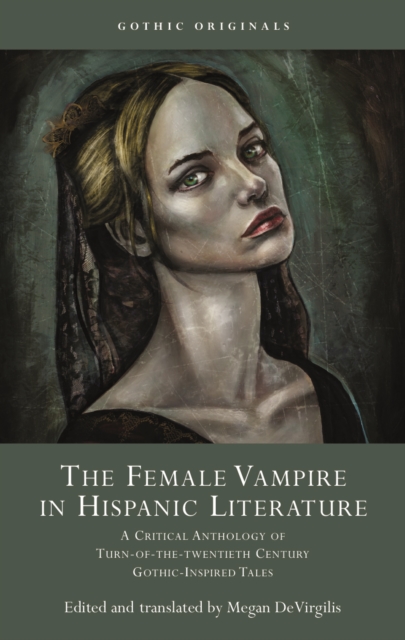
The Female Vampire in Hispanic Literature: A Critical Anthology of Turn of the 20th Century Gothic-Inspired Tales
This book exposes how turn-of-the-twentieth-century Hispanic authors broke from European and American Gothic models to contend with their own anxieties over modernity and rising first-wave feminisms. The result was a trend of sympathetic female vampires, predating comparable Anglo and European representations by several decades. In its analysis of the female vampire in Hispanic literature, the critical introduction also traces the Gothic's origins and developments in Latin America and Spain, presenting a working theory of Gothic traditions in the form of a transhispanic literary phenomenon. The tales compiled in the collection include Leopoldo Lugones's 'The Female Vampire' (1899), Clemente Palma's 'The White Farmhouse' (1904), Antonio de Hoyos y Vinent's 'Mr. Cadaver and Miss Vampire' (1910), Carmen de Burgos's The Cold Woman (1922), and Horacio Quiroga's 'The Vampire' (1927). Only two of these tales have been previously been translated into English, and each appears here for the first time with scholarly annotations and accompanying analysis.
eBook