
Catalogue Search | MBRL


Are you sure you want to remove the book from the shelf?

{{itemTitle}}
10
result(s) for
"Literature and society South Africa History 20th century."
Sort by:


South Africa and the dream of love to come : queer sexuality and the struggle for freedom
After apartheid, South Africa established a celebrated new political order that imagined the postcolonial nation as belonging equally to the descendents of indigenous people, colonizing settlers, transported slaves, indentured laborers, and immigrants. Its constitution, adopted in 1996, was the first in the world to include gays and lesbians as full citizens. Brenna M. Munro examines the stories that were told about sexuality, race, and nation throughout the struggle against apartheid in order to uncover how these narratives ultimately enabled gay people to become imaginable as fellow citizens. She also traces how the gay, lesbian, or bisexual person appeared as a stock character in the pageant of nationhood during the transition to democracy. In the process, she offers an alternative cultural history of South Africa. Munro asserts that the inclusion of gay people made South Africans feel \"modern\"-at least for a while. Being gay or being lesbian was reimagined in the 1990s as distinctly South African, but the \"newness\" that made these sexualities apt symbols for a transformed nation can also be understood as foreign and un-African. Indeed, a Western-style gay identity is often interpreted through the formula \"gay equals modernity equals capitalism.\" As South Africa's reentrance into the global economy has failed to bring prosperity to the majority of its citizens, homophobic violence has been on the rise. Employing a wide array of texts-including prison memoirs, poetry, plays, television shows, photography, political speeches, and the postapartheid writings of Nobel Laureates Nadine Gordimer and J. M. Coetzee-Munro reports on how contemporary queer activists and artists are declining to remain ambassadors for the \"rainbow nation\" and refusing to become scapegoats for the perceived failures of liberation and liberalism.
eBook

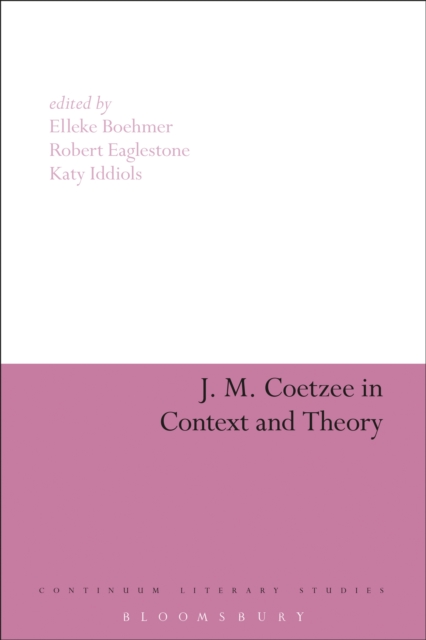
J. M. Coetzee in Context and Theory
Nobel Laureate and the first author to win the Booker Prize twice, J.M.Coetzee is perhaps the world's leading living novelist writing in English.Including an international roster of world leading critics and novelists, and drawing on new research, this innovative book analyses the whole range of Coetzee's work, from his most recent novels.
eBook


Bulletproof
In 1856 and 1857, in response to a prophet’s command, the Xhosa people of southern Africa killed their cattle and ceased planting crops; the resulting famine cost tens of thousands of lives. Much like other millenarian, anticolonial movements—such as the Ghost Dance in North America and the Birsa Munda uprising in India—these actions were meant to transform the world and liberate the Xhosa from oppression. Despite the movement’s momentous failure to achieve that goal, the event has continued to exert a powerful pull on the South African imagination ever since. It is these afterlives of the prophecy that Jennifer Wenzel explores in Bulletproof. Wenzel examines literary and historical texts to show how writers have manipulated images and ideas associated with the cattle killing—harvest, sacrifice, rebirth, devastation—to speak to their contemporary predicaments. Widening her lens, Wenzel also looks at how past failure can both inspire and constrain movements for justice in the present, and her brilliant insights into the cultural implications of prophecy will fascinate readers across a wide variety of disciplines.
eBook

EDUCATION AND THE AGRARIAN QUESTION IN SOUTH AFRICA, c. 1900–40
During the first half of the twentieth century, deep structural changes occurred in the South African countryside. While farming became an important pillar of the national economy, more and more people left the land in search of better lives in towns and cities. This article examines agricultural education, an early avenue of state intervention in farming, to elucidate how officials and groups of farmers navigated the ‘agrarian question’ by trying to define the roles that men, women, blacks, and whites played in the sector's restructuring. I argue that agricultural planning was inextricable from ideologies and politics of segregation, a factor that historiography has not systematically taken into account. By comparing interventions in the Transkei and Ciskei with those in the Orange Free State, this article illuminates the interrelations between rural planning and segregation, as well as how they were complicated by delineations of class and gender.
Journal Article

Wilhelm Bleek and the Khoisan Imagination: A Study of Censorship, Genocide and Colonial Science
In 1864, Wilhelm Bleek published a collection of Khoi narratives titled Reynard the Fox in South Africa, or Hottentot Fables and Tales. This article critically examines this foundational event in South African literary history, arguing that it entailed a Victorian circumscription of the Khoisan imagination, containing its libidinal and transgressive energies within the generic limits of the naïve European children's folktale. Bleek's theories of language and race are examined as providing the context for his editorial approach to Khoi narratives in which the original 'nakedness' was written out. The extent of Bleek's censorship of indigenous orature becomes visible when comparing his 'fables' to a largely unknown corpus of Khoi tales, collected by the German ethnographer Leonhard Schultze during the Nama genocide in the early twentieth century. The article compares these collections of oral narratives, and suggests that this has implications for the way the famous Bleek and Lloyd /Xam archive was subsequently constituted in the 1870s. Wilhelm Bleek's interventions in civilising the Khoisan imagination marks a move away from a potentially Rabelaisian trajectory in South African literature through which the Khoisan could be represented and represent themselves. In admitting a sanitised indigenous orature into the colonial literary order, it is argued that Bleek helped to create a restrictive cultural politics in South Africa from which the country is yet to emerge fully.
Journal Article