
Catalogue Search | MBRL


Are you sure you want to remove the book from the shelf?

{{itemTitle}}
5
result(s) for
"Literature-Archival resources"
Sort by:

The Future of Literary Archives
Literary archives differ from most other types of archival papers in that their locations are more diverse and difficult to predict. The essays collected in this book derive from the recent work of the Diasporic Literary Archives Network, whose focus on diaspora provides a philosophical framework which gives a highly original set of points of reference for the study of literary archives, including concepts such as the natural home, the appropriate location, exile, dissidence, fugitive existence, cultural hegemony, patrimony, heritage, and economic migration.
eBook

Literary research and British postmodernism
Literary Research and British Postmodernism is a guide for researchers of postwar British literature that defines best practices for scholars conducting research in this period. Individual chapters connect the complex relationships between print and multimedia, technological advancements, and the influence of critical theory that converge in postwar British literature.
eBook

eCulture : cultural content in the digital age
Do virtual museums really provide added value to end-users, or do they just contribute to the abundance of images?Does the World Wide Web save endangered cultural heritage, or does it foster a society with less variety?How can information technology help to preserve the diversity of cultures in our fast-changing world?.
eBook

Sport History in the Digital Era
From statistical databases to story archives, from fan sites to the real-time reactions of Twitter-empowered athletes, the digital communication revolution has changed the way fans relate to LeBron's latest triple double or Tom Brady's last second touchdown pass. In this volume, contributors from Australia, Ireland, New Zealand, the United Kingdom, and the United States analyze the parallel transformation in the field of sport history, showing the ways powerful digital tools raise vital philosophical, epistemological, ontological, methodological, and ethical questions for scholars and students alike.Chapters consider how philosophical and theoretical understandings of the meaning of history influence engagement with digital history, and conceptualize the relationship between history making and the digital era. As the writers show, digital media's mostly untapped potential for studying the recent past via media like blogs, chat rooms, and gambling sites forge a symbiosis between sports and the internet while offering historians new vistas to explore and utilize. In this new era, digital history becomes a dynamic site of enquiry and discussion where scholars enter into a give-and-take with individuals and invite their audience to grapple with, rather than passively absorb, evidence. Timely and provocative, Sport History in the Digital Era affirms how the information revolution has transformed sport and sport history--and shows the road ahead. Contributors include Douglas Booth, Mike Cronin, Martin Johnes, Matthew Klugman, Geoffery Z. Kohe, Tara Magdalinski, Fiona McLachlan, Bob Nicholson, Rebecca Olive, Gary Osmond, Murray G. Phillips, Stephen Robertson, Synthia Sydnor, Holly Thorpe, and Wayne Wilson.
eBook
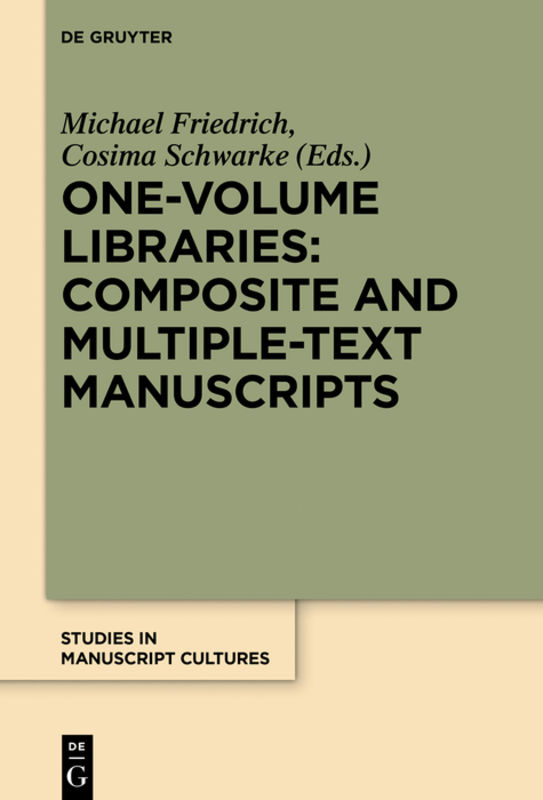
One-Volume Libraries
Composite and multiple-text manuscripts are traditionally studied for their individual texts, but recent trends in codicology have paved the way for a more comprehensive approach: Manuscripts are unique artefacts which reveal how they were produced and used as physical objects. While multiple-text manuscripts codicologically are to be considered as production units, i.e. they were originally planned and realized in order to carry more than one text, composites consist of formerly independent codicological units and were put together at a later stage with intentions that might be completely different from those of its original parts. Both sub-types of manuscripts are still sometimes called \"miscellanies\", a term relating to the texts only. The codicological difference is important for reconstructing why and how these manuscripts which in many cases resemble (or contain) a small library were produced and used. Contributions on the manuscript cultures of China, India, Africa, the Islamic world and European traditions lead not only to the conclusion that \"one-volume libraries\" have been produced in many manuscript cultures, but allow also for the identification of certain types of uses.
eBook