
Catalogue Search | MBRL


Are you sure you want to remove the book from the shelf?

{{itemTitle}}
8
result(s) for
"Living wage movement Political aspects United States."
Sort by:

The politics of common sense : how social movements use public discourse to change politics and win acceptance
\"The way that movements communicate with the general public matters for their chances of lasting success. Devo Woodly argue that the potential for movement-led political change is significantly rooted in mainstream democratic discourse and specifically in the political acceptance of new issues by news media, the general public, and elected officials. This is true to some extent for any group wishing to alter status quo distributions of rights and/or resources, but is especially important for grassroots challengers who do not already have a place of legitimated influence in the polity. By examining the talk of two contemporary movements, the living wage and marriage equality, during the critical decade after their emergence between 1994-2004, Woodly shows that while the living wage movement experienced over 120 policy victories and the marriage equality movement suffered many policy defeats, the overall impact that marriage equality had on changing American politics was much greater than that of the living wage because of its deliberate effort to change mainstream political discourse, and thus, the public understanding of the politics surrounding the issue\"-- Provided by publisher.
Book

Human Rights and Public Opinion: From Attitudes to Action
Hertel et al examine original public opinion data on American attitudes regarding human rights and ethical consumption. Contrary to the notion that civil and political rights trump economic rights in American popular consciousness, they demonstrate that Americans widely view the right to a minimum standard of living as a human right--and say they are willing to pay more for ethically produced goods in order to promote such rights.
Journal Article
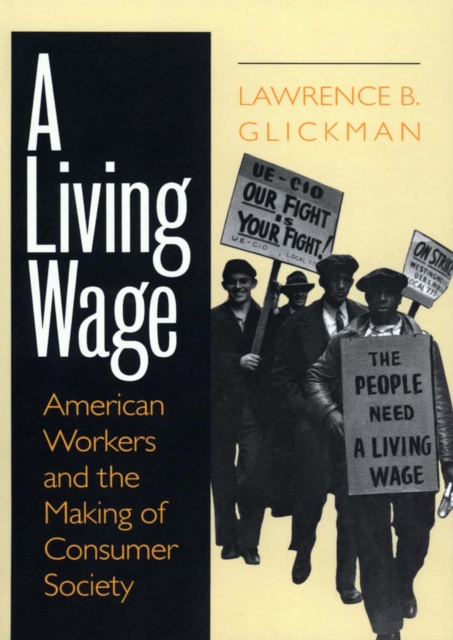
A living wage : American workers and the making of consumer society
The labor movement's response to wages shows how American workers negotiated the transition from artisan to consumer, opening up new political possibilities for organized workers and creating contradictions that continue to haunt the labor movement today.
eBook

Women's Working Poverty: Feminist and Religious Alliances in the Living Wage Movement
Scholars generally underanalyze the roles of religious and feminist organizations in the contemporary living wage movement. Yet coalitions of religious and feminist organizations contribute significantly to the movement through funding, research, and leadership development. Moreover, these alliances to counter the \"““feminization of poverty\"”” also raise ethical issues about the \"““feminization of organizing.\"”” In this article, the author analyzes these coalitions and offers a theo-ethical reflection on the gendered \"““sacrificial\"”” demands of low-wage worker organizing.
Journal Article

Community Economic Development as Progressive Politics: Toward a Grassroots Movement for Economic Justice
Community economic development (CED) emerged during the 1990s as the dominant approach to redressing urban poverty, replacing entitlement programs and civil rights initiatives with a market-based strategy for promoting economic equality. Premised on the idea that poor neighborhoods are underutilized markets in need of private sector investment, market-based CED gained a broad range of ideological adherents, resonating with proponents of black nationalism, neoliberal economics, and postmodern micropolitics. As the decade brought economic issues to the fore and legal services advocates faced mounting federal restrictions, increasing numbers of poverty lawyers adopted the market-based CED model, providing transactional legal assistance to community organizations engaged in neighborhood revitalization initiatives. Yet, despite the expansion of the market paradigm, analysts have largely avoided a critical dialogue about CED theory and have neglected a careful examination of the evolving nature of grassroots CED practice. This Article sets forth an indigenous critique of market-based CED, arguing that it fails to deliver on its promise of poverty alleviation, diverts attention from the need for a coordinated political response to economic disadvantage, privileges localism over structural reform, and impedes the formation of multiracial political alliances. This Article then presents an alternative model of politically engaged CED that integrates legal advocacy and community organizing to build cross-neighborhood coalitions that promote broad-based economic reform. It concludes by outlining the contours of this new approach, highlighting how poverty lawyers are collaborating with organizing groups to expand living wage ordinances, establish cooperative businesses, and implement comprehensive hiring and job training programs.
Journal Article


Working for a Living Wage
Living wage campaigns seek to require private businesses that benefit from public money to pay their workers a living wage (usually defined as at least enough to bring a family of four to the federal poverty line, currently $8.20 an hour). Over the years, activists have adapted the living wage phrase to a range of campaigns around working conditions, workers' right to organize and corporate accountability.
Journal Article

Stomping labor
With the repealing of the ergonomics rule and his decision to ban the presence of unions in the Department of Justice, President Bush is clearly seizing on Sep 11 to advance his domestic priority to crush organized labor. However, one of the few positives signs for labor is the ongoing passage of living wage ordinances across the country.
Magazine Article